



1 / 32
Read as text
Page 1
VOLUME 3 • ISSUE 1 MORE THAN A MAGAZINE: SPEAKING UP AND EMPOWERING $4.00
INTERVIEW
Attorney & Change Maker
Robert Forquer
MY TURN
Photo Essay
Homeless Voices
REFUGEE
Support Service
Arrive, Survive, Thrive
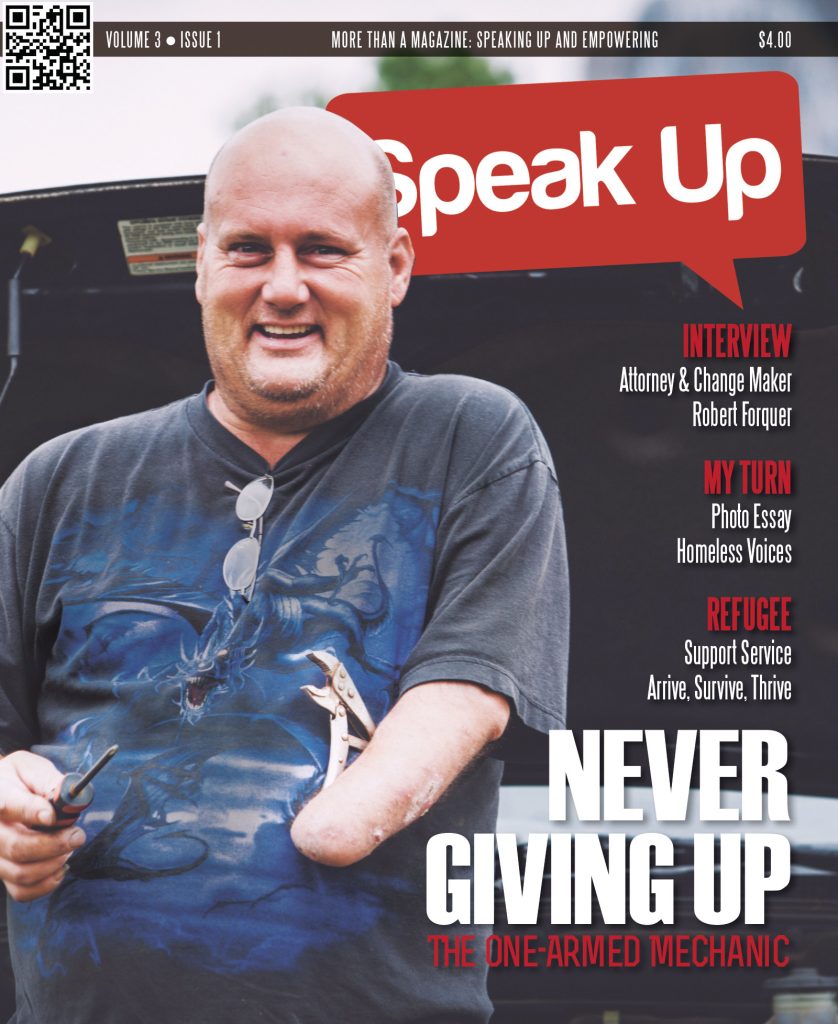
NEVER
GIVING UP
The One-Armed Mechanic
Page 2
THIS MAGAZINE CREATES
JOBS AND GIVES HOPE.
Executive Director
Matt Shaw
Art Director Photographers
Carol Lantis Chris Austin, Kate Glantz, David Johnson,
Peggi Knowe, Josh Putnam, Debbi Shaw,
Designer Jenna Thomas
Kylie Wyman
2013 Interns
Street Editor Sabrina Basile-Paquette
Harry Griffin Dias Dobson
Noah Driver
Editors Kylie Wyman
Lana Shaw
Peggi Knowe Board of Directors
Sandra Stiles John Clarke
Noah Driver Phil Felten
Sabrina Basile-Paquette Lisa Koons
Cesar Silva
Contributors Bruce Simpson
Noah Driver, Tom Carter, Kate Glantz,
David Alan Goldberg, Eric Gorman, Lauren Secretary
Greutman, Frederick Hall, Peggi Knowe, Lindsay DaCosta
Robert Lupton, Lynn Mendes, Steve Parker,
Tyrone Scott, Chris Sirico, Kaitlyn Tokay Cover photo by Joshua Putnam
SPEAK UP MAGAZINE IS A 501(C)(3) PUBLIC CHARITY. 1515-B S. MINT SREET CHARLOTTE, NC 28203 – 704.900.1836 – WWW.SPEAKUPMAG.ORG
Page 3
URBAN PIONEERS
VENDOR PROFILE
The King’s Kitchen 5 Andrea Garland
6
Charity: Transformative or Toxic?4 LETTERS 7 ASKING THE RIGHT QUESTIONS
CROWDFUNDING KINDNESS
8 Be Benevolent A CONVERSATION WITH
Harold Twitty 9
MY TURN
THE INTERVIEW Street Voices 17 Robert Forquer 22
REFUGEE
Arrive, Survive, Thrive 27
HEROES
Boss to Beggar 12
16 INFOGRAPHICChild Trafficking
31 ABOUT SPEAK UP 30 RESOURCE GUIDE CONTENTS:
SUVIVOR
In Our Own Backyard 14
ON THE WEBSITE: For article supplements, additional photos and more, go to speakupmag.org/issue3
Page 4
4
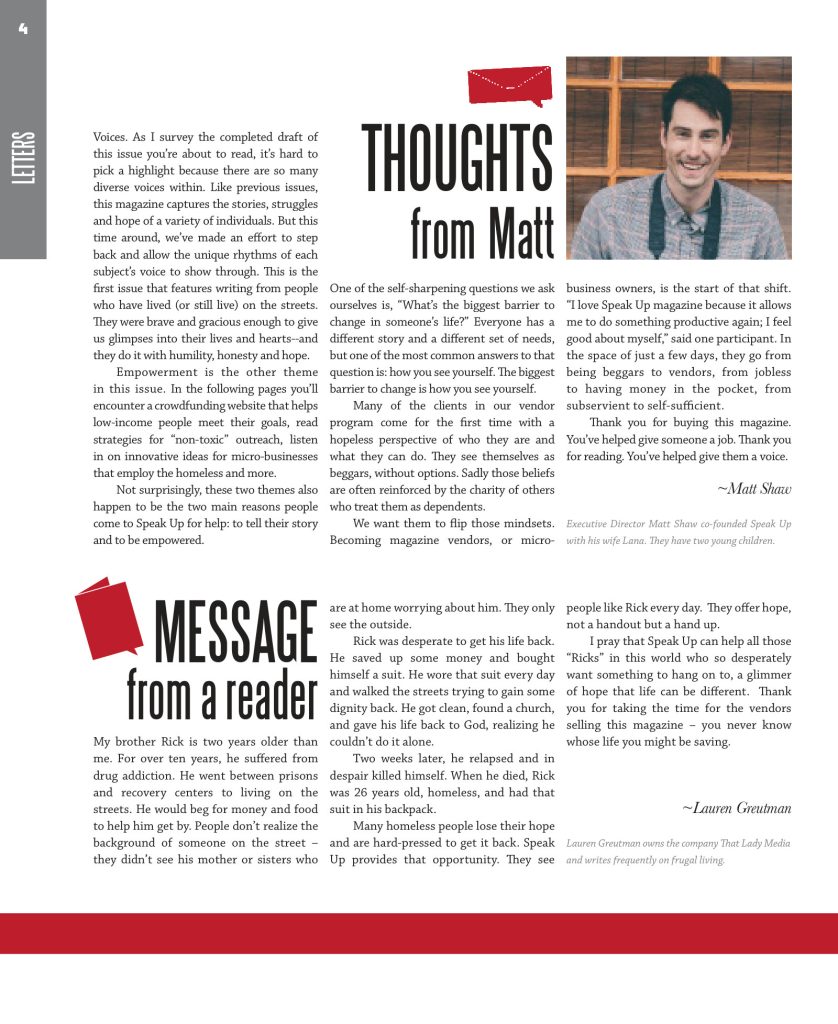
Voices. As I survey the completed draft of
this issue you’re about to read, it’s hard to
pick a highlight because there are so manyLETTERS
diverse voices within. Like previous issues, THOUGHTS this magazine captures the stories, struggles
and hope of a variety of individuals. But this
time around, we’ve made an effort to step
back and allow the unique rhythms of each from Matt
subject’s voice to show through. This is the
first issue that features writing from people One of the self-sharpening questions we ask business owners, is the start of that shift.
who have lived (or still live) on the streets. ourselves is, “What’s the biggest barrier to “I love Speak Up magazine because it allows
They were brave and gracious enough to give change in someone’s life?” Everyone has a me to do something productive again; I feel
us glimpses into their lives and hearts–and different story and a different set of needs, good about myself,” said one participant. In
they do it with humility, honesty and hope. but one of the most common answers to that the space of just a few days, they go from
Empowerment is the other theme question is: how you see yourself. The biggest being beggars to vendors, from jobless
in this issue. In the following pages you’ll barrier to change is how you see yourself. to having money in the pocket, from
encounter a crowdfunding website that helps Many of the clients in our vendor subservient to self-sufficient.
low-income people meet their goals, read program come for the first time with a Thank you for buying this magazine.
strategies for “non-toxic” outreach, listen hopeless perspective of who they are and You’ve helped give someone a job. Thank you
in on innovative ideas for micro-businesses what they can do. They see themselves as for reading. You’ve helped give them a voice.
that employ the homeless and more. beggars, without options. Sadly those beliefs
Not surprisingly, these two themes also are often reinforced by the charity of others ~Matt Shaw
happen to be the two main reasons people who treat them as dependents.
come to Speak Up for help: to tell their story We want them to flip those mindsets. Executive Director Matt Shaw co-founded Speak Up
and to be empowered. Becoming magazine vendors, or micro- with his wife Lana. They have two young children.
SpeakUp are at home worrying about him. They only people like Rick every day. They offer hope,
see the outside. not a handout but a hand up.
Rick was desperate to get his life back. I pray that Speak Up can help all those
He saved up some money and bought “Ricks” in this world who so desperately MESSAGE
himself a suit. He wore that suit every day want something to hang on to, a glimmer
and walked the streets trying to gain some of hope that life can be different. Thank
dignity back. He got clean, found a church, you for taking the time for the vendors from a reader and gave his life back to God, realizing he selling this magazine – you never know
My brother Rick is two years older than couldn’t do it alone. whose life you might be saving.
me. For over ten years, he suffered from Two weeks later, he relapsed and in
drug addiction. He went between prisons despair killed himself. When he died, Rick
and recovery centers to living on the was 26 years old, homeless, and had that
streets. He would beg for money and food suit in his backpack. ~Lauren Greutman
to help him get by. People don’t realize the Many homeless people lose their hope
background of someone on the street – and are hard-pressed to get it back. Speak Lauren Greutman owns the company That Lady Media
they didn’t see his mother or sisters who Up provides that opportunity. They see and writes frequently on frugal living.
Page 5
5
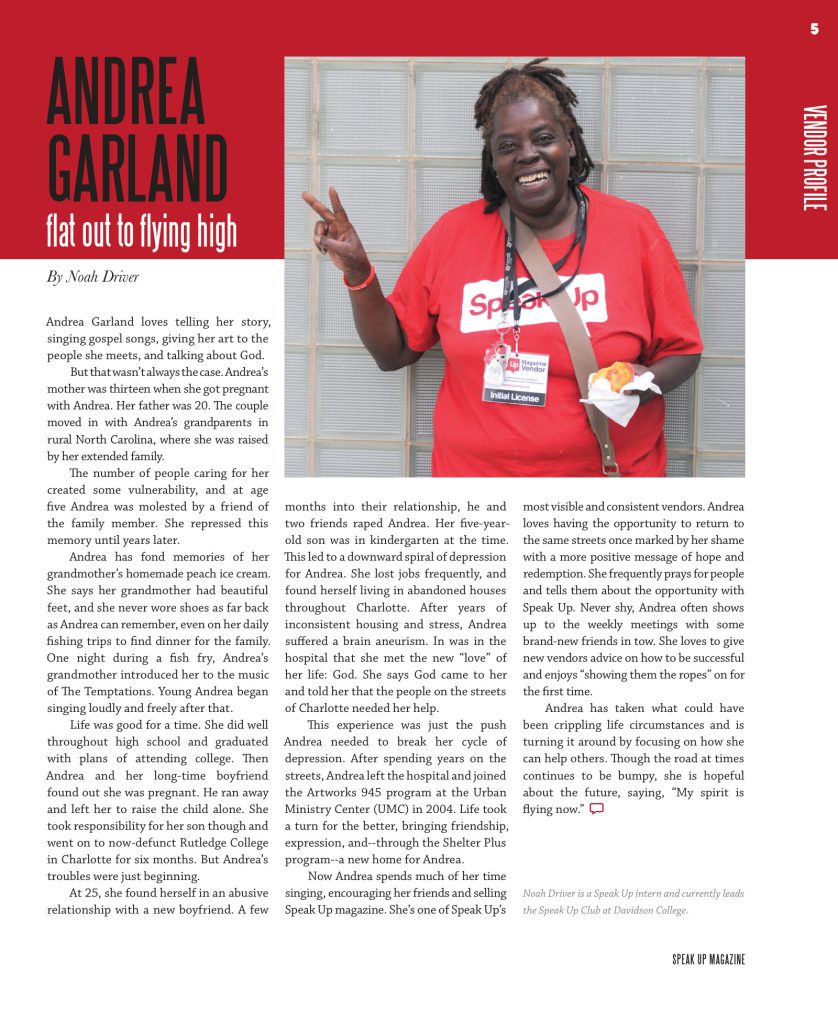
ANDREA VENDOR
PROFILEGARLAND
flat out to flying high
By Noah Driver
Andrea Garland loves telling her story,
singing gospel songs, giving her art to the
people she meets, and talking about God.
But that wasn’t always the case. Andrea’s
mother was thirteen when she got pregnant
with Andrea. Her father was 20. The couple
moved in with Andrea’s grandparents in
rural North Carolina, where she was raised
by her extended family.
The number of people caring for her
created some vulnerability, and at age
five Andrea was molested by a friend of months into their relationship, he and most visible and consistent vendors. Andrea
the family member. She repressed this two friends raped Andrea. Her five-year- loves having the opportunity to return to
memory until years later. old son was in kindergarten at the time. the same streets once marked by her shame
Andrea has fond memories of her This led to a downward spiral of depression with a more positive message of hope and
grandmother’s homemade peach ice cream. for Andrea. She lost jobs frequently, and redemption. She frequently prays for people
She says her grandmother had beautiful found herself living in abandoned houses and tells them about the opportunity with
feet, and she never wore shoes as far back throughout Charlotte. After years of Speak Up. Never shy, Andrea often shows
as Andrea can remember, even on her daily inconsistent housing and stress, Andrea up to the weekly meetings with some
fishing trips to find dinner for the family. suffered a brain aneurism. In was in the brand-new friends in tow. She loves to give
One night during a fish fry, Andrea’s hospital that she met the new “love” of new vendors advice on how to be successful
grandmother introduced her to the music her life: God. She says God came to her and enjoys “showing them the ropes” on for
of The Temptations. Young Andrea began and told her that the people on the streets the first time.
singing loudly and freely after that. of Charlotte needed her help. Andrea has taken what could have
Life was good for a time. She did well This experience was just the push been crippling life circumstances and is
throughout high school and graduated Andrea needed to break her cycle of turning it around by focusing on how she
with plans of attending college. Then depression. After spending years on the can help others. Though the road at times
Andrea and her long-time boyfriend streets, Andrea left the hospital and joined continues to be bumpy, she is hopeful
found out she was pregnant. He ran away the Artworks 945 program at the Urban about the future, saying, “My spirit is
and left her to raise the child alone. She Ministry Center (UMC) in 2004. Life took flying now.”
took responsibility for her son though and a turn for the better, bringing friendship,
went on to now-defunct Rutledge College expression, and–through the Shelter Plus
in Charlotte for six months. But Andrea’s program–a new home for Andrea.
troubles were just beginning. Now Andrea spends much of her time
At 25, she found herself in an abusive singing, encouraging her friends and selling Noah Driver is a Speak Up intern and currently leads
relationship with a new boyfriend. A few Speak Up magazine. She’s one of Speak Up’s the Speak Up Club at Davidson College.
SPEAK UP MAGAZINE
Page 6
6
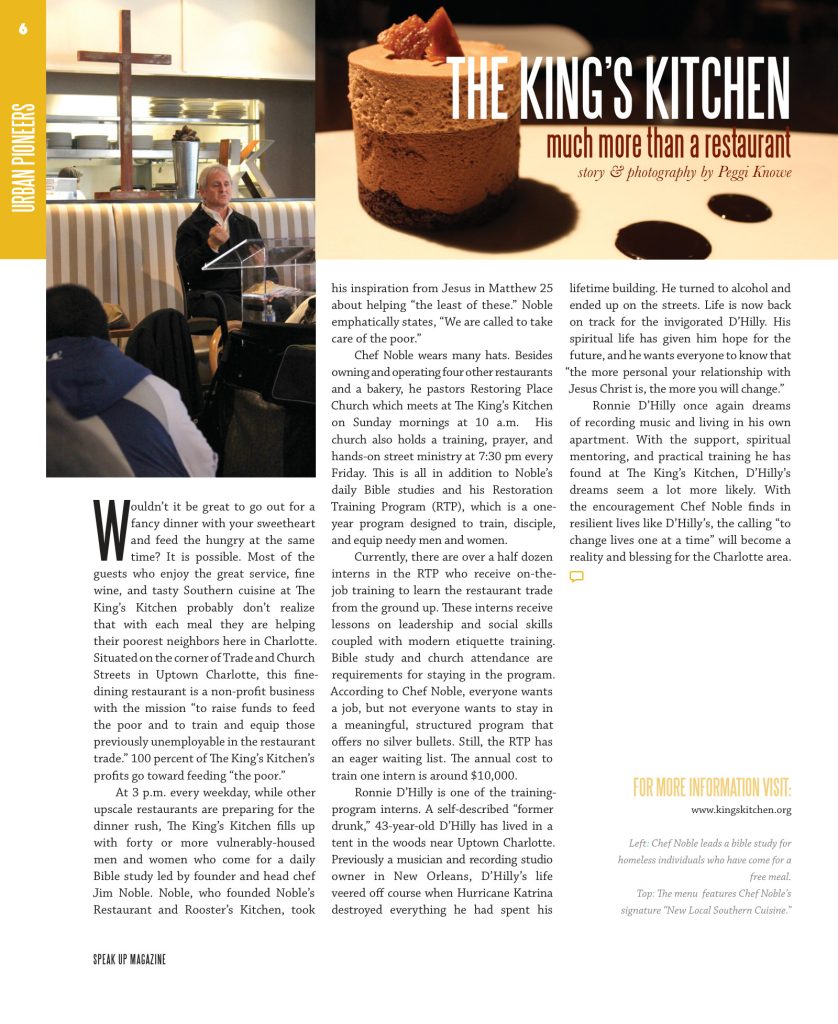
THE KING’S KITCHEN
PIONEERS much more than a restaurant
story & photography by Peggi Knowe
URBAN
his inspiration from Jesus in Matthew 25 lifetime building. He turned to alcohol and
about helping “the least of these.” Noble ended up on the streets. Life is now back
emphatically states, “We are called to take on track for the invigorated D’Hilly. His
care of the poor.” spiritual life has given him hope for the
Chef Noble wears many hats. Besides future, and he wants everyone to know that
owning and operating four other restaurants “the more personal your relationship with
and a bakery, he pastors Restoring Place Jesus Christ is, the more you will change.”
Church which meets at The King’s Kitchen Ronnie D’Hilly once again dreams
on Sunday mornings at 10 a.m. His of recording music and living in his own
church also holds a training, prayer, and apartment. With the support, spiritual
hands-on street ministry at 7:30 pm every mentoring, and practical training he has
Friday. This is all in addition to Noble’s found at The King’s Kitchen, D’Hilly’s
daily Bible studies and his Restoration dreams seem a lot more likely. With
ouldn’t it be great to go out for a Training Program (RTP), which is a one- the encouragement Chef Noble finds in
fancy dinner with your sweetheart year program designed to train, disciple, resilient lives like D’Hilly’s, the calling “to
and feed the hungry at the same and equip needy men and women. change lives one at a time” will become a
time? It is possible. Most of the Currently, there are over a half dozen reality and blessing for the Charlotte area. W
guests who enjoy the great service, fine interns in the RTP who receive on-the-
wine, and tasty Southern cuisine at The job training to learn the restaurant trade
King’s Kitchen probably don’t realize from the ground up. These interns receive
that with each meal they are helping lessons on leadership and social skills
their poorest neighbors here in Charlotte. coupled with modern etiquette training.
Situated on the corner of Trade and Church Bible study and church attendance are
Streets in Uptown Charlotte, this fine- requirements for staying in the program.
dining restaurant is a non-profit business According to Chef Noble, everyone wants
with the mission “to raise funds to feed a job, but not everyone wants to stay in
the poor and to train and equip those a meaningful, structured program that
previously unemployable in the restaurant offers no silver bullets. Still, the RTP has
trade.” 100 percent of The King’s Kitchen’s an eager waiting list. The annual cost to
profits go toward feeding “the poor.” train one intern is around $10,000.
At 3 p.m. every weekday, while other Ronnie D’Hilly is one of the training- FOR MORE INFORMATION VISIT:
upscale restaurants are preparing for the program interns. A self-described “former www.kingskitchen.org
dinner rush, The King’s Kitchen fills up drunk,” 43-year-old D’Hilly has lived in a
with forty or more vulnerably-housed tent in the woods near Uptown Charlotte. Left: Chef Noble leads a bible study for
men and women who come for a daily Previously a musician and recording studio homeless individuals who have come for a
Bible study led by founder and head chef owner in New Orleans, D’Hilly’s life free meal.
Jim Noble. Noble, who founded Noble’s veered off course when Hurricane Katrina Top: The menu features Chef Noble’s
Restaurant and Rooster’s Kitchen, took destroyed everything he had spent his signature “New Local Southern Cuisine.”
SPEAK UP MAGAZINE
Page 7
7
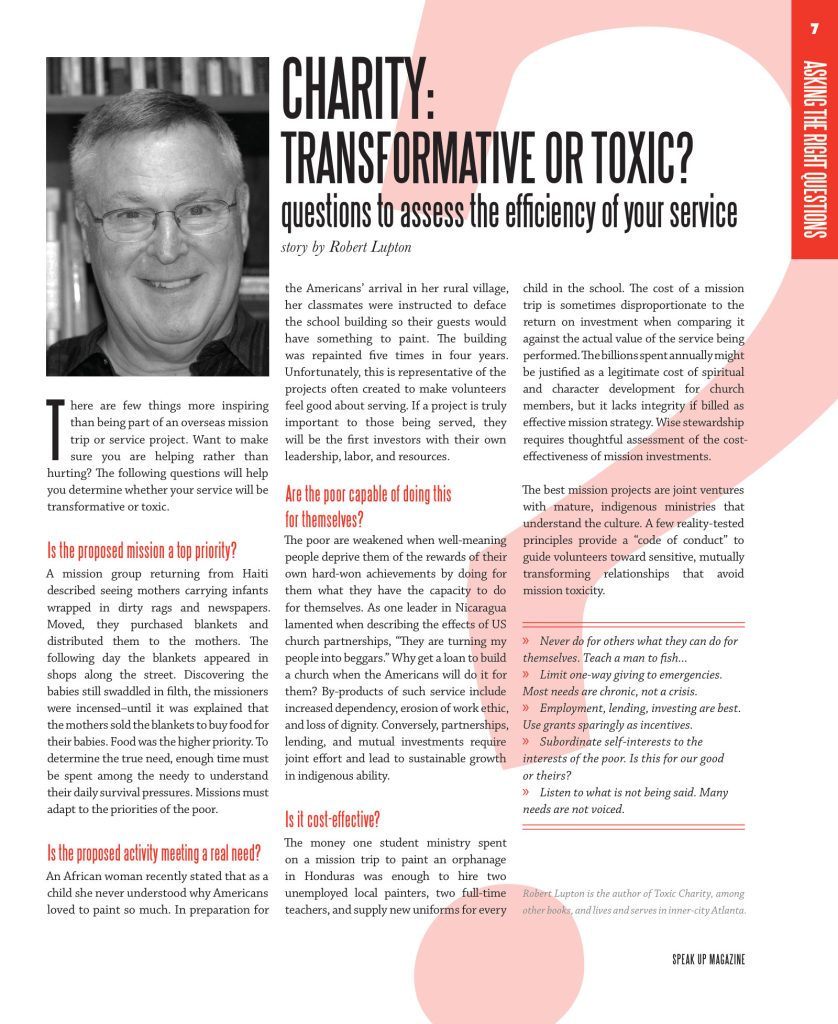
ASKING CHARITY: THE
RIGHT TRANSFORMATIVE OR TOXIC?
questions to assess the efficiency of your service QUESTIONS
story by Robert Lupton
the Americans’ arrival in her rural village, child in the school. The cost of a mission
her classmates were instructed to deface trip is sometimes disproportionate to the
the school building so their guests would return on investment when comparing it
have something to paint. The building against the actual value of the service being
was repainted five times in four years. performed. The billions spent annually might
Unfortunately, this is representative of the be justified as a legitimate cost of spiritual
projects often created to make volunteers and character development for church
here are few things more inspiring feel good about serving. If a project is truly members, but it lacks integrity if billed as
than being part of an overseas mission important to those being served, they effective mission strategy. Wise stewardship
trip or service project. Want to make will be the first investors with their own requires thoughtful assessment of the cost-
sure you are helping rather than leadership, labor, and resources. effectiveness of mission investments.T
hurting? The following questions will help
you determine whether your service will be Are the poor capable of doing this The best mission projects are joint ventures
transformative or toxic. with mature, indigenous ministries that
for themselves? understand the culture. A few reality-tested
The poor are weakened when well-meaning principles provide a “code of conduct” to
Is the proposed mission a top priority? people deprive them of the rewards of their guide volunteers toward sensitive, mutually
A mission group returning from Haiti own hard-won achievements by doing for transforming relationships that avoid
described seeing mothers carrying infants them what they have the capacity to do mission toxicity.
wrapped in dirty rags and newspapers. for themselves. As one leader in Nicaragua
Moved, they purchased blankets and lamented when describing the effects of US
distributed them to the mothers. The church partnerships, “They are turning my »» Never do for others what they can do for
following day the blankets appeared in people into beggars.” Why get a loan to build themselves. Teach a man to fish…
shops along the street. Discovering the a church when the Americans will do it for »» Limit one-way giving to emergencies.
babies still swaddled in filth, the missioners them? By-products of such service include Most needs are chronic, not a crisis.
were incensed–until it was explained that increased dependency, erosion of work ethic, »» Employment, lending, investing are best.
the mothers sold the blankets to buy food for and loss of dignity. Conversely, partnerships, Use grants sparingly as incentives.
their babies. Food was the higher priority. To lending, and mutual investments require »» Subordinate self-interests to the
determine the true need, enough time must joint effort and lead to sustainable growth interests of the poor. Is this for our good
be spent among the needy to understand in indigenous ability. or theirs?
their daily survival pressures. Missions must »» Listen to what is not being said. Many
adapt to the priorities of the poor. needs are not voiced.
Is it cost-effective?
The money one student ministry spent
Is the proposed activity meeting a real need? on a mission trip to paint an orphanage
An African woman recently stated that as a in Honduras was enough to hire two
child she never understood why Americans unemployed local painters, two full-time Robert Lupton is the author of Toxic Charity, among
loved to paint so much. In preparation for teachers, and supply new uniforms for every other books, and lives and serves in inner-city Atlanta.
SPEAK UP MAGAZINE?
Page 8
8
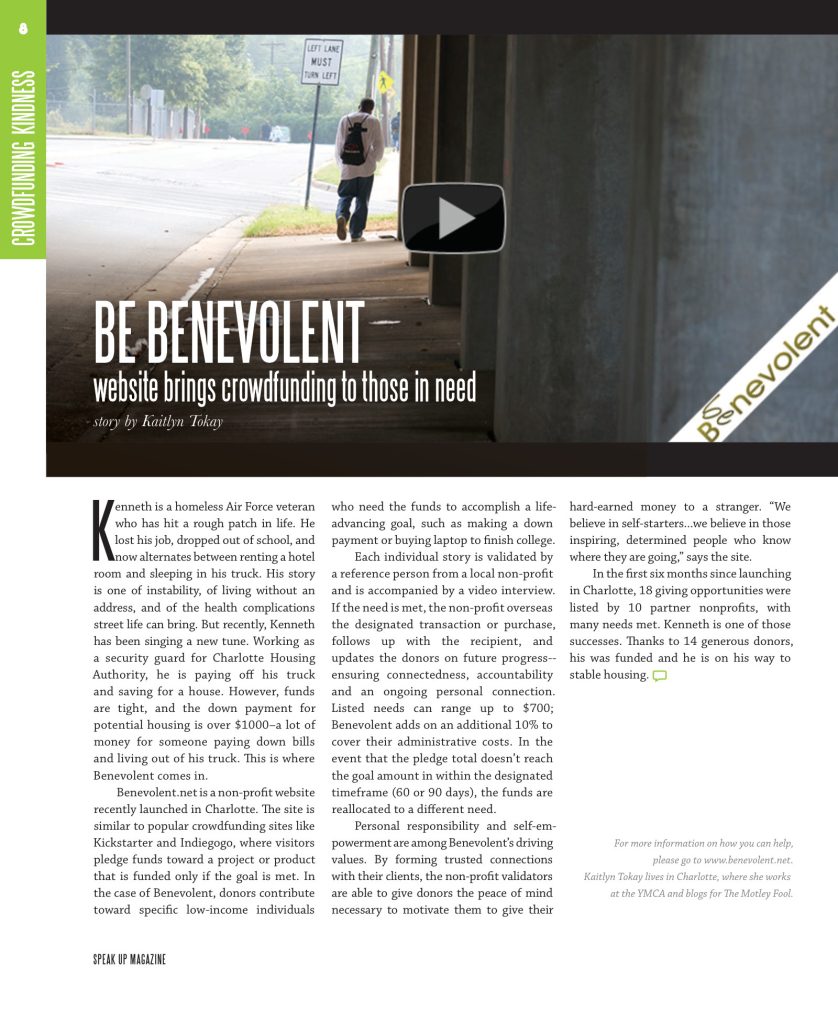
KINDNESS
CROWDFUNDING
BE BENEVOLENT
website brings crowdfunding to those in need
story by Kaitlyn Tokay
enneth is a homeless Air Force veteran who need the funds to accomplish a life- hard-earned money to a stranger. “We
who has hit a rough patch in life. He advancing goal, such as making a down believe in self-starters…we believe in those
lost his job, dropped out of school, and payment or buying laptop to finish college. inspiring, determined people who know
now alternates between renting a hotel Each individual story is validated by where they are going,” says the site. K
room and sleeping in his truck. His story a reference person from a local non-profit In the first six months since launching
is one of instability, of living without an and is accompanied by a video interview. in Charlotte, 18 giving opportunities were
address, and of the health complications If the need is met, the non-profit overseas listed by 10 partner nonprofits, with
street life can bring. But recently, Kenneth the designated transaction or purchase, many needs met. Kenneth is one of those
has been singing a new tune. Working as follows up with the recipient, and successes. Thanks to 14 generous donors,
a security guard for Charlotte Housing updates the donors on future progress– his was funded and he is on his way to
Authority, he is paying off his truck ensuring connectedness, accountability stable housing.
and saving for a house. However, funds and an ongoing personal connection.
are tight, and the down payment for Listed needs can range up to $700;
potential housing is over $1000–a lot of Benevolent adds on an additional 10% to
money for someone paying down bills cover their administrative costs. In the
and living out of his truck. This is where event that the pledge total doesn’t reach
Benevolent comes in. the goal amount in within the designated
Benevolent.net is a non-profit website timeframe (60 or 90 days), the funds are
recently launched in Charlotte. The site is reallocated to a different need.
similar to popular crowdfunding sites like Personal responsibility and self-em-
Kickstarter and Indiegogo, where visitors powerment are among Benevolent’s driving For more information on how you can help,
pledge funds toward a project or product values. By forming trusted connections please go to www.benevolent.net.
that is funded only if the goal is met. In with their clients, the non-profit validators Kaitlyn Tokay lives in Charlotte, where she works
the case of Benevolent, donors contribute are able to give donors the peace of mind at the YMCA and blogs for The Motley Fool.
toward specific low-income individuals necessary to motivate them to give their
SPEAK UP MAGAZINE
Page 9
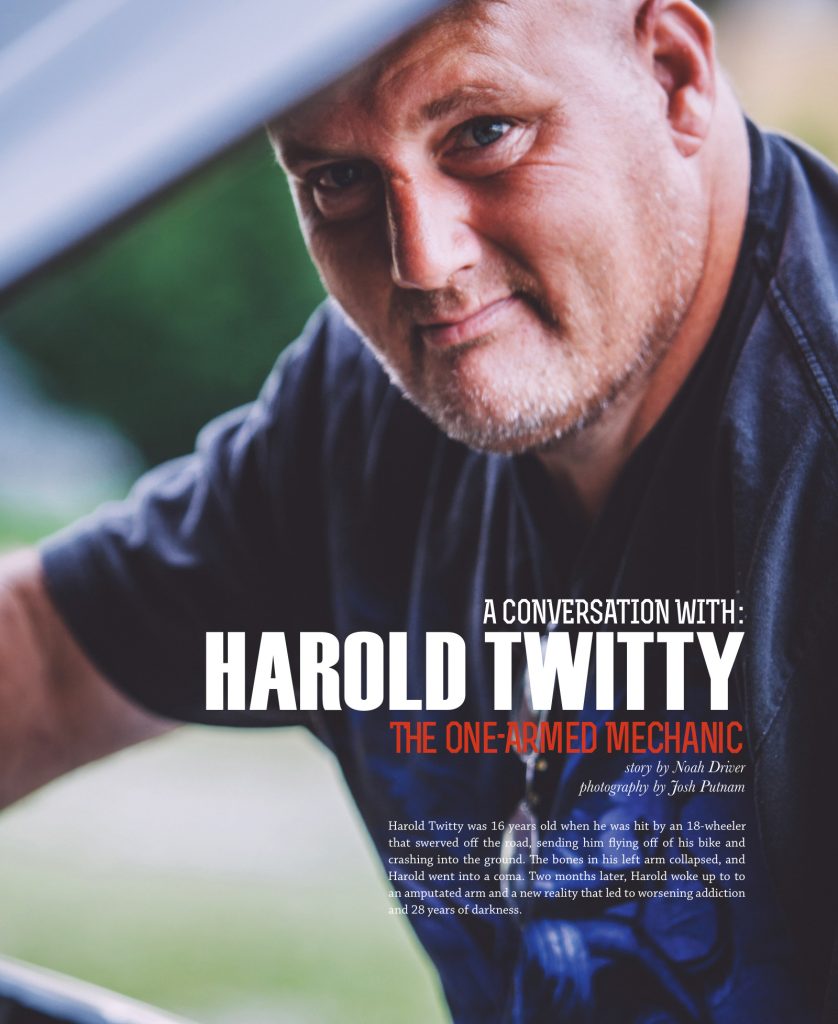
A CONVERSATION WITH:
HAROLD TWITTY
The One-Armed Mechanic
story by Noah Driver
photography by Josh Putnam
Harold Twitty was 16 years old when he was hit by an 18-wheeler
that swerved off the road, sending him flying off of his bike and
crashing into the ground. The bones in his left arm collapsed, and
Harold went into a coma. Two months later, Harold woke up to to
an amputated arm and a new reality that led to worsening addiction
and 28 years of darkness.
Page 10
10
as I don’t give up, everything changes.” But when
the conversation gets more personal, Harold speeds
through his narrative.
“We had a fairly happy family…” he says staring
across the room. But any happy memories he holds
are laced with dark shadows of bitter fighting, alcohol
and abuse. One of his first low points came at age
eight, when he was sexually assaulted by an uncle.CONVERSATIONS Things within his family continued to disintegrate.
His father shot him in the back after a fight when
Harold was in his mid-20s. It wasn’t until two decades
later that he learned that this man was not actually
his biological father. His birth mother had died, and
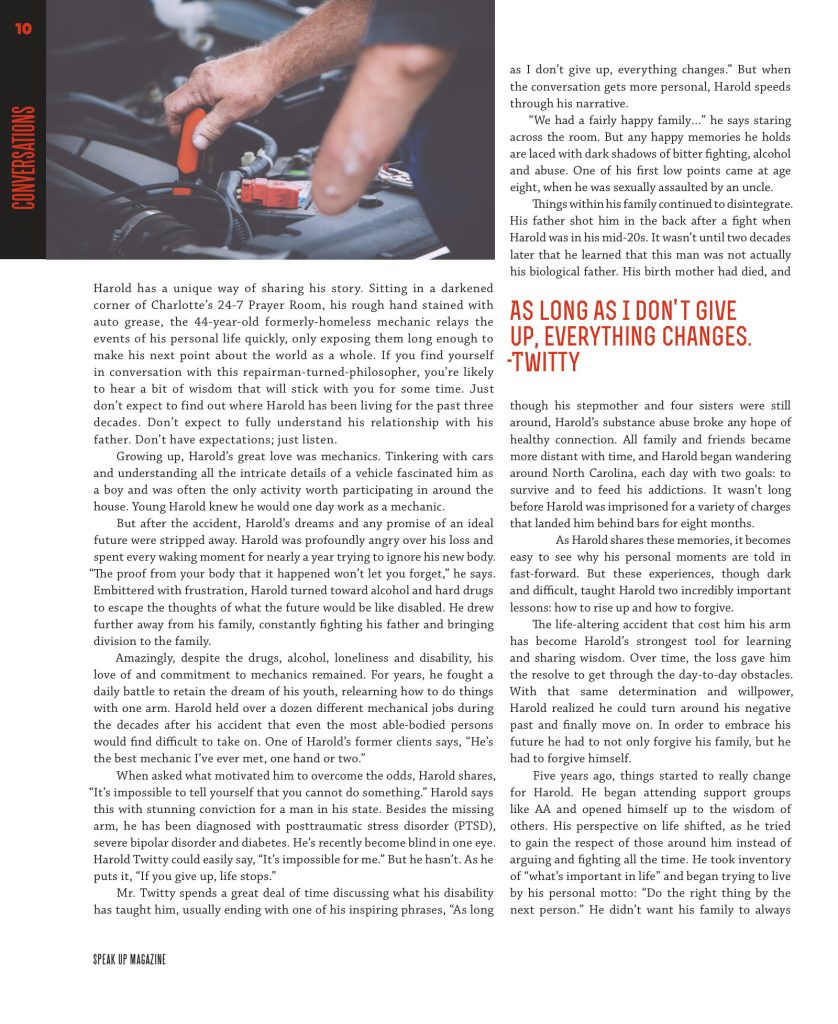
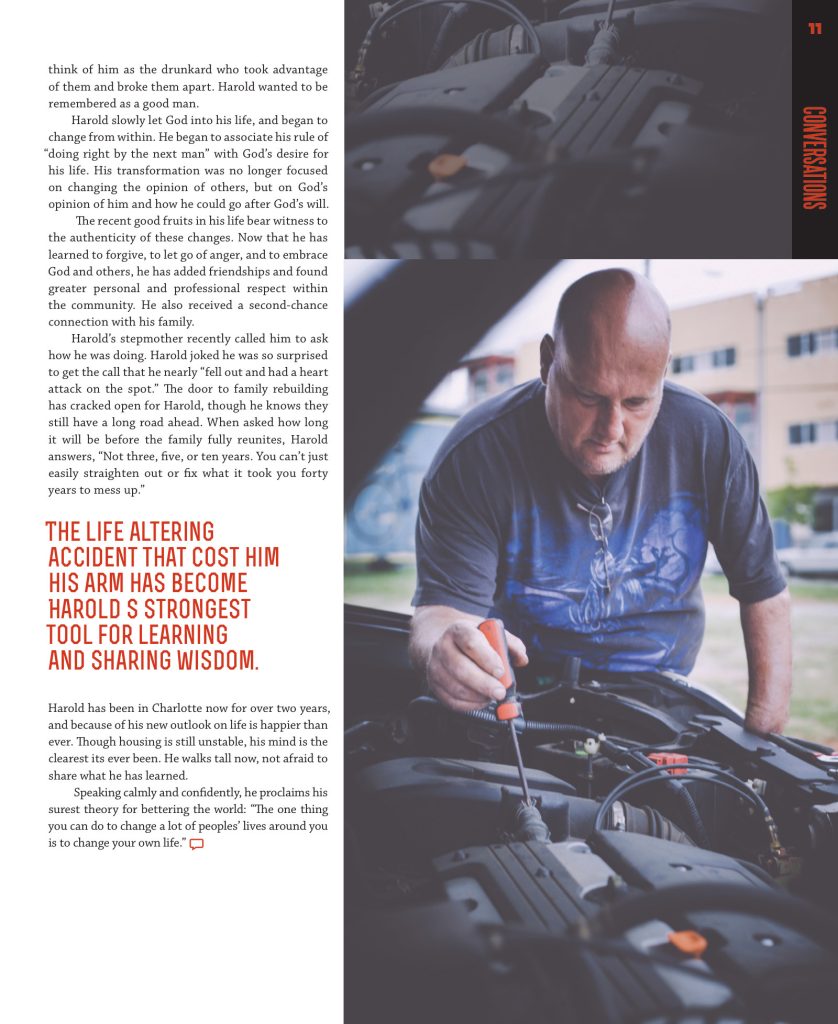
Harold has a unique way of sharing his story. Sitting in a darkened
corner of Charlotte’s 24-7 Prayer Room, his rough hand stained with
auto grease, the 44-year-old formerly-homeless mechanic relays the As long as I don' t give
events of his personal life quickly, only exposing them long enough to up, everything changes.
make his next point about the world as a whole. If you find yourself
in conversation with this repairman-turned-philosopher, you’re likely -Twitty
to hear a bit of wisdom that will stick with you for some time. Just
don’t expect to find out where Harold has been living for the past three though his stepmother and four sisters were still
decades. Don’t expect to fully understand his relationship with his around, Harold’s substance abuse broke any hope of
father. Don’t have expectations; just listen. healthy connection. All family and friends became
Growing up, Harold’s great love was mechanics. Tinkering with cars more distant with time, and Harold began wandering
and understanding all the intricate details of a vehicle fascinated him as around North Carolina, each day with two goals: to
a boy and was often the only activity worth participating in around the survive and to feed his addictions. It wasn’t long
house. Young Harold knew he would one day work as a mechanic. before Harold was imprisoned for a variety of charges
But after the accident, Harold’s dreams and any promise of an ideal that landed him behind bars for eight months.
future were stripped away. Harold was profoundly angry over his loss and As Harold shares these memories, it becomes
spent every waking moment for nearly a year trying to ignore his new body. easy to see why his personal moments are told in
“The proof from your body that it happened won’t let you forget,” he says. fast-forward. But these experiences, though dark
Embittered with frustration, Harold turned toward alcohol and hard drugs and difficult, taught Harold two incredibly important
to escape the thoughts of what the future would be like disabled. He drew lessons: how to rise up and how to forgive.
further away from his family, constantly fighting his father and bringing The life-altering accident that cost him his arm
division to the family. has become Harold’s strongest tool for learning
Amazingly, despite the drugs, alcohol, loneliness and disability, his and sharing wisdom. Over time, the loss gave him
love of and commitment to mechanics remained. For years, he fought a the resolve to get through the day-to-day obstacles.
daily battle to retain the dream of his youth, relearning how to do things With that same determination and willpower,
with one arm. Harold held over a dozen different mechanical jobs during Harold realized he could turn around his negative
the decades after his accident that even the most able-bodied persons past and finally move on. In order to embrace his
would find difficult to take on. One of Harold’s former clients says, “He’s future he had to not only forgive his family, but he
the best mechanic I’ve ever met, one hand or two.” had to forgive himself.
When asked what motivated him to overcome the odds, Harold shares, Five years ago, things started to really change
“It’s impossible to tell yourself that you cannot do something.” Harold says for Harold. He began attending support groups
this with stunning conviction for a man in his state. Besides the missing like AA and opened himself up to the wisdom of
arm, he has been diagnosed with posttraumatic stress disorder (PTSD), others. His perspective on life shifted, as he tried
severe bipolar disorder and diabetes. He’s recently become blind in one eye. to gain the respect of those around him instead of
Harold Twitty could easily say, “It’s impossible for me.” But he hasn’t. As he arguing and fighting all the time. He took inventory
puts it, “If you give up, life stops.” of “what’s important in life” and began trying to live
Mr. Twitty spends a great deal of time discussing what his disability by his personal motto: “Do the right thing by the
has taught him, usually ending with one of his inspiring phrases, “As long next person.” He didn’t want his family to always
SPEAK UP MAGAZINE
Page 11
11
think of him as the drunkard who took advantage
of them and broke them apart. Harold wanted to be
remembered as a good man.
Harold slowly let God into his life, and began to
change from within. He began to associate his rule of
“doing right by the next man” with God’s desire for
his life. His transformation was no longer focused
on changing the opinion of others, but on God’s opinion of him and how he could go after God’s will. CONVERSATIONS
The recent good fruits in his life bear witness to
the authenticity of these changes. Now that he has
learned to forgive, to let go of anger, and to embrace
God and others, he has added friendships and found
greater personal and professional respect within
the community. He also received a second-chance
connection with his family.
Harold’s stepmother recently called him to ask
how he was doing. Harold joked he was so surprised
to get the call that he nearly “fell out and had a heart
attack on the spot.” The door to family rebuilding
has cracked open for Harold, though he knows they
still have a long road ahead. When asked how long
it will be before the family fully reunites, Harold
answers, “Not three, five, or ten years. You can’t just
easily straighten out or fix what it took you forty
years to mess up.”
The life-altering
accident that cost him
his arm has become
Harold’s strongest
tool for learning
and sharing wisdom.
Harold has been in Charlotte now for over two years,
and because of his new outlook on life is happier than
ever. Though housing is still unstable, his mind is the
clearest its ever been. He walks tall now, not afraid to
share what he has learned.
Speaking calmly and confidently, he proclaims his
surest theory for bettering the world: “The one thing
you can do to change a lot of peoples’ lives around you
is to change your own life.”
SPEAK UP MAGAZINE
Page 12
12
HEROES “BOSS TO BEGGAR”
a CEO takes to the streets
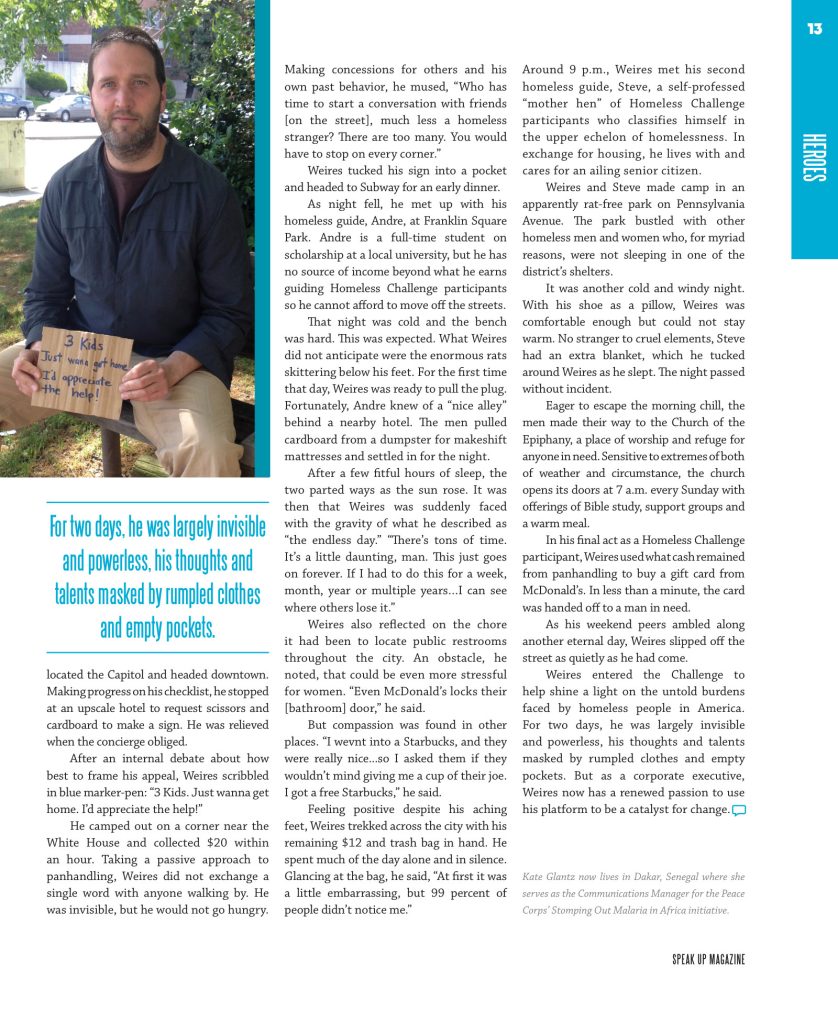
story & photography by Kate Glantz
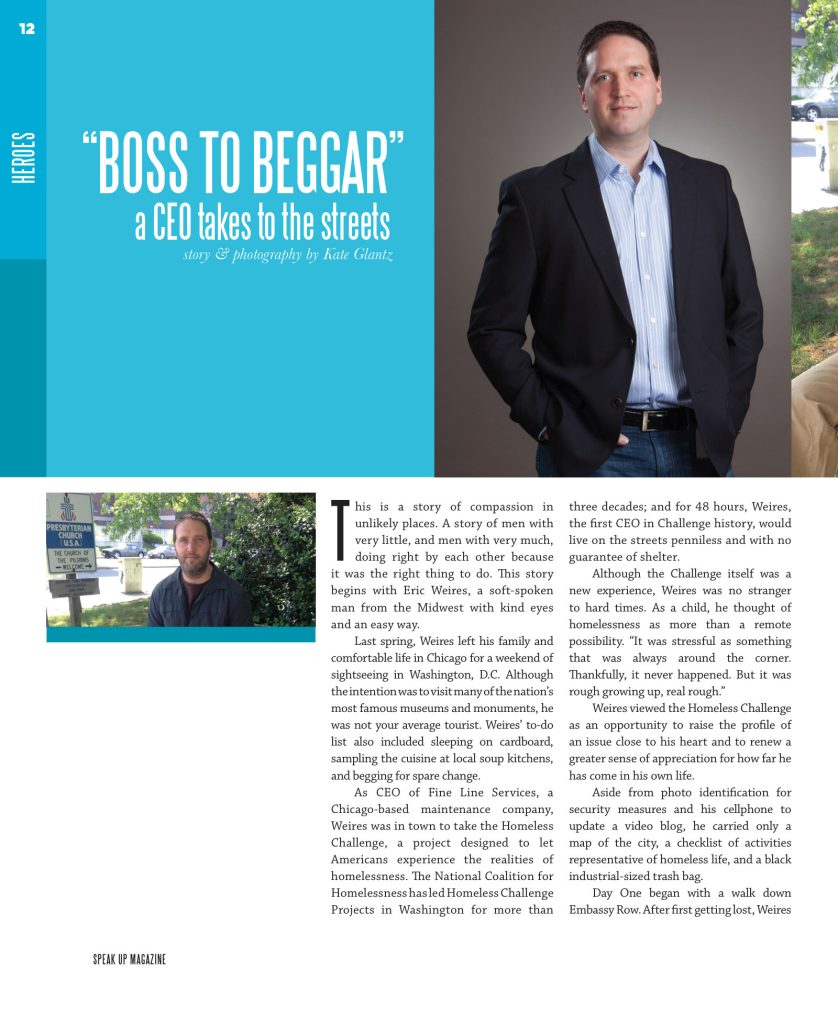
his is a story of compassion in three decades; and for 48 hours, Weires,
unlikely places. A story of men with the first CEO in Challenge history, would
very little, and men with very much, live on the streets penniless and with no
doing right by each other because guarantee of shelter. T
it was the right thing to do. This story Although the Challenge itself was a
begins with Eric Weires, a soft-spoken new experience, Weires was no stranger
man from the Midwest with kind eyes to hard times. As a child, he thought of
and an easy way. homelessness as more than a remote
Last spring, Weires left his family and possibility. “It was stressful as something
comfortable life in Chicago for a weekend of that was always around the corner.
sightseeing in Washington, D.C. Although Thankfully, it never happened. But it was
the intention was to visit many of the nation’s rough growing up, real rough.”
most famous museums and monuments, he Weires viewed the Homeless Challenge
was not your average tourist. Weires’ to-do as an opportunity to raise the profile of
list also included sleeping on cardboard, an issue close to his heart and to renew a
sampling the cuisine at local soup kitchens, greater sense of appreciation for how far he
and begging for spare change. has come in his own life.
As CEO of Fine Line Services, a Aside from photo identification for
Chicago-based maintenance company, security measures and his cellphone to
Weires was in town to take the Homeless update a video blog, he carried only a
Challenge, a project designed to let map of the city, a checklist of activities
Americans experience the realities of representative of homeless life, and a black
homelessness. The National Coalition for industrial-sized trash bag.
Homelessness has led Homeless Challenge Day One began with a walk down
Projects in Washington for more than Embassy Row. After first getting lost, Weires
SPEAK UP MAGAZINE
Page 13
13
Making concessions for others and his Around 9 p.m., Weires met his second
own past behavior, he mused, “Who has homeless guide, Steve, a self-professed
time to start a conversation with friends “mother hen” of Homeless Challenge
[on the street], much less a homeless participants who classifies himself in
stranger? There are too many. You would the upper echelon of homelessness. In
have to stop on every corner.” exchange for housing, he lives with and
Weires tucked his sign into a pocket cares for an ailing senior citizen. HEROES
and headed to Subway for an early dinner. Weires and Steve made camp in an
As night fell, he met up with his apparently rat-free park on Pennsylvania
homeless guide, Andre, at Franklin Square Avenue. The park bustled with other
Park. Andre is a full-time student on homeless men and women who, for myriad
scholarship at a local university, but he has reasons, were not sleeping in one of the
no source of income beyond what he earns district’s shelters.
guiding Homeless Challenge participants It was another cold and windy night.
so he cannot afford to move off the streets. With his shoe as a pillow, Weires was
That night was cold and the bench comfortable enough but could not stay
was hard. This was expected. What Weires warm. No stranger to cruel elements, Steve
did not anticipate were the enormous rats had an extra blanket, which he tucked
skittering below his feet. For the first time around Weires as he slept. The night passed
that day, Weires was ready to pull the plug. without incident.
Fortunately, Andre knew of a “nice alley” Eager to escape the morning chill, the
behind a nearby hotel. The men pulled men made their way to the Church of the
cardboard from a dumpster for makeshift Epiphany, a place of worship and refuge for
mattresses and settled in for the night. anyone in need. Sensitive to extremes of both
After a few fitful hours of sleep, the of weather and circumstance, the church
two parted ways as the sun rose. It was opens its doors at 7 a.m. every Sunday with
then that Weires was suddenly faced offerings of Bible study, support groups and
with the gravity of what he described as a warm meal. For two days, he was largely invisible “the endless day.” “There’s tons of time. In his final act as a Homeless Challenge
It’s a little daunting, man. This just goes participant, Weires used what cash remained and powerless, his thoughts and on forever. If I had to do this for a week, from panhandling to buy a gift card from
month, year or multiple years…I can see McDonald’s. In less than a minute, the card talents masked by rumpled clothes where others lose it.” was handed off to a man in need.
Weires also reflected on the chore As his weekend peers ambled along and empty pockets. it had been to locate public restrooms another eternal day, Weires slipped off the
throughout the city. An obstacle, he street as quietly as he had come.
located the Capitol and headed downtown. noted, that could be even more stressful Weires entered the Challenge to
Making progress on his checklist, he stopped for women. “Even McDonald’s locks their help shine a light on the untold burdens
at an upscale hotel to request scissors and [bathroom] door,” he said. faced by homeless people in America.
cardboard to make a sign. He was relieved But compassion was found in other For two days, he was largely invisible
when the concierge obliged. places. “I wevnt into a Starbucks, and they and powerless, his thoughts and talents
After an internal debate about how were really nice…so I asked them if they masked by rumpled clothes and empty
best to frame his appeal, Weires scribbled wouldn’t mind giving me a cup of their joe. pockets. But as a corporate executive,
in blue marker-pen: “3 Kids. Just wanna get I got a free Starbucks,” he said. Weires now has a renewed passion to use
home. I’d appreciate the help!” Feeling positive despite his aching his platform to be a catalyst for change.
He camped out on a corner near the feet, Weires trekked across the city with his
White House and collected $20 within remaining $12 and trash bag in hand. He
an hour. Taking a passive approach to spent much of the day alone and in silence.
panhandling, Weires did not exchange a Glancing at the bag, he said, “At first it was Kate Glantz now lives in Dakar, Senegal where she
single word with anyone walking by. He a little embarrassing, but 99 percent of serves as the Communications Manager for the Peace
was invisible, but he would not go hungry. people didn’t notice me.” Corps’ Stomping Out Malaria in Africa initiative.
SPEAK UP MAGAZINE
Page 14
14
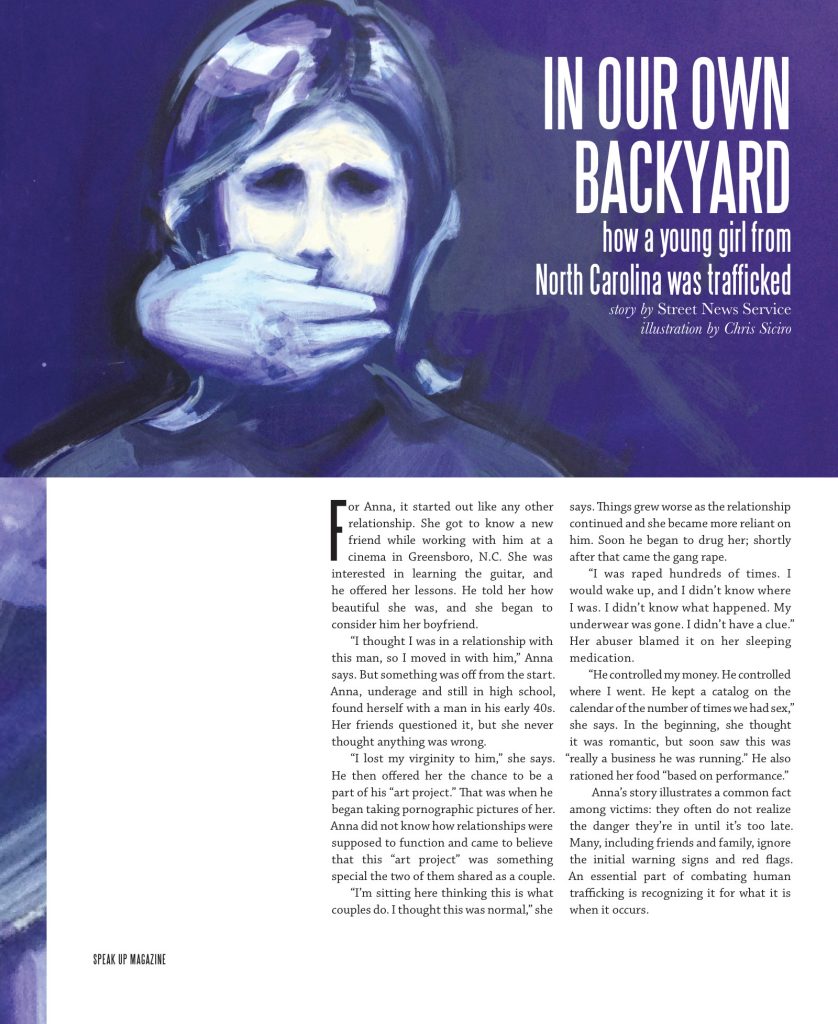
IN OUR OWN
SURVIVOR BACKYARD
how a young girl from
North Carolina was trafficked
story by Street News Service
illustration by Chris Siciro
or Anna, it started out like any other says. Things grew worse as the relationship
relationship. She got to know a new continued and she became more reliant on
friend while working with him at a him. Soon he began to drug her; shortly
cinema in Greensboro, N.C. She was after that came the gang rape. F
interested in learning the guitar, and “I was raped hundreds of times. I
he offered her lessons. He told her how would wake up, and I didn’t know where
beautiful she was, and she began to I was. I didn’t know what happened. My
consider him her boyfriend. underwear was gone. I didn’t have a clue.”
“I thought I was in a relationship with Her abuser blamed it on her sleeping
this man, so I moved in with him,” Anna medication.
says. But something was off from the start. “He controlled my money. He controlled
Anna, underage and still in high school, where I went. He kept a catalog on the
found herself with a man in his early 40s. calendar of the number of times we had sex,”
Her friends questioned it, but she never she says. In the beginning, she thought
thought anything was wrong. it was romantic, but soon saw this was
“I lost my virginity to him,” she says. “really a business he was running.” He also
He then offered her the chance to be a rationed her food “based on performance.”
part of his “art project.” That was when he Anna’s story illustrates a common fact
began taking pornographic pictures of her. among victims: they often do not realize
Anna did not know how relationships were the danger they’re in until it’s too late.
supposed to function and came to believe Many, including friends and family, ignore
that this “art project” was something the initial warning signs and red flags.
special the two of them shared as a couple. An essential part of combating human
“I’m sitting here thinking this is what trafficking is recognizing it for what it is
couples do. I thought this was normal,” she when it occurs.
SPEAK UP MAGAZINE
Page 15
15
“A lot of it is just trusting your gut.” Carrie, another survivor,
admits that when she was being abused, she could feel something
was wrong, but ignored it. “Most of us aren’t checked into our
emotions all of the time. You need to be really present with
yourself.” She also added that it’s important to gauge the quality
of your personal relationships with others. “Don’t give away your
power to anyone, ever,” Carrie said. “You always have the power SURVIVOR to make a choice in your life.” Anna was finally able to make that choice and escape when HUMAN TRAFFICKING
she was offered the chance to move elsewhere. She began
transferring her belongings to her new home during school hours and lied to her abuser about leaving her things at school. & HOMELESSNESS
She lost her job at the cinema and quietly moved out. The man
“If we solve the problem of affordable housing in
Anna’s story illustrates a common fact among thisendingcountry,trafficking],”that wouldsays goexecutivea long waydirector[towardfor
victims: they often do not realize Normathe CoalitionRamos.Against“There Traffickingis a huge inconnectionWomen,
the danger they’re in until it’s too late. betweenSharonhomelessnessMcDonald,andtheprostitution.”Director of Fami-
lies and Youth at the National Alliance to End
began actively searching for her. Others began to realize there Homelessness agrees. According to McDonald,
was something wrong with the relationship outside of the age homelessness creates a vulnerability that
disparity and offered more support. But another troubling traffickers often exploit.
issue surfaced. Though Anna had not recognized it, her daring “People are abused, afraid, and isolated on
escape revealed a conflicting emotion: she still had feelings for the street. Then, someone comes along offering
her abuser–something experts say is common among trafficking respite. One of the ways that [homeless] youth
victims. Thankfully, however, Anna stuck it out. are trafficked and targeted is through their
Later, Anna learned that her ex-boyfriend was luring other vulnerability. It’s not just physical; it could also
girls to his rural home in North Carolina with fake modeling be emotional.”
contracts for his “art project.” Alarmed by this news, Anna alerted Trying to determine whether or not persons
the police, more out of jealousy than concern. However, she offering “care” are genuine is a challenge
refused to give the information necessary for his arrest because homeless individuals face daily. Even shelters
of her conflicting feelings. She still did not fully comprehend that are not always safe and can be used as recruiting
she had been a victim of sex trafficking. grounds for trafficking. Sometimes even the
It was only when she discovered this man had been mass- people experiencing homelessness recruit others,
producing the pornographic photographs he had taken of her brainwashed by their abusers into believing they
that she realized what their relationship had really been. Anna are actually helping a friend leave the street.
began to learn about trafficking even more in college, and finally If not lured in by positive attention, others
understood she was a survivor herself. She recognized that she may head into dangerous activity simply out
needed help and found it in the form of Mercy Ministries, a of desperation. Too often people experiencing
free-of-charge program for abused women ages 13-28 and homelessness engage in what McDonald calls
based in Nashville. survival sex or sex for housing. That is why
Anna now says that she’s made a choice to not let her negative providing easy access to safe and affordable
experiences define her. “Jesus Christ comes into your heart and permanent housing is so important. Without
He redeems you and He changes you; and I am now free,” she says. safe shelter, ending trafficking among youth who
“If you all just knew what I felt when I was in that and how happy experience homelessness will be nearly impossible.
I am now. I know I’m beautiful. I know I’m worthy, and I know “The first step is making sure people are aware
I’m worth it.” of trafficking,” McDonald says. “But we also need
to make sure there are places for kids to come
when they exit that lifestyle.”
Page 17
17
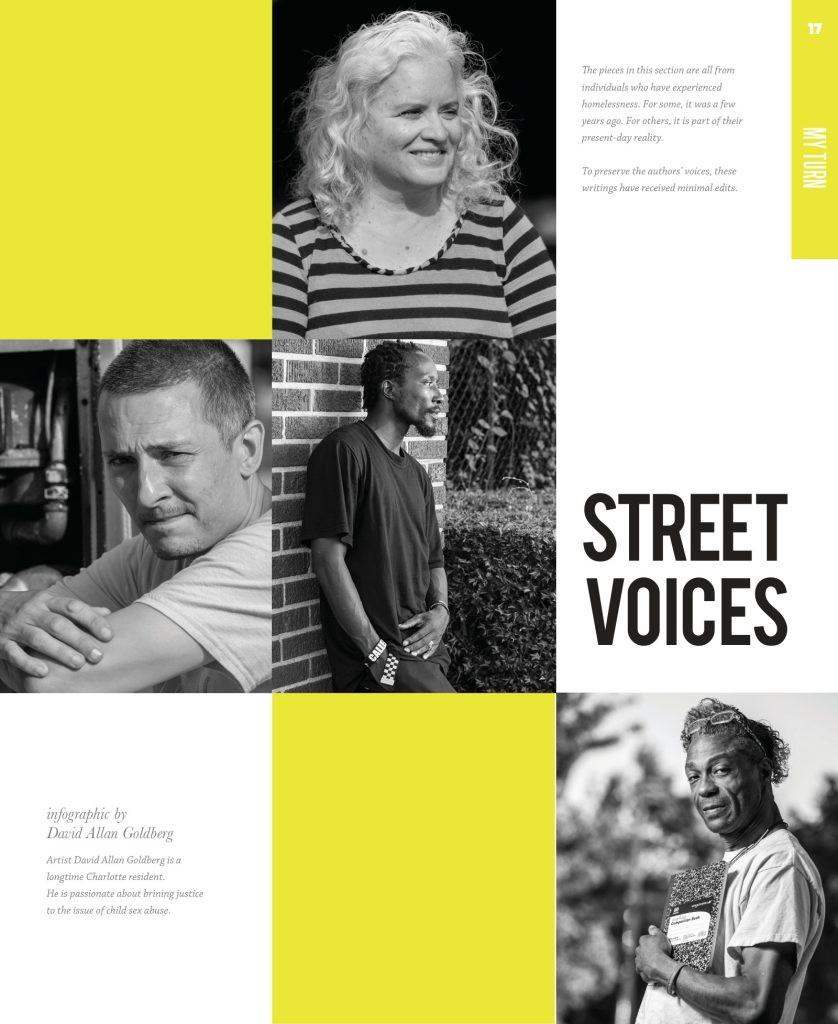
The pieces in this section are all from
individuals who have experienced
homelessness. For some, it was a few
years ago. For others, it is part of their
present-day reality. MY
To preserve the authors’ voices, these TURN writings have received minimal edits.
STREET
VOICES
infographic by
David Allan Goldberg
Artist David Allan Goldberg is a
longtime Charlotte resident.
He is passionate about brining justice
to the issue of child sex abuse.
SPEAK UP MAGAZINE
Page 18
18
TURN
MY
photography by Chris Austin
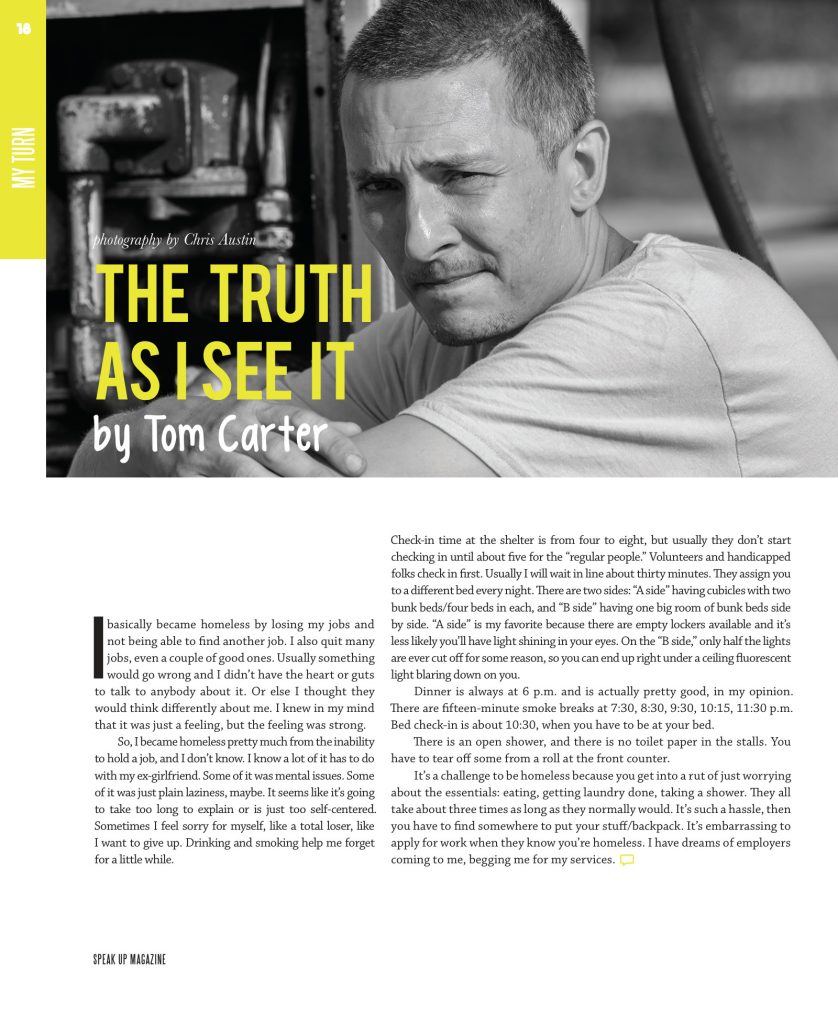
The Truth
As I See It
by Tom Carter
Check-in time at the shelter is from four to eight, but usually they don’t start
checking in until about five for the “regular people.” Volunteers and handicapped
folks check in first. Usually I will wait in line about thirty minutes. They assign you
to a different bed every night. There are two sides: “A side” having cubicles with two
bunk beds/four beds in each, and “B side” having one big room of bunk beds side
basically became homeless by losing my jobs and by side. “A side” is my favorite because there are empty lockers available and it’s
not being able to find another job. I also quit many less likely you’ll have light shining in your eyes. On the “B side,” only half the lights
jobs, even a couple of good ones. Usually something are ever cut off for some reason, so you can end up right under a ceiling fluorescent
would go wrong and I didn’t have the heart or guts light blaring down on you. I
to talk to anybody about it. Or else I thought they Dinner is always at 6 p.m. and is actually pretty good, in my opinion.
would think differently about me. I knew in my mind There are fifteen-minute smoke breaks at 7:30, 8:30, 9:30, 10:15, 11:30 p.m.
that it was just a feeling, but the feeling was strong. Bed check-in is about 10:30, when you have to be at your bed.
So, I became homeless pretty much from the inability There is an open shower, and there is no toilet paper in the stalls. You
to hold a job, and I don’t know. I know a lot of it has to do have to tear off some from a roll at the front counter.
with my ex-girlfriend. Some of it was mental issues. Some It’s a challenge to be homeless because you get into a rut of just worrying
of it was just plain laziness, maybe. It seems like it’s going about the essentials: eating, getting laundry done, taking a shower. They all
to take too long to explain or is just too self-centered. take about three times as long as they normally would. It’s such a hassle, then
Sometimes I feel sorry for myself, like a total loser, like you have to find somewhere to put your stuff/backpack. It’s embarrassing to
I want to give up. Drinking and smoking help me forget apply for work when they know you’re homeless. I have dreams of employers
for a little while. coming to me, begging me for my services.
SPEAK UP MAGAZINE
Page 19
19
MY
TURN
used to love sitting under the stars. Still do. Being
in the woods is something I am used to. However,
sleeping in the snow is something you never get used
to. I always keep an Army-type attitude. It helps.I
I really never had too many problems adapting to my
situation. But my decisions that got me to this “calling to
the streets” have put awful strains on my family.
I sat under a bridge one night after losing $900.
That money was supposed to get me off the streets. It
was right on time. I forget who sent the check, but I
thought I had a new life. I wanted to keep quiet about
it knowing that people would be right on me to spend photography by Chris Austin
it. Yet I called my girlfriend and told her how I just got
paid. After we spent a few days in a hotel, she told me
that we spent all of the money, even the money that I
had put away. I was crushed. I felt like a fool.
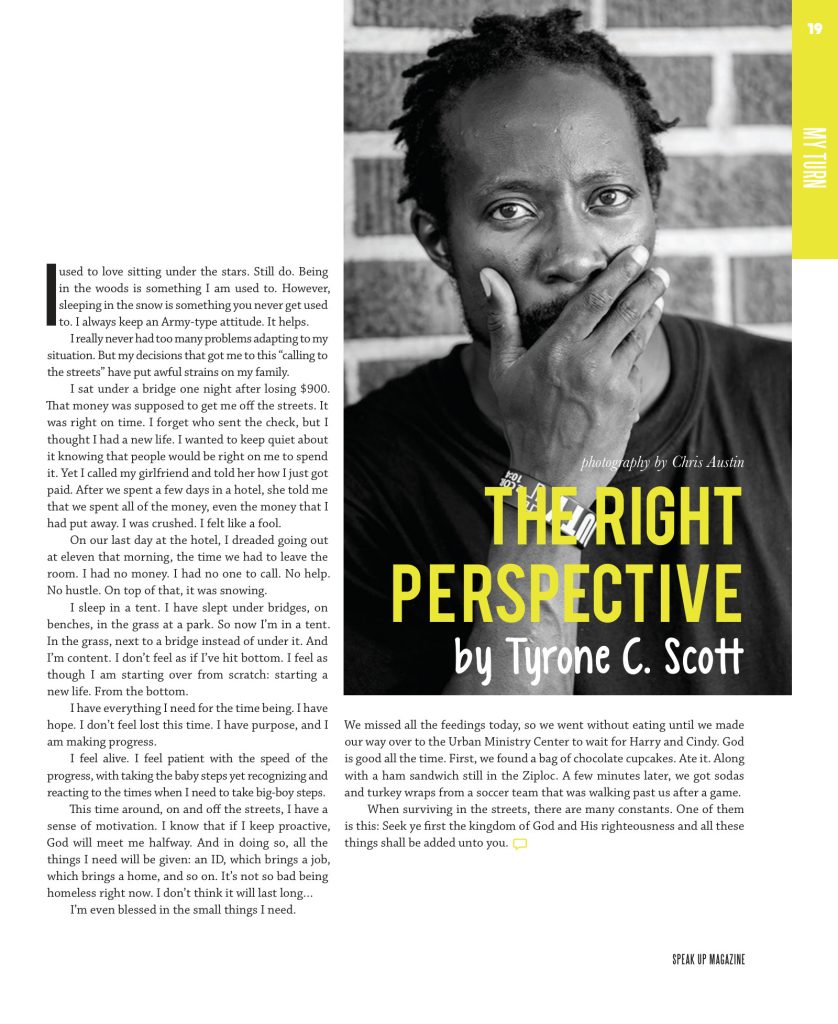
On our last day at the hotel, I dreaded going out The right
at eleven that morning, the time we had to leave the
room. I had no money. I had no one to call. No help.
No hustle. On top of that, it was snowing.
I sleep in a tent. I have slept under bridges, on benches, in the grass at a park. So now I’m in a tent. Perspective
In the grass, next to a bridge instead of under it. And
I’m content. I don’t feel as if I’ve hit bottom. I feel as though I am starting over from scratch: starting a by Tyrone C. Scott
new life. From the bottom.
I have everything I need for the time being. I have
hope. I don’t feel lost this time. I have purpose, and I We missed all the feedings today, so we went without eating until we made
am making progress. our way over to the Urban Ministry Center to wait for Harry and Cindy. God
I feel alive. I feel patient with the speed of the is good all the time. First, we found a bag of chocolate cupcakes. Ate it. Along
progress, with taking the baby steps yet recognizing and with a ham sandwich still in the Ziploc. A few minutes later, we got sodas
reacting to the times when I need to take big-boy steps. and turkey wraps from a soccer team that was walking past us after a game.
This time around, on and off the streets, I have a When surviving in the streets, there are many constants. One of them
sense of motivation. I know that if I keep proactive, is this: Seek ye first the kingdom of God and His righteousness and all these
God will meet me halfway. And in doing so, all the things shall be added unto you.
things I need will be given: an ID, which brings a job,
which brings a home, and so on. It’s not so bad being
homeless right now. I don’t think it will last long…
I’m even blessed in the small things I need.
SPEAK UP MAGAZINE
Page 20
20
TURN
MY
we were bused from there to the Welcome
Arnold overnight shelter, which was a
renovated jailhouse. Beds and hot meals
were provided.
What I remember most was how it
all ended. My daughter bought a home
in Johnston, RI, which could house two
families. She allowed me to stay there.
photography by Chris Austin And I finally began receiving disability
payments. We lived in secluded, serene,
wooded surroundings. I felt safe at last.
Homelessness can happen to anyone. I
have found that a variety of places provide
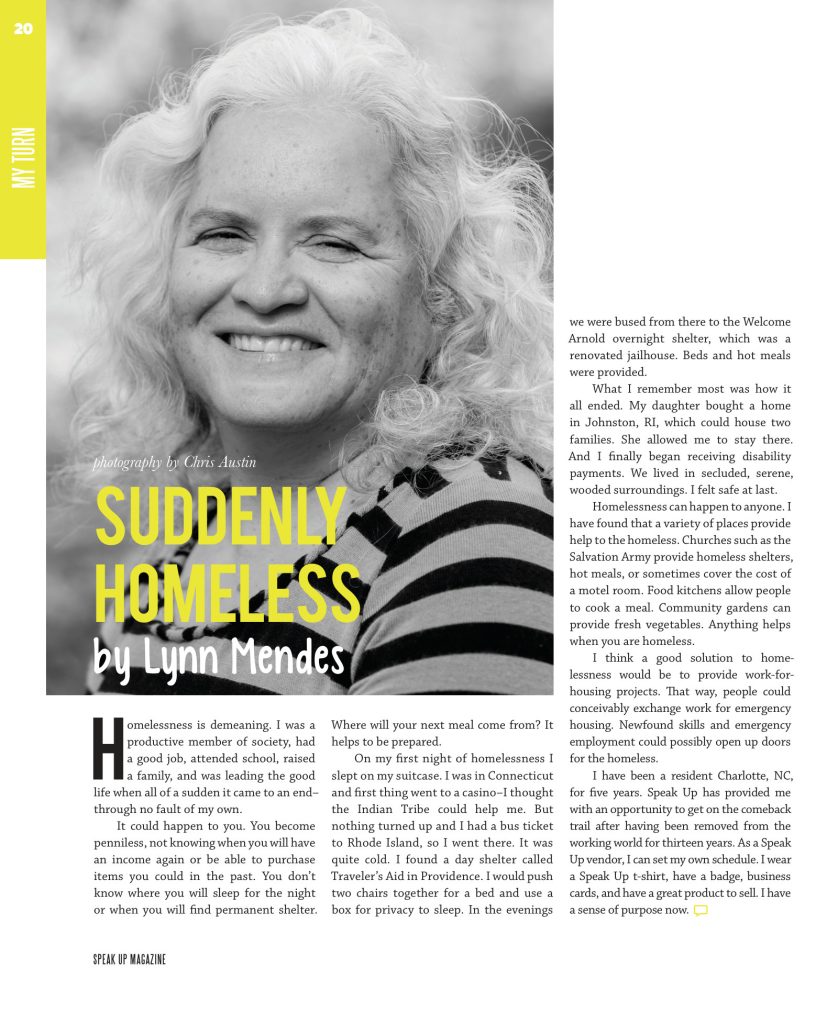
help to the homeless. Churches such as the suddenly
Salvation Army provide homeless shelters,
hot meals, or sometimes cover the cost of
a motel room. Food kitchens allow people
to cook a meal. Community gardens can homeless provide fresh vegetables. Anything helps
when you are homeless.
I think a good solution to home- by Lynn Mendes lessness would be to provide work-for-
housing projects. That way, people could
conceivably exchange work for emergency
omelessness is demeaning. I was a Where will your next meal come from? It housing. Newfound skills and emergency
productive member of society, had helps to be prepared. employment could possibly open up doors
a good job, attended school, raised On my first night of homelessness I for the homeless.
a family, and was leading the good slept on my suitcase. I was in Connecticut I have been a resident Charlotte, NC, H
life when all of a sudden it came to an end– and first thing went to a casino–I thought for five years. Speak Up has provided me
through no fault of my own. the Indian Tribe could help me. But with an opportunity to get on the comeback
It could happen to you. You become nothing turned up and I had a bus ticket trail after having been removed from the
penniless, not knowing when you will have to Rhode Island, so I went there. It was working world for thirteen years. As a Speak
an income again or be able to purchase quite cold. I found a day shelter called Up vendor, I can set my own schedule. I wear
items you could in the past. You don’t Traveler’s Aid in Providence. I would push a Speak Up t-shirt, have a badge, business
know where you will sleep for the night two chairs together for a bed and use a cards, and have a great product to sell. I have
or when you will find permanent shelter. box for privacy to sleep. In the evenings a sense of purpose now.
SPEAK UP MAGAZINE
Page 21
21
MY
TURN
photography by Chris Austin
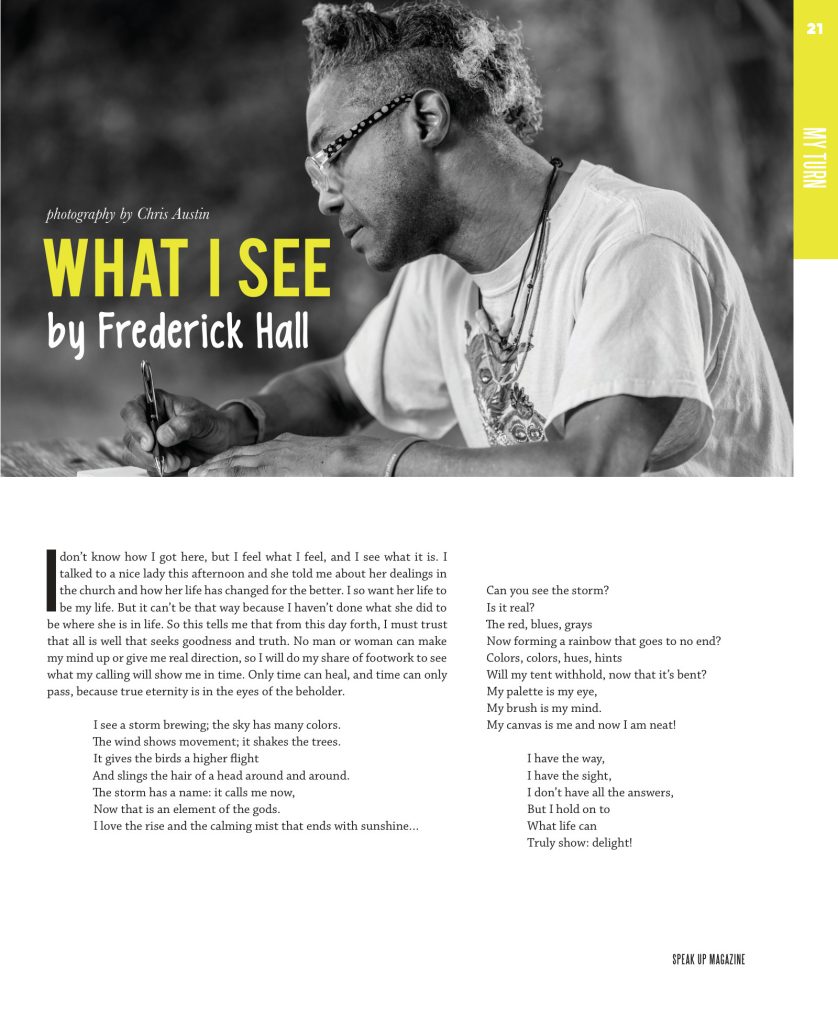
What I See
by Frederick Hall
don’t know how I got here, but I feel what I feel, and I see what it is. I
talked to a nice lady this afternoon and she told me about her dealings in
the church and how her life has changed for the better. I so want her life to Can you see the storm?
be my life. But it can’t be that way because I haven’t done what she did to Is it real?I
be where she is in life. So this tells me that from this day forth, I must trust The red, blues, grays
that all is well that seeks goodness and truth. No man or woman can make Now forming a rainbow that goes to no end?
my mind up or give me real direction, so I will do my share of footwork to see Colors, colors, hues, hints
what my calling will show me in time. Only time can heal, and time can only Will my tent withhold, now that it’s bent?
pass, because true eternity is in the eyes of the beholder. My palette is my eye,
My brush is my mind.
I see a storm brewing; the sky has many colors. My canvas is me and now I am neat!
The wind shows movement; it shakes the trees.
It gives the birds a higher flight I have the way,
And slings the hair of a head around and around. I have the sight,
The storm has a name: it calls me now, I don’t have all the answers,
Now that is an element of the gods. But I hold on to
I love the rise and the calming mist that ends with sunshine… What life can
Truly show: delight!
SPEAK UP MAGAZINE
Page 22
22
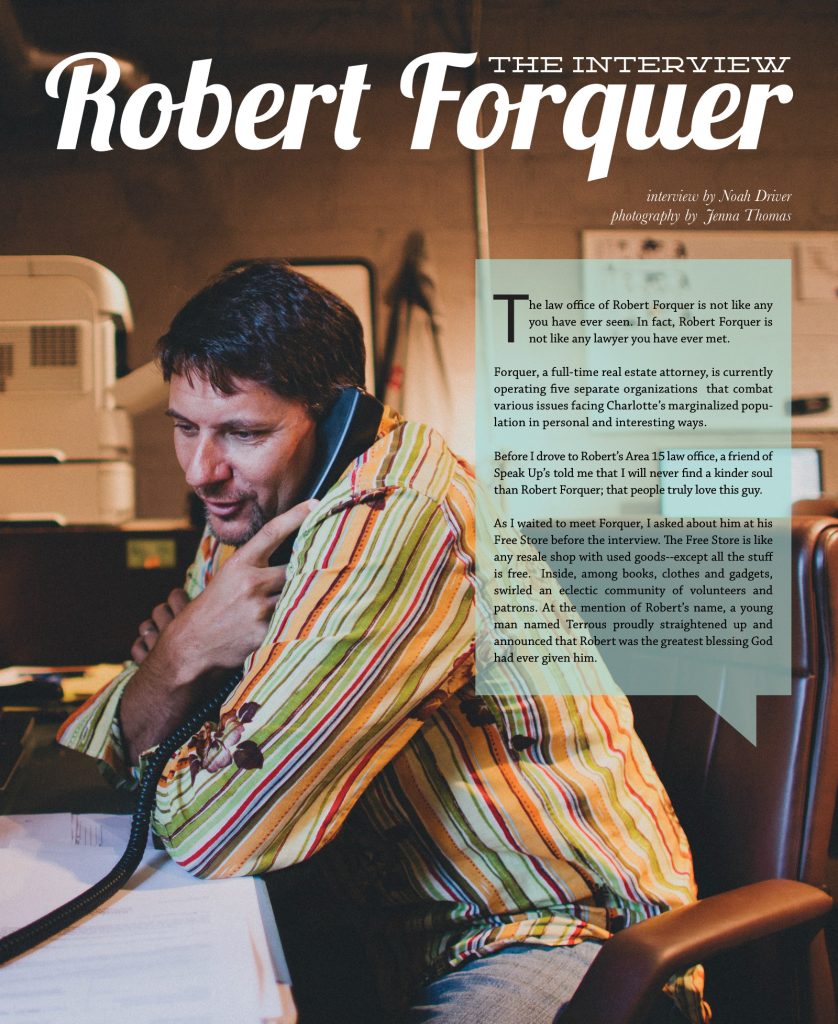
The Interview
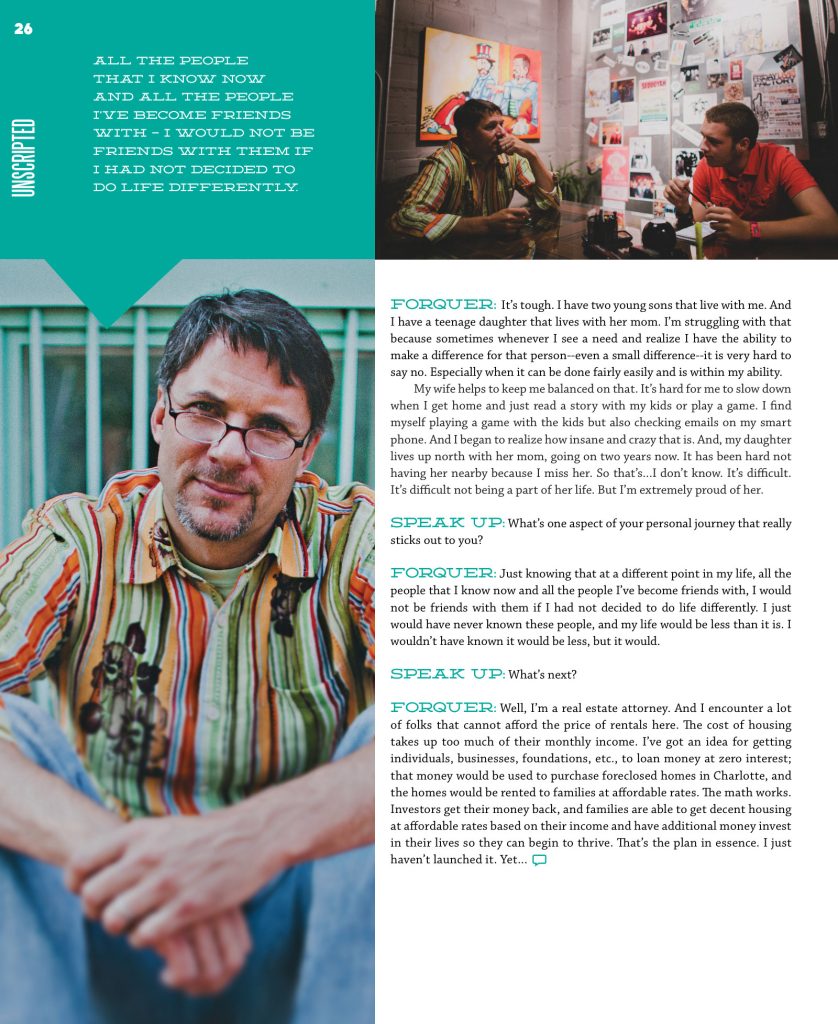
Robert ForquerUNSCRIPTED interview by Noah Driver
photography by Jenna Thomas
he law office of Robert Forquer is not like any
you have ever seen. In fact, Robert Forquer is
not like any lawyer you have ever met. T
Forquer, a full-time real estate attorney, is currently
operating five separate organizations that combat
various issues facing Charlotte’s marginalized popu-
lation in personal and interesting ways.
Before I drove to Robert’s Area 15 law office, a friend of
Speak Up’s told me that I will never find a kinder soul
than Robert Forquer; that people truly love this guy.
As I waited to meet Forquer, I asked about him at his
Free Store before the interview. The Free Store is like
any resale shop with used goods–except all the stuff
is free. Inside, among books, clothes and gadgets,
swirled an eclectic community of volunteers and
patrons. At the mention of Robert’s name, a young
man named Terrous proudly straightened up and
announced that Robert was the greatest blessing God
had ever given him.
SPEAK UP MAGAZINE
Page 23
23
Standing nearly six-three with classically-handsome looks, Forquer’s presence Paul and I really wanted to experience this deep
on the deck behind his Free Store was appropriately striking. He kindly directed relationship with people different from us. So, I’m
us across the courtyard into his office for the interview, pausing periodically to still learning how to do that. And it’s messy. We’ve
greet a total of six friends by name as shouts of “Robert!” rang throughout. been cursed out. We’ve been yelled at. We’ve been
As we settled into the conference room within his office, I surveyed the loved on. We’ve loved on other people. And I learned
surroundings. Two additional full-time attorneys, the hum of a copier, a a lot about life by the people that I’ve made friends
mountain bike hanging from the ceiling (Robert’s fair weather transportation with. I think that it’s helped me in my relationshipto the courthouse), a homeless friend who needed to tell Robert about his with Jesus Christ because I think Jesus got that. I UNSCRIPTED
stomach ache, piles of paper, a half dozen computer screens and eclectic wall think He understood.
art make up his domain. And now when I read through the Gospels, I see
From here he oversees The Free Store; the Justice Project, which the value that Jesus brought human beings and human
revitalizes vulnerable neighborhoods; Legal Edge Law Firm, which serves life. I missed that for a lot of years. I missed that.
economically challenged clients; Reel Men lawn care company, which employs
underemployed men; Vision Possible Consultants, the 501(c)3 umbrella; and Speak Up: You’ve started a company
the Law Firm of Robert Forquer. called Reel Men that employs near-homeless men to
become lawn care professionals. Is that connected to
Speak Up: This is a very unique place and set of responsibilities. the Free Store?
How did you get to this point?
Forquer: It is. It’s my attempt at the next
Forquer: Well, I’ve been an attorney for almost twenty years step toward empowerment that I would like to see the
specializing in real estate transactional work. Nowadays, I want to work with Free Store become. These are my friends, and these
fewer realtors, buyers and sellers and be able to spend more time developing men love to work, love to have a job, but they can’t
relationships. because of the way the economy is.
That’s what I want Legal Edge to be. Legal Edge is really nothing more So, the idea of Reel Men was, “We can find some
than a law firm with a focus on working with folks that need attorney yards. We can cut some grass.” And, if we use these
assistance but don’t have the funds or the ability. old-time reel mowers that are very labor-intensive,
we can provide jobs for several of my friends without
Speak Up: Was there a professional shift at some point? having a huge number of yards to cut.
We’ve been able get enough yards to where we are
Forquer: Absolutely. The first half of my life, I went through able to rent a house, and now several of these men are
thinking I was a pretty good person, worked hard and tried to build and make living together and paying for rent and utilities with
more money this year than I did last year. And I sort of got tired, or older, or money still leftover.
smarter, or something, and I just didn’t want to follow that path anymore. I think they feel more like men–real men–having
When I was going down that path, I didn’t really pay that much attention employment and having a couple dollars in their
to others or to relationships or anything like that. My ideas about work have pocket walking around. There’s something about
changed. It’s still work. And it is important to pay the bills and make the having a couple bucks in your pocket. And having
mortgage payment, put food on the table, and pay the guys I work with. But something to do where you know you are contributing
my motivations have changed and it’s taken a lot of pressure off. and you are earning. It makes a huge difference in a
man’s life.
Speak Up: How did you start the free store?
Speak Up: Any stories stand out to you
Forquer: The Free Store came about several years ago when my from the Reel Men experience?
brother-in-law, Paul Fisher, and I found it by accident when it was in need of
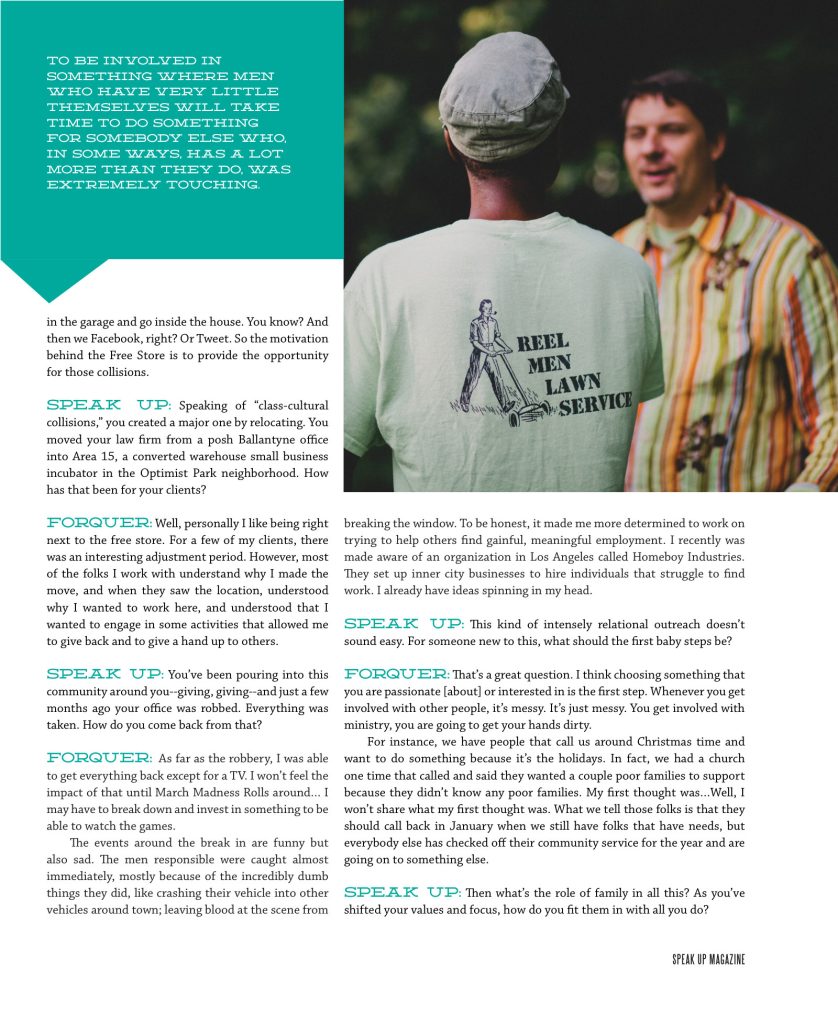
new management. Forquer: The men were cutting grass for
A lot of what I was involved with at my church at the time went from one one of our clients one day, and they noticed that the
event to another. The church would have a Fall Festival, Valentine’s Dinner, etc. lawn next door was a little long, and the owner came
After one event, you went on to something else, the next thing. But the Free out of the house. So Billy, one of the supervisors, went
Store is every day, every day, same people, same people, different people, same to talk with her and discovered that her husband was
people. It’s where I learned to slow down with the people around me. They have in the hospital and not doing well. In fact, they didn’t
a history. They have a life. They have meaning. And society has placed a value expect him to get out of the hospital. She was going
on their lives that is less than the value of other people’s lives. to the hospital to be with her husband. So, the guys
SPEAK UP MAGAZINE
Page 24
24
got done cutting the client’s yard, and they went next that we can work on, we work on those. For individual houses, we do repairs,
door and cut her grass and cleaned out her gutters. To fix roofs, build handicapped ramps if the family needs one. If they have kids
be involved in something where men, who have very struggling in math, we match up the volunteers so that the volunteers can be
little themselves, will take time to do something for tutoring or giving music lessons. Whatever we can do.
somebody else who, in some ways, has a lot more than The goal is that by being involved it will change the volunteers; they will
they do, was extremely touching. change how they live after they are done being involved. A lot of times, when
I think it brought home exactly why we started the middle class gets involved with something like that, we feel like we’reUNSCRIPTED this: to continue to build community and build going to come in and fix a problem, or we’re going to show somebody how to
relationships. And here these guys were extending it do something correctly. That’s not the case. It goes both ways.
and turning around and helping somebody else. We hope that by the end of the year the volunteers have learned to
carve out some time and some resources, that they’ll live life differently
Speak Up: What is the Justice Project? afterwards, stay invested in their relationships and do life differently. It’s a
big undertaking.
Forquer: The Justice Project is a year-long
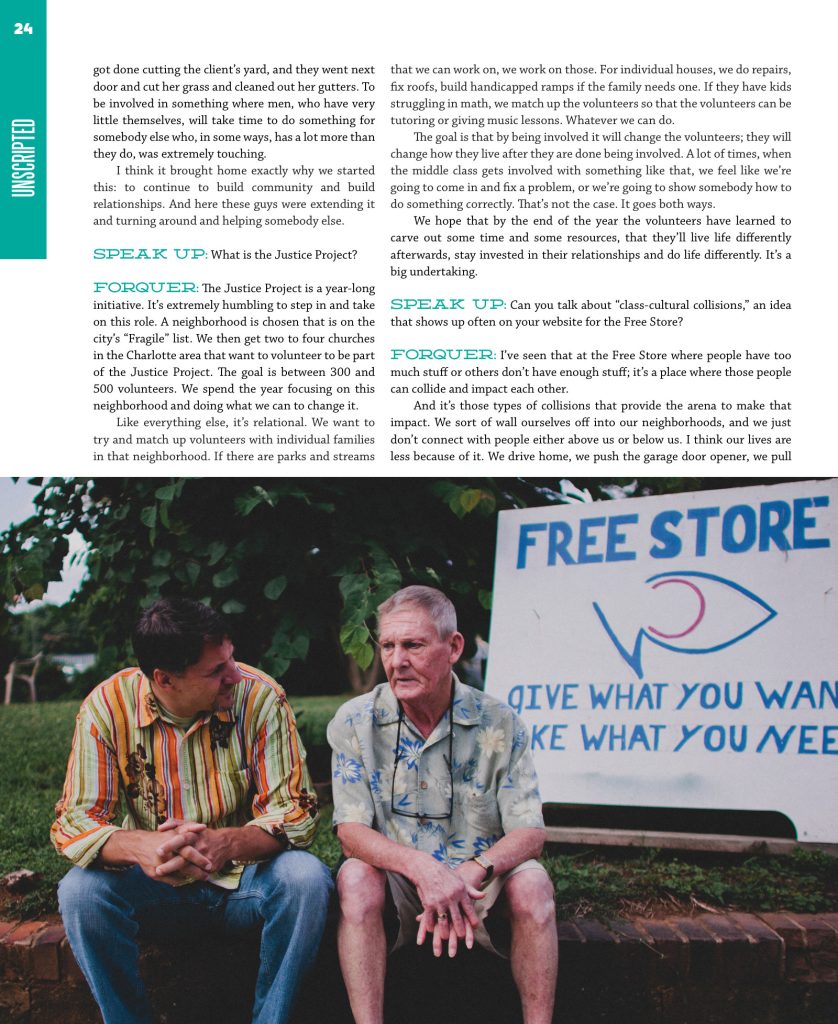
initiative. It’s extremely humbling to step in and take Speak Up: Can you talk about “class-cultural collisions,” an idea
on this role. A neighborhood is chosen that is on the that shows up often on your website for the Free Store?
city’s “Fragile” list. We then get two to four churches
in the Charlotte area that want to volunteer to be part Forquer: I’ve seen that at the Free Store where people have too
of the Justice Project. The goal is between 300 and much stuff or others don’t have enough stuff; it’s a place where those people
500 volunteers. We spend the year focusing on this can collide and impact each other.
neighborhood and doing what we can to change it. And it’s those types of collisions that provide the arena to make that
Like everything else, it’s relational. We want to impact. We sort of wall ourselves off into our neighborhoods, and we just
try and match up volunteers with individual families don’t connect with people either above us or below us. I think our lives are
in that neighborhood. If there are parks and streams less because of it. We drive home, we push the garage door opener, we pull
SPEAK UP MAGAZINE
Page 25
25
To be involved in
something where men
who have very little
themselves will take
time to do something
for somebody else who,
in some ways, has a lot
more than they do, was
extremely touching. UNSCRIPTED
in the garage and go inside the house. You know? And
then we Facebook, right? Or Tweet. So the motivation
behind the Free Store is to provide the opportunity
for those collisions.
Speak Up: Speaking of “class-cultural
collisions,” you created a major one by relocating. You
moved your law firm from a posh Ballantyne office
into Area 15, a converted warehouse small business
incubator in the Optimist Park neighborhood. How
has that been for your clients?
Forquer: Well, personally I like being right breaking the window. To be honest, it made me more determined to work on
next to the free store. For a few of my clients, there trying to help others find gainful, meaningful employment. I recently was
was an interesting adjustment period. However, most made aware of an organization in Los Angeles called Homeboy Industries.
of the folks I work with understand why I made the They set up inner city businesses to hire individuals that struggle to find
move, and when they saw the location, understood work. I already have ideas spinning in my head.
why I wanted to work here, and understood that I
wanted to engage in some activities that allowed me Speak Up: This kind of intensely relational outreach doesn’t
to give back and to give a hand up to others. sound easy. For someone new to this, what should the first baby steps be?
Speak Up: You’ve been pouring into this Forquer: That’s a great question. I think choosing something that
community around you–giving, giving–and just a few you are passionate [about] or interested in is the first step. Whenever you get
months ago your office was robbed. Everything was involved with other people, it’s messy. It’s just messy. You get involved with
taken. How do you come back from that? ministry, you are going to get your hands dirty.
For instance, we have people that call us around Christmas time and
Forquer: As far as the robbery, I was able want to do something because it’s the holidays. In fact, we had a church
to get everything back except for a TV. I won’t feel the one time that called and said they wanted a couple poor families to support
impact of that until March Madness Rolls around… I because they didn’t know any poor families. My first thought was…Well, I
may have to break down and invest in something to be won’t share what my first thought was. What we tell those folks is that they
able to watch the games. should call back in January when we still have folks that have needs, but
The events around the break in are funny but everybody else has checked off their community service for the year and are
also sad. The men responsible were caught almost going on to something else.
immediately, mostly because of the incredibly dumb
things they did, like crashing their vehicle into other Speak Up: Then what’s the role of family in all this? As you’ve
vehicles around town; leaving blood at the scene from shifted your values and focus, how do you fit them in with all you do?
SPEAK UP MAGAZINE
Page 26
26
All the people
that I know now
and all the people
I’ve become friends
with – I would not be
friends with them if
I had not decided to
do life differently.UNSCRIPTED
Forquer: It’s tough. I have two young sons that live with me. And
I have a teenage daughter that lives with her mom. I’m struggling with that
because sometimes whenever I see a need and realize I have the ability to
make a difference for that person–even a small difference–it is very hard to
say no. Especially when it can be done fairly easily and is within my ability.
My wife helps to keep me balanced on that. It’s hard for me to slow down
when I get home and just read a story with my kids or play a game. I find
myself playing a game with the kids but also checking emails on my smart
phone. And I began to realize how insane and crazy that is. And, my daughter
lives up north with her mom, going on two years now. It has been hard not
having her nearby because I miss her. So that’s…I don’t know. It’s difficult.
It’s difficult not being a part of her life. But I’m extremely proud of her.
Speak Up: What’s one aspect of your personal journey that really
sticks out to you?
Forquer: Just knowing that at a different point in my life, all the
people that I know now and all the people I’ve become friends with, I would
not be friends with them if I had not decided to do life differently. I just
would have never known these people, and my life would be less than it is. I
wouldn’t have known it would be less, but it would.
Speak Up: What’s next?
Forquer: Well, I’m a real estate attorney. And I encounter a lot
of folks that cannot afford the price of rentals here. The cost of housing
takes up too much of their monthly income. I’ve got an idea for getting
individuals, businesses, foundations, etc., to loan money at zero interest;
that money would be used to purchase foreclosed homes in Charlotte, and
the homes would be rented to families at affordable rates. The math works.
Investors get their money back, and families are able to get decent housing
at affordable rates based on their income and have additional money invest
in their lives so they can begin to thrive. That’s the plan in essence. I just
haven’t launched it. Yet…
SPEAK UP MAGAZINE
Page 27
Arrive 27
REFUGEESurvive
Thrive
HELPING REFUGEES NAVIGATE
A CONFUSING NEW WORLD
IS JUST THE BEGINNING
story by Steve Parker
photography by Jenna Thomas
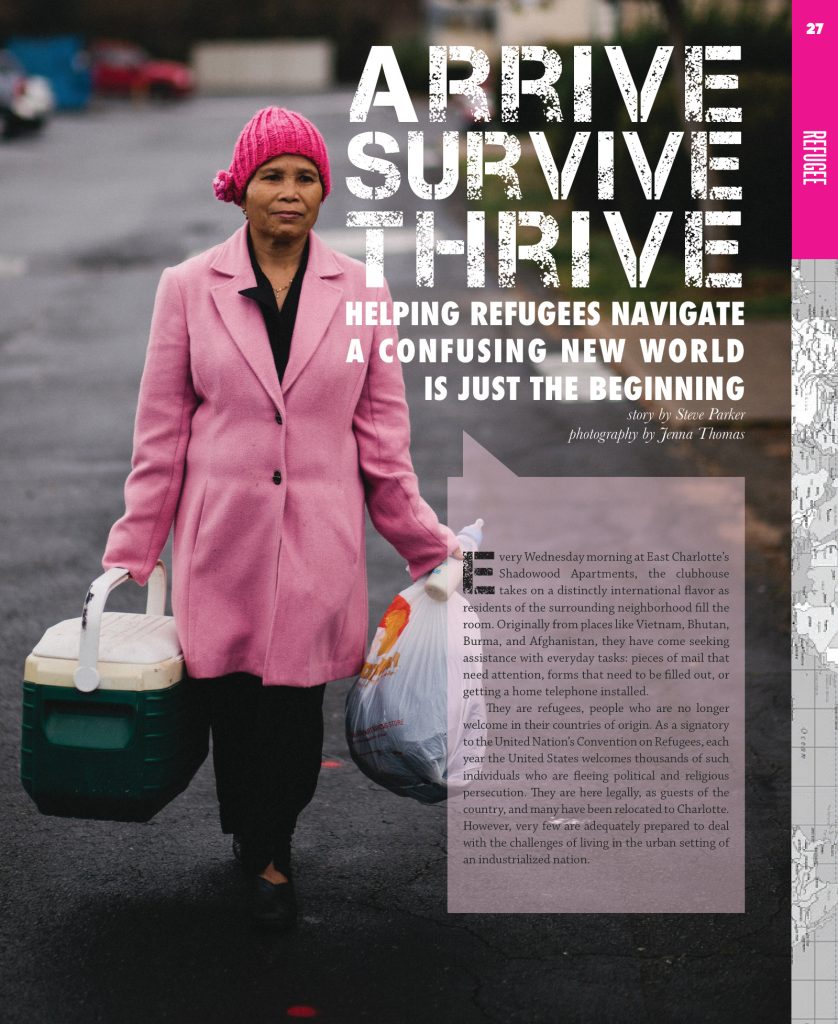
very Wednesday morning at East Charlotte’s
Shadowood Apartments, the clubhouse
takes on a distinctly international flavor as E
residents of the surrounding neighborhood fill the
room. Originally from places like Vietnam, Bhutan,
Burma, and Afghanistan, they have come seeking
assistance with everyday tasks: pieces of mail that
need attention, forms that need to be filled out, or
getting a home telephone installed.
They are refugees, people who are no longer
welcome in their countries of origin. As a signatory
to the United Nation’s Convention on Refugees, each
year the United States welcomes thousands of such
individuals who are fleeing political and religious
persecution. They are here legally, as guests of the
country, and many have been relocated to Charlotte.
However, very few are adequately prepared to deal
with the challenges of living in the urban setting of
an industrialized nation.
SPEAK UP MAGAZINE
Page 28
28
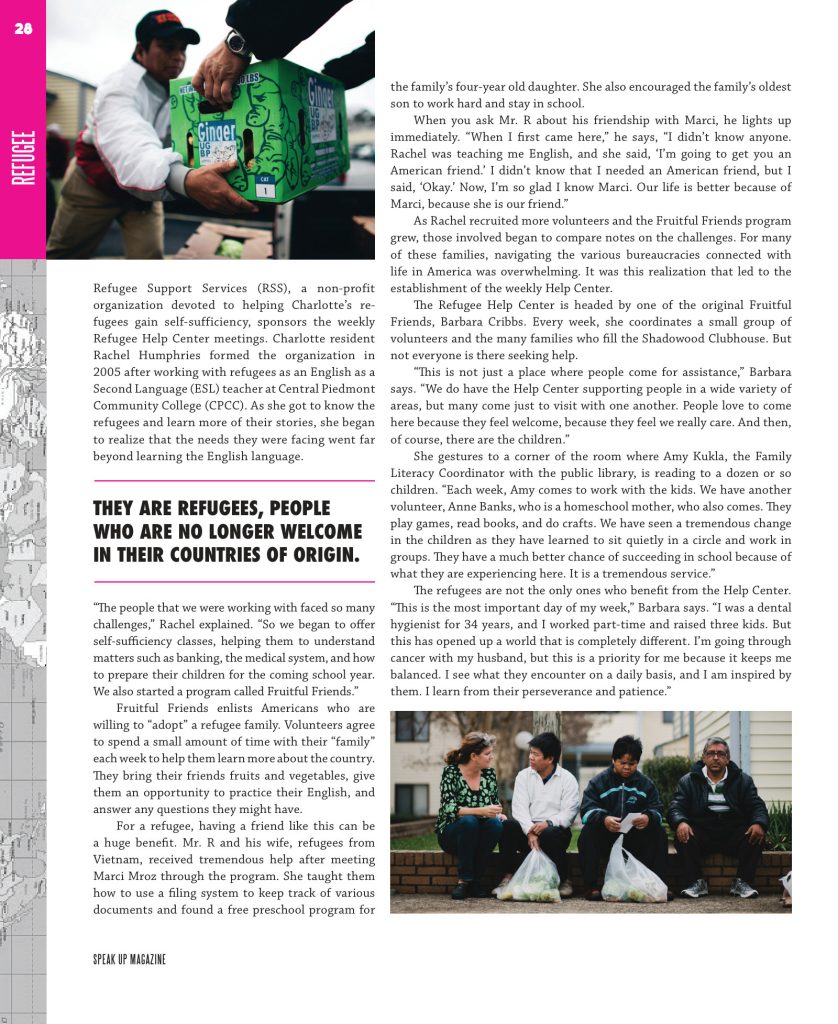
the family’s four-year old daughter. She also encouraged the family’s oldest
son to work hard and stay in school.
When you ask Mr. R about his friendship with Marci, he lights up
immediately. “When I first came here,” he says, “I didn’t know anyone.
Rachel was teaching me English, and she said, ‘I’m going to get you an
American friend.’ I didn’t know that I needed an American friend, but IREFUGEE
said, ‘Okay.’ Now, I’m so glad I know Marci. Our life is better because of
Marci, because she is our friend.”
As Rachel recruited more volunteers and the Fruitful Friends program
grew, those involved began to compare notes on the challenges. For many
of these families, navigating the various bureaucracies connected with
life in America was overwhelming. It was this realization that led to the
Refugee Support Services (RSS), a non-profit establishment of the weekly Help Center.
organization devoted to helping Charlotte’s re- The Refugee Help Center is headed by one of the original Fruitful
fugees gain self-sufficiency, sponsors the weekly Friends, Barbara Cribbs. Every week, she coordinates a small group of
Refugee Help Center meetings. Charlotte resident volunteers and the many families who fill the Shadowood Clubhouse. But
Rachel Humphries formed the organization in not everyone is there seeking help.
2005 after working with refugees as an English as a “This is not just a place where people come for assistance,” Barbara
Second Language (ESL) teacher at Central Piedmont says. “We do have the Help Center supporting people in a wide variety of
Community College (CPCC). As she got to know the areas, but many come just to visit with one another. People love to come
refugees and learn more of their stories, she began here because they feel welcome, because they feel we really care. And then,
to realize that the needs they were facing went far of course, there are the children.”
beyond learning the English language. She gestures to a corner of the room where Amy Kukla, the Family
Literacy Coordinator with the public library, is reading to a dozen or so
children. “Each week, Amy comes to work with the kids. We have another
volunteer, Anne Banks, who is a homeschool mother, who also comes. They THEY ARE REFUGEES, PEOPLE
WHO ARE NO LONGER WELCOME playin thegames,childrenreadasbooks,they haveand dolearnedcrafts.toWesithavequietlyseenina atremendouscircle and workchangein
IN THEIR COUNTRIES OF ORIGIN. groups. They have a much better chance of succeeding in school because of
what they are experiencing here. It is a tremendous service.”
The refugees are not the only ones who benefit from the Help Center.
“The people that we were working with faced so many “This is the most important day of my week,” Barbara says. “I was a dental
challenges,” Rachel explained. “So we began to offer hygienist for 34 years, and I worked part-time and raised three kids. But
self-sufficiency classes, helping them to understand this has opened up a world that is completely different. I’m going through
matters such as banking, the medical system, and how cancer with my husband, but this is a priority for me because it keeps me
to prepare their children for the coming school year. balanced. I see what they encounter on a daily basis, and I am inspired by
We also started a program called Fruitful Friends.” them. I learn from their perseverance and patience.”
Fruitful Friends enlists Americans who are
willing to “adopt” a refugee family. Volunteers agree
to spend a small amount of time with their “family”
each week to help them learn more about the country.
They bring their friends fruits and vegetables, give
them an opportunity to practice their English, and
answer any questions they might have.
For a refugee, having a friend like this can be
a huge benefit. Mr. R and his wife, refugees from
Vietnam, received tremendous help after meeting
Marci Mroz through the program. She taught them
how to use a filing system to keep track of various
documents and found a free preschool program for
SPEAK UP MAGAZINE
Page 29
29
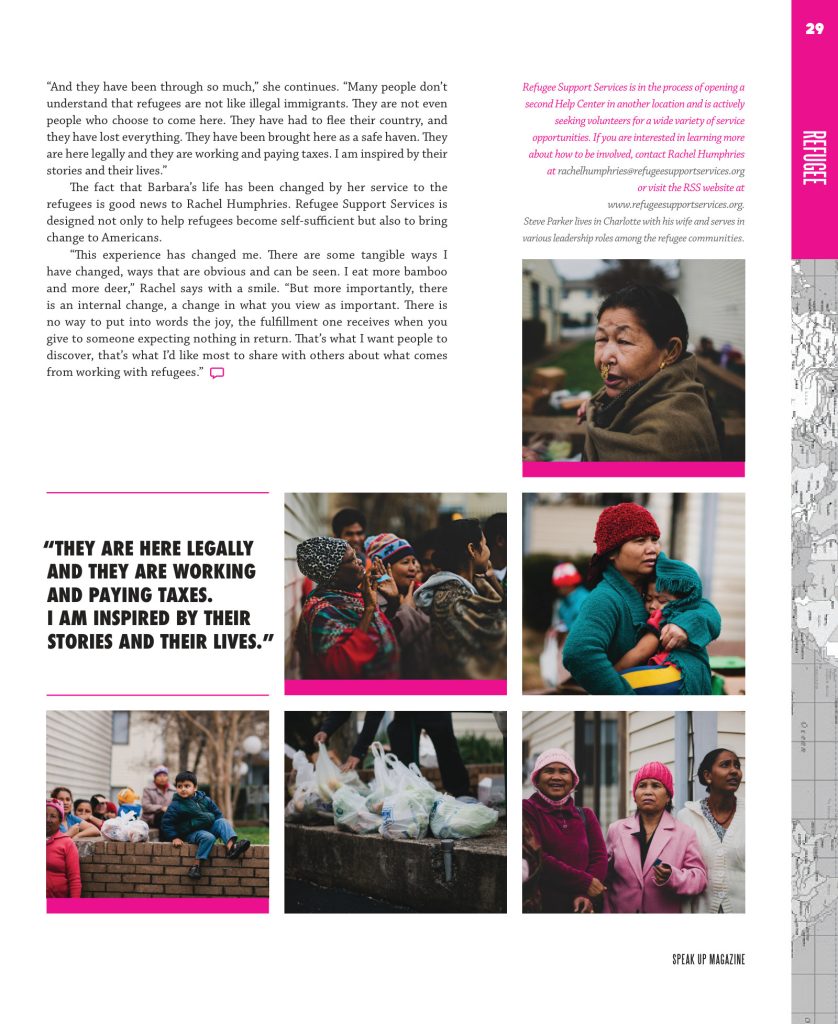
“And they have been through so much,” she continues. “Many people don’t Refugee Support Services is in the process of opening a
understand that refugees are not like illegal immigrants. They are not even second Help Center in another location and is actively
people who choose to come here. They have had to flee their country, and seeking volunteers for a wide variety of service
they have lost everything. They have been brought here as a safe haven. They opportunities. If you are interested in learning more
are here legally and they are working and paying taxes. I am inspired by their about how to be involved, contact Rachel Humphries
stories and their lives.” at rachelhumphries@refugeesupportservices.org REFUGEE
The fact that Barbara’s life has been changed by her service to the or visit the RSS website at
refugees is good news to Rachel Humphries. Refugee Support Services is www.refugeesupportservices.org.
designed not only to help refugees become self-sufficient but also to bring Steve Parker lives in Charlotte with his wife and serves in
change to Americans. various leadership roles among the refugee communities.
“This experience has changed me. There are some tangible ways I
have changed, ways that are obvious and can be seen. I eat more bamboo
and more deer,” Rachel says with a smile. “But more importantly, there
is an internal change, a change in what you view as important. There is
no way to put into words the joy, the fulfillment one receives when you
give to someone expecting nothing in return. That’s what I want people to
discover, that’s what I’d like most to share with others about what comes
from working with refugees.”
“THEY ARE HERE LEGALLY
AND THEY ARE WORKING
AND PAYING TAXES.
I AM INSPIRED BY THEIR
STORIES AND THEIR LIVES.”
SPEAK UP MAGAZINE
Page 30
LL
DD
77 ParkerParker
DrDr
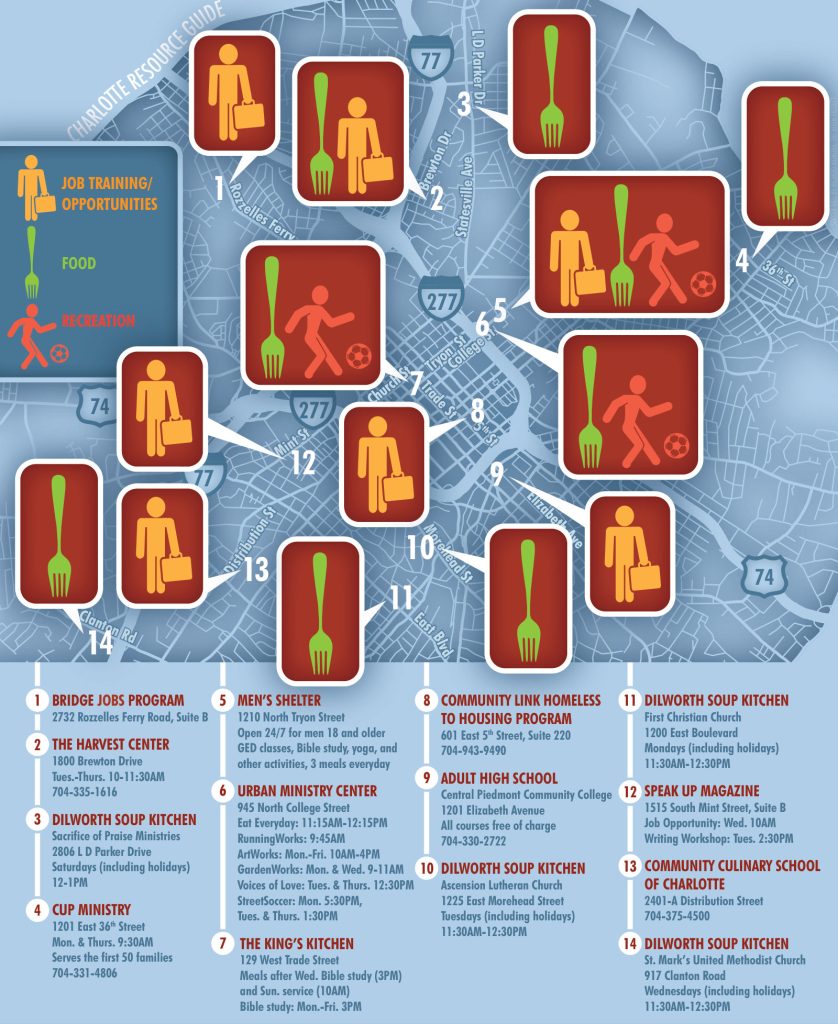
PROJECT 3
NOUN
THE DrDr
ee MOREIRA,
AvAv
ee RICARDO JOB TRAINING/ BrewtonBrewton BY 1RozRoz villvill BALL OPPORTUNITIES zz 2 elleselles SOCCER StatesStates FerryFerry
FOOD 4 36th36th36th StStSt
277 5 RECREATION 6StSt
TryonTryonCollegeCollegeStSt
StSt7 ChurchChurch TradeTrade 74 277 StSt 8 5th5th StSt
MintMint StSt
12 77 9
StSt ElizabethElizabeth
10 AveAve MoreheaMorehea DistributionDistribution dd 13 StSt 74
11
ClantonClanton EastEast RdRd BB lvlv 14 dd
1 BRIDGE JOBS PROGRAM 5 MEN’S SHELTER 8 COMMUNITY LINK HOMELESS 11 DILWORTH SOUP KITCHEN
2732 Rozzelles Ferry Road, Suite B 1210 North Tryon Street TO HOUSING PROGRAM First Christian Church
Open 24/7 for men 18 and older 601 East 5th Street, Suite 220 1200 East Boulevard
2 THE HARVEST CENTER GED classes, Bible study, yoga, and 704-943-9490 Mondays (including holidays)
1800 Brewton Drive other activities, 3 meals everyday 11:30AM-12:30PM
Tues.-Thurs. 10-11:30AM 9 ADULT HIGH SCHOOL
704-335-1616 6 URBAN MINISTRY CENTER Central Piedmont Community College 12 SPEAK UP MAGAZINE
945 North College Street 1201 Elizabeth Avenue 1515 South Mint Street, Suite B
3 DILWORTH SOUP KITCHEN Eat Everyday: 11:15AM-12:15PM All courses free of charge Job Opportunity: Wed. 10AM
Sacrifice of Praise Ministries RunningWorks: 9:45AM 704-330-2722 Writing Workshop: Tues. 2:30PM
2806 L D Parker Drive ArtWorks: Mon.-Fri. 10AM-4PM
Saturdays (including holidays) GardenWorks: Mon. & Wed. 9-11AM 10 DILWORTH SOUP KITCHEN 13 COMMUNITY CULINARY SCHOOL
12-1PM Voices of Love: Tues. & Thurs. 12:30PM Ascension Lutheran Church OF CHARLOTTE
StreetSoccer: Mon. 5:30PM, 1225 East Morehead Street 2401-A Distribution Street
4 CUP MINISTRY Tues. & Thurs. 1:30PM Tuesdays (including holidays) 704-375-4500
1201 East 36th Street 11:30AM-12:30PM
Mon. & Thurs. 9:30AM 7 THE KING’S KITCHEN 14 DILWORTH SOUP KITCHEN
Serves the first 50 families 129 West Trade Street St. Mark’s United Methodist Church
704-331-4806 Meals after Wed. Bible study (3PM) 917 Clanton Road
and Sun. service (10AM) Wednesdays (including holidays)
Bible study: Mon.-Fri. 3PM 11:30AM-12:30PM
Page 31
“SPEAK UP FOR THOSE
WHO CANNOT SPEAKABOUT FOR THEMSELVES, FOR
THE RIGHTS OF ALL WHO
More than a Magazine
Speak Up Magazine is a 501(c)3 non-profit based inCharlotte, NC. The purpose is two-fold: to give a voice ARE DESTITUTE. SPEAK
and to provide employment for vulnerably-housed
and homeless individuals. As you’ve read, the contentis focused on issues of social justice, poverty and UP AND JUDGE FAIRLY;
homelessness. In addition to the magazine, Speak Up
facilitates other projects that support this mission:such as weekly writing workshops and an publication DEFEND THE RIGHTS OF
that is 100% written by street writers.
Vendor Initiative THE POOR AND NEEDY.”
Speak Up offers an income opportunity for homeless
and low-income people. Vendors buy copies of Speak Up
Magazine for $1, then sell the magazine for $4, keepingthe proceeds. This provides a legitimate alternative to PROVERBS 31:8-9
panhandling and dependency on social services, which
leads to dignity and hope. This is a based on a model
that is successful in hundreds of cities around the globe
and has touched the lives of a quarter of a million low-
income individuals since the early 1990s.
Get Involved Support
Volunteers are essential to so much of what goes on Speak Up relies upon the financial support of readers like you. We are
at Speak Up. This magazine was produced with the sustained by a variety of individual donors, small businesses and places of
support and contributions of dozens of volunteers. worship. Speak Up is a growing organization with an increasing impact, and
Regular needs at Speak Up are for writing and reporting, every contribution extends our reach. Please consider partnering with a one-
photography, video capture, video production, design, time gift, recurring support or an organizational sponsorship.
fundraising, promotion, life skills training, financial Give now and learn more: speakupmag.org/donate
literacy training, sales training, administrative work, VOLUME1•ISSUE1
office staffing and more. STAYINFORMED.HELPTHENEEDY.GETINVOLVED. $3.00
We love college students of all ages. Speak Up VOLUME 2 • ISSUE 1 sTaY inFORmeD, HeLp THe neeDY, geT inVOLVeD. $4.00
has hosted interns from a variety of local colleges–
including Johnson and Wales, Davidson College, andQueens University. DUMPSTER
INTERVIEW:To inquire about any of these opportunities, visit: CharlotteDIVING Rocker FOR John mark mcmillan
www.speakupmag.org/help
HOT ISSUES: AWARENESS Halogen TV Takes (anddinner) INTERVIEWon sex Trafficking Indie Rocker
URBAN DenisonWitmer PIONEERS GRASSROOTS: The Store Billboards Become Bags Where and Change LivesGRASSROOTS Everything’sFree
58:“Homeless?Livewithus!”
MORESCAN CONTENTCODEFORInfographic by: Eric Gorman SPEAKUPMAG.ORG/MONTHLY PARKOURProjectIsaiah
Speak Up • Issue 1 • 1
speak up magazine INCHARLOTTE
Page 32
THIS MAGAZINE CREATES
JOBS AND GIVES HOPE.
THANK YOU TO ALL OUR SPONSORS
www.freedomgroups.com www.lakeshorecf.com www.iamthatlady.com
The School Store
www.theschoolstore.org www.justatwig.com www.warehouse242.org
Thank You supporters, volunteers and donors:
Banks Baker, Amy Bennett, Kyle and Shannon Boyd, Audrey Branch, Bryant Brown, Denise Burkard, Cajun Canvas, Nate Casey, Grace
Chang, Brent and Stephanie Christy, Bobby and Jen Catoe, John Clarke, Dean and Fiona Copley, Shirley Crandall, Steve Crimi, John
and Lindsay DaCosta, Marc Dickmann, Noah Driver, Tracy Driver, Faith in the Family International, Phil and Marilyn Felten, Troy and
Christina Felten, Robert and Tracy Forquer, Jason Gilmore, Nikki Godfrey-Hill, Lauren Greutman, Harry Griffin, Margaret Haynes,
Joe Helms, Ron and Rose Hinckley, Sam Hinkley, Steven Hodgen, Chuck Jarrett, Paul and Chrissy Jaselskis, Jonathan Jones, Alyson
Joyner, Jaime Kesler, Lisa Koons, Steve and Peggi Knowe, Late 4 Dinner, Lakeshore Christian Fellowship, Eve Lane, Carol Lantis, Glenna
Leamer, Bryan K. Lewis, Joshua Lewis, Owen and Lauren Lienhard, Chase Lovins, Charles and Edie Matthewson, Edwin and Mary Ann
Matthewson, James Matthewson, Seth and Haley McCord, Shelly McWilliams, Shelli Merritt, Bobby and Lisa Moody, Brian and Joy
Morykon, Chelsea Murdock, Chris Murphy, Dave and Ann Nelson, Susan Orrell, Ashlyn Ouellette, Mark and Cynthia Penzien, Jameya
Porter, Shannon Presler, Chris and Cheryl Price, Susan Puffer, Cal and Lea Queener, Jill Rokos, Jon and Keri Schafer, Patrick Selvey, Ben
and Celia Shaw, Bill and Deb Shaw, Corban and Lydia Shaw, Cesar Silva, Bruce and Kathy Simpson, Emily Simpson, Josh and Whitney
Skeans, Angela Snyder, Sharon Snyder, Social Venture Partners, Sandra Stiles, Stevan and Jill Talevski, Kate Tracy, Toye Tyler, Vision
Possible Ministries, Inc., Rise Ward, Warehouse 242 Church, Bill Whitley, Lianna Wlasiuk, Kylie Wyman, Todd and Wendy Wyman.