












1 / 32
Read as text
Page 1
VOLUME 2 • ISSUE 1 STAY INFORMED, HELP THE NEEDY, GET INVOLVED. $4.00
INTERVIEW:
Charlotte Rocker
John Mark McMillan
HOT ISSUES:
Halogen TV Takes on
Sex Trafficking
GRASSROOTS:
Billboards Become Bags
and Change Lives
PARKOUR
SPEAK UP MAGAZINEINCHARLOTTE
Page 2
Executive Director
Matt Shaw THIS MAGAZINE CREATES Managing Editor
Lana Shaw
Designer + Illustrator JOBS AND GIVES HOPE. Carol Lantis
Copy Editors
Phil Felten, Samantha Reed
Contributors
Leo Babauta, Rob Burbank,
Christina Felten, Hollis Johnson,
Keia Mastrianni, Matt Shaw,
Emily Simpson
Photographers
Eartha Goodwin, Norman Latva,
Dustin Manning, Elizabeth Marx,
Josh Putnam, Emily Simpson,
Speak Up is a Street Magazine: Street magazines and newspapers are independent Deb, Shaw, Jenna Thomas
publications distributed primarily by homeless and and vulnerably-housed people,
giving them a unique work opportunity. After successfully completing the initial training Vendor Support
and signing to a code of conduct, these Speak Up vendors receive a uniform and Rob Burbank
temporary ID badge. The first five magazines are free—giving even the poorest people
a chance to start working. Vendors then purchase subsequent copies for $2.00, Marketing
keep the cash from every sale and buy more as needed. This creates a cycle of self- Traci Panik
sufficiency that leads to dignity and hope.
Modern Global Impact: Speak Up is an associate member of the North Board of Directors
American Street Newspaper Association, which connects and supports over 45 street Phil Felten, Troy Felten,
newspapers and magazines throughout North America. Since 1994, modern street Lisa Koons, Cesar Silva ,
papers have provided opportunity and hope to over 250,000 homeless and severely Bruce Simpson
disadvantaged people around the world. For more information, including a street
paper startup guide, go to nasna.org. Cover Photo by Jenna Thomas
SPEAK UP MAGAZINE IS A 501(C)(3) PUBLIC CHARITY. 512 E. 15TH STREET, SUITE 1, CHARLOTTE, NC 28206
SPEAK UP MAGAZINE
Page 3
CONVERSATIONS
Mitch 8
4 LETTERfrom the Editor
URBAN PIONEERS
Needing Moore 20
COVER STORY
Parkour Charlotte 14
VENDOR STORY
GRASSROOTS CHARLOTTE Ruth 28 Hope Through Stitches 5 MUSIC
John Mark McMillan 23
HOT ISSUES
Halogen TV: Tainted Love 11
LIVE WELL CONTENTS: 30 Make Life Effortless
ON THE WEBSITE: For article supplements, additional photos and more, go to speakupmag.org/issue2
SPEAK UP MAGAZINE
Page 4
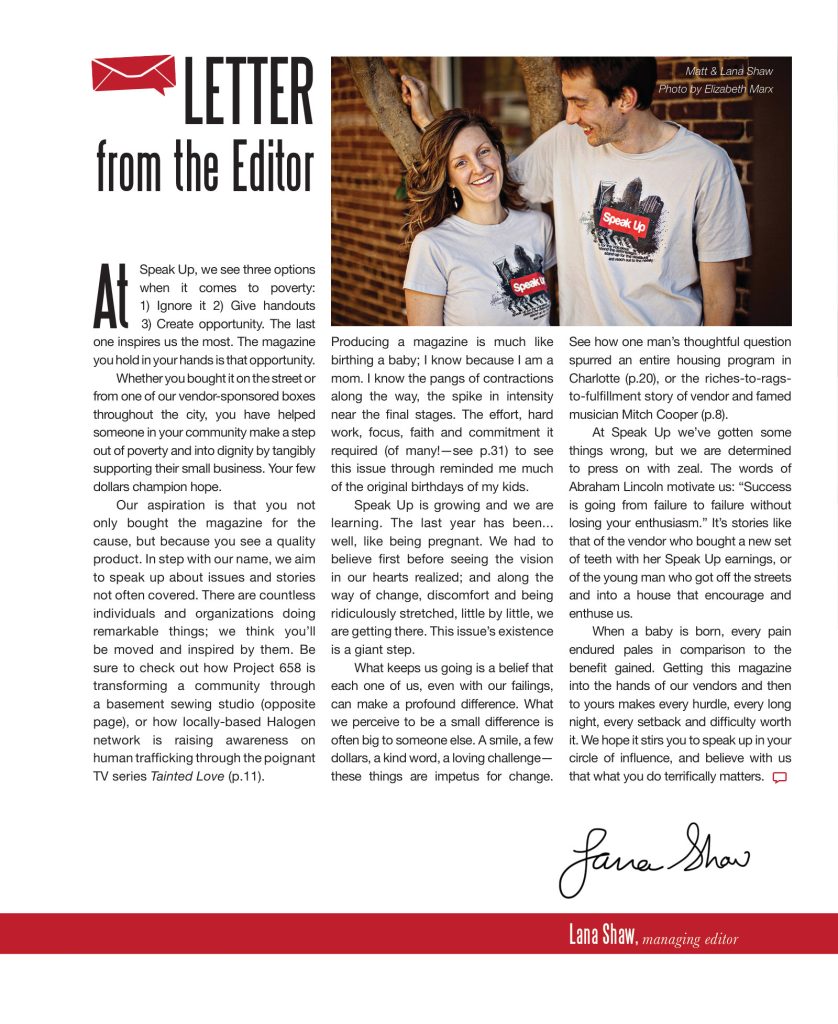
Matt & Lana Shaw
Photo by Elizabeth Marx LETTER
from the Editor
Speak Up, we see three options
when it comes to poverty:
1) Ignore it 2) Give handouts
3) Create opportunity. The lastAt
one inspires us the most. The magazine Producing a magazine is much like See how one man’s thoughtful question
you hold in your hands is that opportunity. birthing a baby; I know because I am a spurred an entire housing program in
Whether you bought it on the street or mom. I know the pangs of contractions Charlotte (p.20), or the riches-to-rags-
from one of our vendor-sponsored boxes along the way, the spike in intensity to-fulfillment story of vendor and famed
throughout the city, you have helped near the final stages. The effort, hard musician Mitch Cooper (p.8).
someone in your community make a step work, focus, faith and commitment it At Speak Up we’ve gotten some
out of poverty and into dignity by tangibly required (of many!—see p.31) to see things wrong, but we are determined
supporting their small business. Your few this issue through reminded me much to press on with zeal. The words of
dollars champion hope. of the original birthdays of my kids. Abraham Lincoln motivate us: “Success
Our aspiration is that you not Speak Up is growing and we are is going from failure to failure without
only bought the magazine for the learning. The last year has been… losing your enthusiasm.” It’s stories like
cause, but because you see a quality well, like being pregnant. We had to that of the vendor who bought a new set
product. In step with our name, we aim believe first before seeing the vision of teeth with her Speak Up earnings, or
to speak up about issues and stories in our hearts realized; and along the of the young man who got off the streets
not often covered. There are countless way of change, discomfort and being and into a house that encourage and
individuals and organizations doing ridiculously stretched, little by little, we enthuse us.
remarkable things; we think you’ll are getting there. This issue’s existence When a baby is born, every pain
be moved and inspired by them. Be is a giant step. endured pales in comparison to the
sure to check out how Project 658 is What keeps us going is a belief that benefit gained. Getting this magazine
transforming a community through each one of us, even with our failings, into the hands of our vendors and then
a basement sewing studio (opposite can make a profound difference. What to yours makes every hurdle, every long
page), or how locally-based Halogen we perceive to be a small difference is night, every setback and difficulty worth
network is raising awareness on often big to someone else. A smile, a few it. We hope it stirs you to speak up in your
human trafficking through the poignant dollars, a kind word, a loving challenge— circle of influence, and believe with us
TV series Tainted Love (p.11). these things are impetus for change. that what you do terrifically matters.
Lana Shaw, managing editor
SPEAK UP MAGAZINE
Page 5
5
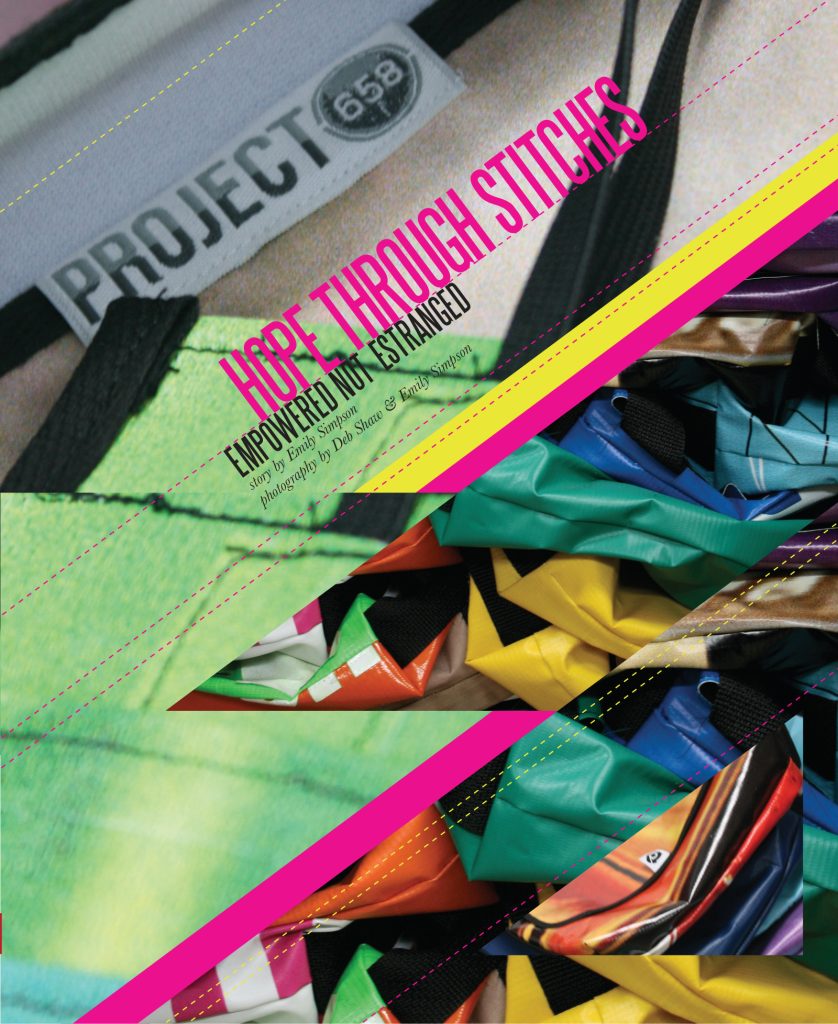
GRASSROOTS
CHARLOTTE STITCHES
THROUGH ESTRANGED Simpson NOT Emily &HOPE SimpsonShaw
EmilybyDeb by EMPOWERED story photography
SPEAK UP MAGAZINE
Page 6
6
CHARLOTTE the basement of a church off Central Avenue, obscurity many refugees face in a new culture by offering on-the-job In dignity is being restored. It’s not through anything training, English tutoring, personal finances education, relationship
glamorous; on the contrary, with Project 658, management, community events and a way to earn money.
hope is found in the mundane. Project 658’s vocational training outreach, initially called the
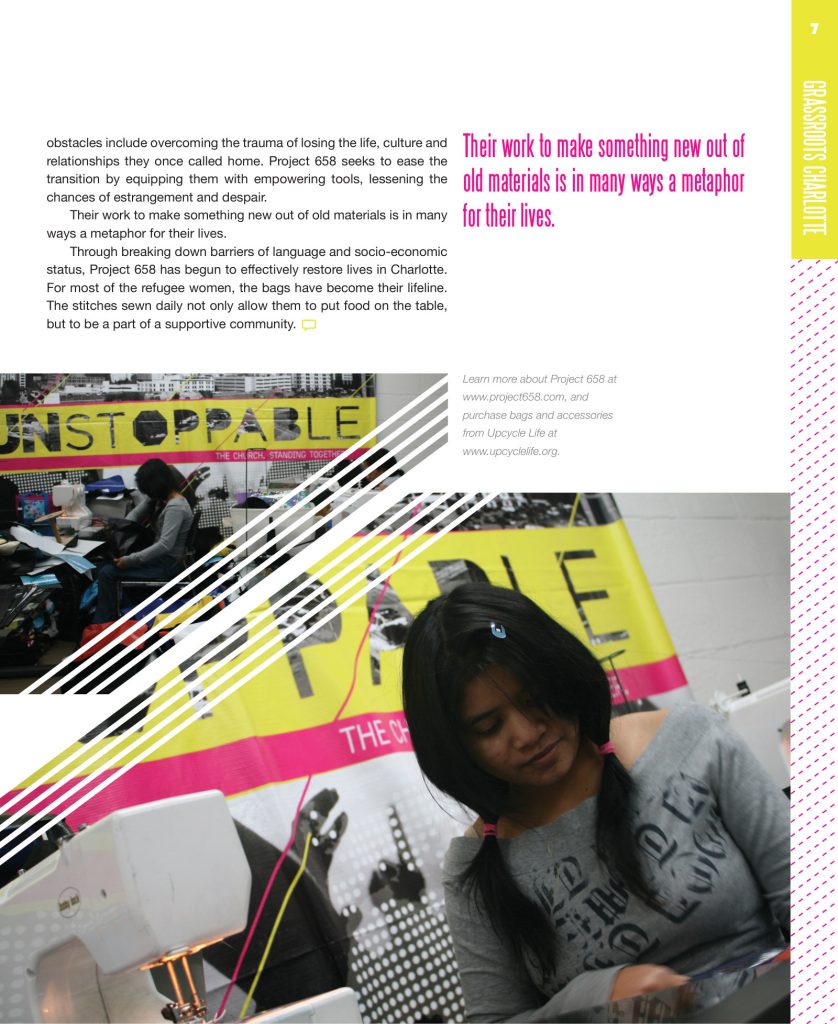
Pler, a 21-year-old refugee from Southeast [Create] Project, gives women a chance to make money and learnGRASSROOTS Asia, looks up from her sewing machine, her dark sewing skills. Recently the [Create] Project spun off to become
pigtails swinging slightly. On her right a chalkboard Upcycle Life, a self-sustaining not-for-profit business. In the past
displays a scripture in English, Jorai and Nepali. two years, approximately 27,000 tote bags made from repurposed
On the walls are pictures and names of the women vinyl billboards have been created in Project 658’s studio. The studio
who work there, their faces conveying promise. buzzes five days a week with hard work, laughter and conversations
Aimed at community transformation and in several languages. The smiles of Vietnamese and Nepali women—
refugee empowerment, Project 658 is the humble and compassionate, perhaps due to their own hardships—
Charlotte-based ministry of Sports Outreach graciously welcome newcomers.
Institute (SOI). Deriving its name from the Bible, CC Reynolds, Local Ministry Coordinator for SOI and Project 658’s
where Jesus says, “I am the true bread that came studio manager, says being a part of a team that creates something
down from heaven—anyone who eats this bread is a way for the women to foster friendships. Though they come
will not die, but live forever” (John 6:58), the from varying backgrounds, each woman’s desire to belong and have
grassroots initiative is bringing hope to Charlotte purpose are the same, so finding common ground comes naturally.
residents from a variety of nations. Project 658 “God has made us all with those desires, some just have bigger
proactively fights against the isolation and obstacles to overcome,” CC shares. For most refugees, those
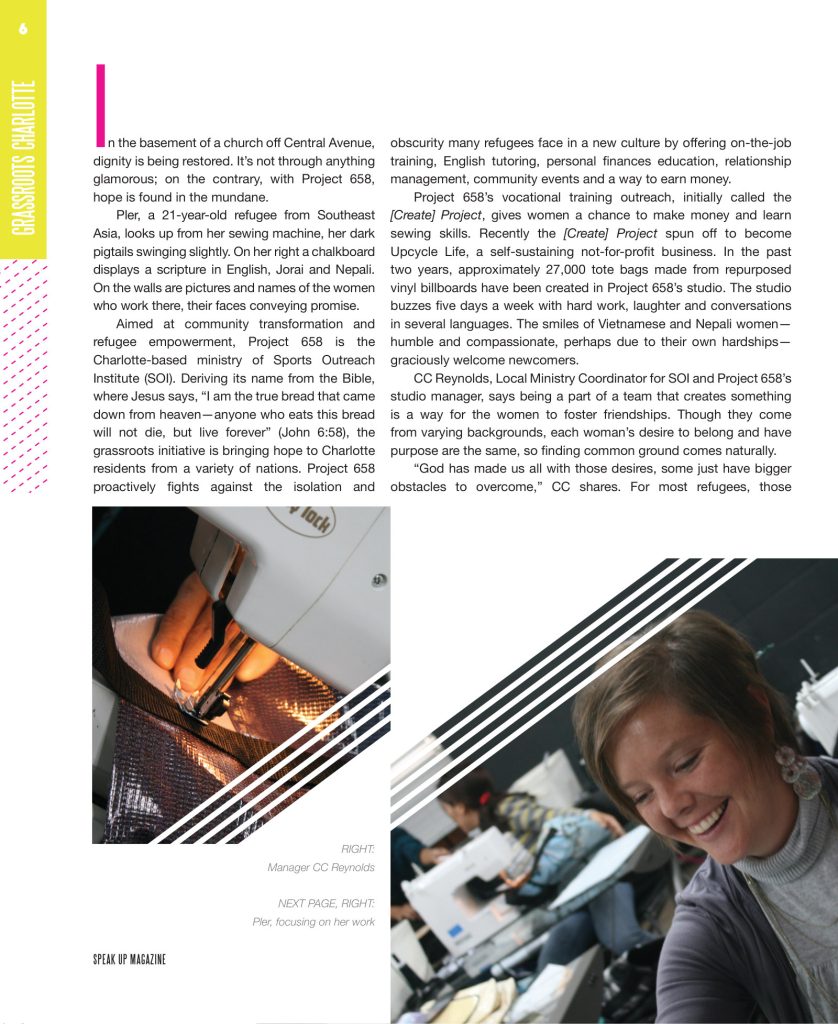
RIGHT:
Manager CC Reynolds
NEXT PAGE, RIGHT:
Pler, focusing on her work
SPEAK UP MAGAZINE
Page 7
7
obstacles include overcoming the trauma of losing the life, culture and Their work to make something new out of GRASSROOTSrelationships they once called home. Project 658 seeks to ease the
transition by equipping them with empowering tools, lessening the old materials is in many ways a metaphor
chances of estrangement and despair.
Their work to make something new out of old materials is in many for their lives. CHARLOTTEways a metaphor for their lives.
Through breaking down barriers of language and socio-economic
status, Project 658 has begun to effectively restore lives in Charlotte.
For most of the refugee women, the bags have become their lifeline.
The stitches sewn daily not only allow them to put food on the table,
but to be a part of a supportive community.
Learn more about Project 658 at
www.project658.com, and
purchase bags and accessories
from Upcycle Life at
www.upcyclelife.org.
SPEAK UP MAGAZINE
Page 8
8
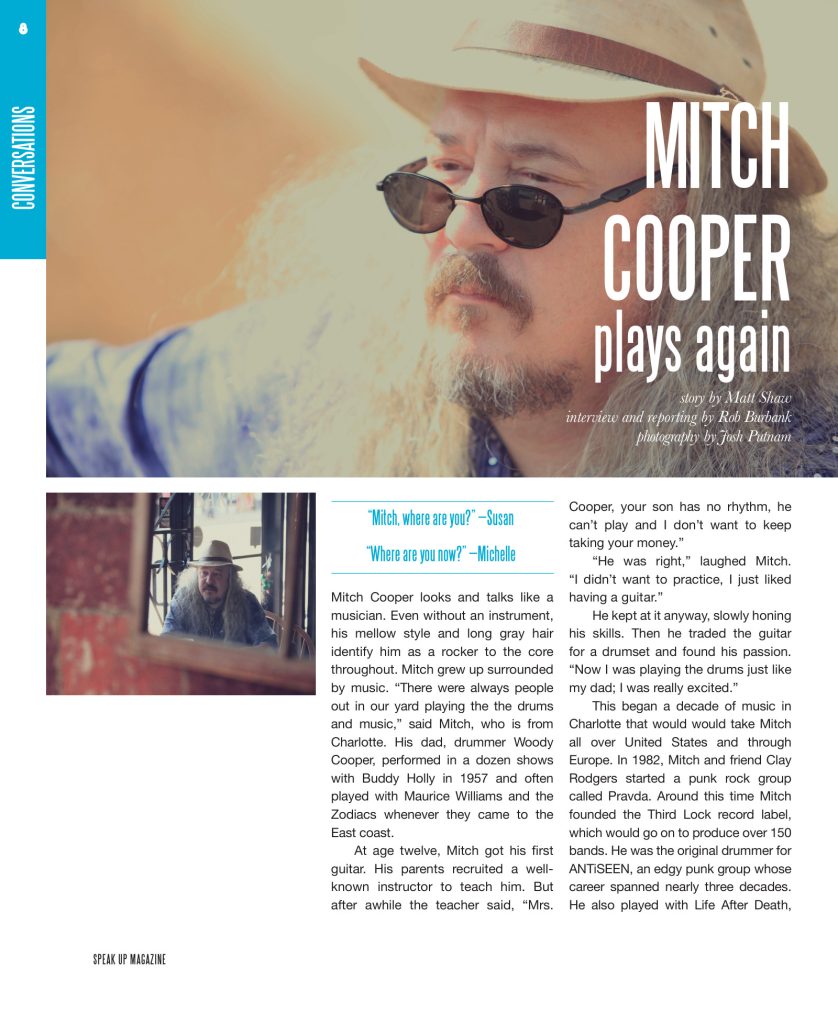
MITCHCONVERSATIONS
COOPER
plays again
story by Matt Shaw
interview and reporting by Rob Burbank
photography by Josh Putnam
Cooper, your son has no rhythm, he
“Mitch, where are you?” —Susan can’t play and I don’t want to keep
taking your money.”
“Where are you now?” —Michelle “He was right,” laughed Mitch.
“I didn’t want to practice, I just liked
Mitch Cooper looks and talks like a having a guitar.”
musician. Even without an instrument, He kept at it anyway, slowly honing
his mellow style and long gray hair his skills. Then he traded the guitar
identify him as a rocker to the core for a drumset and found his passion.
throughout. Mitch grew up surrounded “Now I was playing the drums just like
by music. “There were always people my dad; I was really excited.”
out in our yard playing the the drums This began a decade of music in
and music,” said Mitch, who is from Charlotte that would would take Mitch
Charlotte. His dad, drummer Woody all over United States and through
Cooper, performed in a dozen shows Europe. In 1982, Mitch and friend Clay
with Buddy Holly in 1957 and often Rodgers started a punk rock group
played with Maurice Williams and the called Pravda. Around this time Mitch
Zodiacs whenever they came to the founded the Third Lock record label,
East coast. which would go on to produce over 150
At age twelve, Mitch got his first bands. He was the original drummer for
guitar. His parents recruited a well- ANTiSEEN, an edgy punk group whose
known instructor to teach him. But career spanned nearly three decades.
after awhile the teacher said, “Mrs. He also played with Life After Death,
SPEAK UP MAGAZINE
Page 9
9
Diggin Up Betty and then joined with The Inn moved the party house to a new In 1993, coming back from a show
the eclectic rock band Fetchin Bones. location on 7th street, which Mitch said, with a suitcase full of cash, Mitch was
In 1986, he produced the self-titled “became a fiasco.” Drug use, arrests for robbed. “It was brutal, guns pointing
album “Mitch Cooper” and then moved nudity and a constant flow of visitors and at my head.” Not long after, in a third
into a big house on Central Avenue with partying led to violations and constant party house, he was robbed again.
a collection of other musicians. run-ins with the law. “We had like 100 “There were a bunch of guns—over
“The house turned into a hippie people paying $10 each to stay there,” $75,000 worth of art, cash and propertyhangout, it was a big party place. Mitch said. Eventually the police shut the was stolen.” CONVERSATIONS
We were a number one destination in house down. The experiences freaked him out
[pro-cannabis] “High Times” magazine, Drug abuse began to take its toll and he quit playing music. “I didn’t
people came from all different countries and there was a lot of turnover among want anyone to know who I was
to party with us.” the band. After seven years of leading anymore. I was scared of strangers
It was from there that Mitch and The Inn, Mitch was the only original coming up to me and saying, ‘Hey
Tony Farina started “The Inn”. For Mitch, member remaining. Mitch, what’s up?’”
this was somewhat of a departure from
his previous punk rock efforts. Instead
of drumming, he was now the the lead
songwriter, singer and guitarist. The
sound was trippy and psychedelic.
Extended musical freak outs and
freeform riffing defined much of the
group’s early style. There was lots of
tie-dye and the band handed out LSD
(acid) at concerts. They signed with
Voxx Records, from Burbank, CA, and
began touring and playing all over the
country and in Europe, often opening
for big-names like Blues Traveler.
“We made nice amounts of money
and lived high on the hog,” said Mitch.
“Please play San Francisco soon.” —Chris
“Are you ever going to play again? Portland in 1991
was my favorite show.” —Danny
“I saw The Inn in London 1991. If anyone knows
when he is playing please let me know.” —John
Psychedelic drugs were a part of The
Inn’s appeal and the band’s lifestyle.
“The Inn was in High Times a bunch of
times,” Mitch remembered. “We were
a pot-smoking, LSD-taking band. I’ve
done LSD about 3,000 times.”
It was a fast and wild time.
SPEAK UP MAGAZINE
Page 10
10
One of Mitch’s friends reached out to bit of the time…when I first got into this
him and put him in a methadone clinic, program, I just about starved myself so
where we was able to break free from I could save up and buy a guitar. The
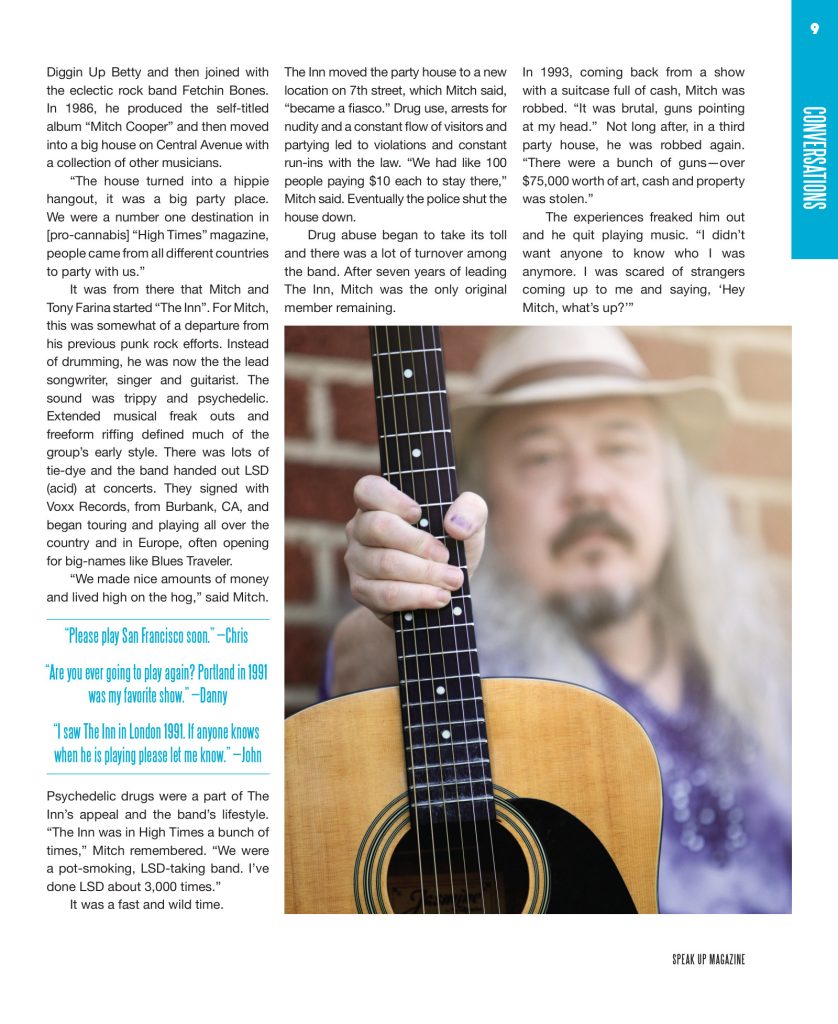
his addiction to heroin. acoustic guitar and I—we’ve come
After the clinic he returned to the together again.”
streets. “The dates are kind of blurry, Mitch Cooper had a vibrant and
but I was homeless for about four visible music career. He was on top of
years.” he said. “I was off heroin, but the world and then he disappeared. OverCONVERSATIONS
was having mental problems. I stayed the course of a decade he was a hermit,
in shelters, with friends—I was in and homeless, addicted and overwhelmed
out of mental hospitals.” by his demons. But he wasn’t forgotten.
“I wasn’t taking care of myself—I The internet message boards and fan
He moved out of the city and began didn’t care about anything or anyone.” websites (quoted throughout) tell a
renting a house in Lake Norman with the He attempted suicide multiple times. “I story of a widely beloved musician.
hope of getting a new start on life. He remember standing on the edge of the And now he’s coming back and people
tried other things—telecommunications, Hawthorne Bridge for an hour thinking are noticing.
becoming a chef (“Julia Child was my about jumping, and nobody stopped He’s been playing with with Dave
hero”)—but nothing worked out. He me.” He spent time in Broughton Curley (on banjo) and William Nance
maintained ownership of the Third Lock Hospital, one of the state’s psychiatric (violin)—they’ve formed The Hillbilly 3,
record label but was disconnected from facilities—“absolute hell,” he said. which has a unique bluegrass sound.
the music scene. The whole time, his Then things began to shift. In He’s still the head of Third Lock records
drug use was out of control. At one the summer of 2011 he got into a and is working on a four disc set
point he was spending over $600 a day transitional program that helped him compiling the best of Prairie Prince,
on heroin. turn around. “I don’t want to mention a musician and artist. And he’s been
By 2005, Mitch Cooper had spent where I’m staying, but this place takes talking with some of original members
all of his money and was evicted from homeless people and gives them a of The Inn—they’re looking to do a
the house. He came back to Charlotte chance to get their lives started over. reunion get-together in December.
They saved my life.” Regardless of what the future holds,
“Where are you? You can come back again. “When I was homeless and ad fame and money will never drive Mitch
Don’t give up.” —Nan dicted, I lost all my self-esteem. I lost my Cooper again. He talks a lot about
teeth. I lost my hair. I lost everything. But wanting to help those who were once
“Mitch, I hope you are okay and will I’m happy now, I wake up in a bed. I’m where he was. “I want to live simply and
content. I’ve found a good church and give back. I want a stranger to become
play out soon.” —Dawn a great girlfriend. I feel more successful my friend. I want to see Charlotte
now than I did when I was making tons become zero percent homeless.”
“Mitch, where are you? I heard you were of money playing music.”
in a mental ward. If so, I hope In July 2012, Mitch celebrated the “I just saw Mitch play with Tom Constanten of
you get well soon.” —Susan seventh anniversary kicking the heroin the Grateful Dead! Killer show.” —Pete
habit. Since then he’s shed a lot of other
and began renting an apartment with baggage. “I don’t have any money. But “I just paid $150 for a signed copy of a Mitch
a friend. But things went south when I’ve never been so rich in my life as I
Cooper CD. I don’t feel ripped off.” —Zack they got into a nasty fight, and his am this very second. Everything’s good,
roommate got a restraining order and man. Everything’s good. I’m so happy
changed the locks. with life right now.” Congratulations to Mitch, who got engaged
“Overnight I became homeless,” True to his heritage and passion, just before this magazine went to press.
he said. “I had spent all my money, the Mitch Cooper is playing music again. For updates about his performance schedule
drug habit was horrible, I was sick.” “My guitar is now in my hand a good go to: speakupmag.org/issue2
SPEAK UP MAGAZINE
Page 11
11
HOT
ISSUES
story by Hollis Johnson
illustration by Carol Lantis
I was nine when it began. I would leave my
family’s house in the evenings before my
father came home from work and go to
my pimp. There, I would be used sexually,
maybe two to three times. When it was over
for the night, I would bring the money back
to my family, never letting my father find out
the truth. My grandmother and aunt knew;
they were the ones who sold me…
Paraphrase of Maly’s* interview
with producers from the television
series Tainted Love
*Real names not used.
SPEAK UP MAGAZINE
Page 12
12
ISSUES
HOT a village outside of Phnom Penh, Halogen’s motto of “be the change” is the standard by which all
Cambodia, Maly’s nightmare was its programming is tested.
also her reality. She estimates “Tainted Love” is a Halogen original series focused on on
99 percent of the children in exposing the realities of foreign and domestic sex trafficking.
her village were being sexually The show is built around interviews with survivors, experts,
exploited at that time. She has since been and workers at nongovernmental organizations who share IN
rescued and is regaining her life with the aid of the stories of atrocities happening to children and adults
an organization designed to help victims of sex around the globe.
trafficking. Though the number of child victims in The series has been filmed in various locations in the
her village has slightly decreased, her older sister U.S. and around the world. During a recent shoot in Thailand
is still trapped in the industry. and Cambodia, this article’s author joined the “Tainted Love”
The United Nations Office on Drugs and production crew for an up close look inside a horrific industry.
Crime recently reported that “2.4 million people The team landed in Bangkok, Thailand, where they mixed in with
across the globe are victims of human trafficking many visiting tourists. According to an undercover investigator
at any one time, and 80 percent of them are being interviewed on the series, an estimated 60 percent of male
exploited as sexual slaves…only one out of 100 foreigners visiting Thailand are sex tourists. The country’s sex
victims of trafficking is ever rescued.” industry generates nearly $5 billion in annual revenue, according
According to the U.S. Department of Health to a 2003 report.
and Human Services, sex trafficking is “a modern- Prostitution has been illegal 2.4 MILLION PEOPLE
day form of slavery in which a commercial sex in Thailand since 1960. However, ACROSS THE GLOBE
act is induced by force, fraud, or coercion, or in the suggestive young women, ARE VICTIMS OF HUMAN
which the person induced to perform such an act ladyboys (young men dressed TRAFFICKING AT ANY ONE
is under the age of 18 years.” as women) and neon lights of TIME, AND 80 PERCENT
The issue of human trafficking has risen in Bangkok’s various red light OF THEM ARE BEING
the public consciousness in recent years, largely districts reveal a vibrant un- EXPLOITED AS SEXUAL
thanks to the efforts of advocacy organizations regulated industry. SLAVES…ONLY ONE
and independent media outlets. Among those, While there, the Tainted Love OUT OF 100 VICTIMS
Charlotte-based Halogen TV is a leading voice. crew interviewed various groups OF TRAFFICKING IS
Halogen TV was founded by Becky Henderson fighting against the sex industry. EVER RESCUED.
in response to what she saw as a deficit in NightLight, an organization with
social justice programming. Halogen is a socially offices in Los Angeles, Atlanta, and Bangkok, focuses on the
conscious entertainment network that encourages rescue and recovery of women trapped in the sex trade. There
and motivates individuals to “be the change” they the women gain valuable tools to help them reintegrate into
want to see in the world. The network derived its society, develop work skills and become independent.
name from a group of chemicals on the periodic Another featured organization, Urban Light in Chiang
table called halogens that must stay connected to Mai, Thailand, works with young male victims. Founded by
survive, are unique and diverse, and are not yet an American woman who was shocked by the lack of help
fully discovered. Halogen TV regards its viewers offered to boys in the sex trade, the organization provides a
on those same three principles, believing in a center with daily programs where they can experience love
rising generation of change-makers. Currently and safety, with the ultimate goal of instilling in them a new
available in 15 million households across the U.S., hope for their future. (See sidebar)
SPEAK UP MAGAZINE
Page 13
13
HOT
Agape International Missions (AIM) in Cambodia provides ISSUES
comprehensive rescue and recovery services. AIM offers TRAPPED
recovery to survivors through their Restoration Center, where
former victims are cared for holistically. AIM reaches out to BY DUTY AND
traffickers, pimps and clients through the Lord’s Gym, a free
workout center where the IGNORANCE
ALONGSIDE THE EMOTIONAL staff builds relationships
STORIES OF RESCUE AND HOPE, with the hope of drawing Although they are victims of sexual
THE SHOW’S CREATORS HAVE them out of the industry. exploitation, most boys didn’t come to the
TRIED TO ILLUSTRATE WAYS THAT AIM also targets the trade in chains. Many were sent from small
VIEWERS CAN GET INVOLVED. families and communities villages to make money for their families.
ravaged by the trade A sense of family duty and responsibility
through Rahab’s House, community centers that offer daily to provide often drives one or all siblings
kids’ clubs, weekly church services, free medical clinics and to prostitution. During the day these boys,
schools. Several of their buildings are strategically located many around the age of 16, play and laugh
near Maly’s village, outside of Phnom Penh, known for its and tease one another—a sharp contrast
child sex slaves and a destination for pedophiles worldwide. to their nighttime behavior, where they do
Alongside the emotional stories of rescue and hope, the anything to sell themselves to male clients.
show’s creators have tried to illustrate ways that viewers can The plight of boys across Thailand
get involved. Producer Tamara Park wants audiences to stay and Cambodia is harrowing. There aren’t
informed on what is happening. She says, “Many of these many organizations helping them, and the
organizations have stateside stores where [viewers] can use demand for boys within the sex industry
their purchasing power to help support the dignity of those is increasing. A further complication is the
women and children who have come out of sexual exploitation.” local perspective that boys are too resilient
TV programming can be a lot like the seamy red light districts and strong to be victims.
in Bangkok, where: “what the customer wants, the customer One young man who shared his story
gets.” The existence of programming like “Tainted Love” shows confided that even now that he is out of
that there is an appetite for honest, sensitive exposure of some the industry, he still feels the stress of
of humanity’s most shameful subjects. Halogen TV’s motto of providing adequately for his family. Urban
“be the change” begins with what consumers feed themselves. Light’s founder shared the story of bringing
Ultimately those appetites will serve either the industry that the boy home with money he had earned
creates victims or the one that sets them free. outside of prostitution. His mother said,
“That’s it? That’s all you have to give us?”
Tainted Love airs on Halogen TV Thursday evenings (5:00-7:00pm) The amount of money often matters more
and Saturday afternoons (3:00-4:00pm) on TimeWarner cable on than the means of getting it, a pressure
channel 282 in the Charlotte viewing area. difficult for many victims to withstand.
For more information on Halogen TV and
Tainted Love, go to: http://halogentv.com
For additional links to organizations mentioned
and other info, go to: http://www.speakupmag.org/issue2
SPEAK UP MAGAZINE
Page 14
14
story by Matt Shaw
photography by Jenna Thomas
PARKOUR
INCHARLOTTE
SPEAK UP MAGAZINE
Page 15
15
COVER PHOTO:
Steven Erdmanczyk does a tic tac off a wall.
LEFT:
Tony Kenmore utilizes his whole body
in the cat leap to the rail.
TOP RIGHT:
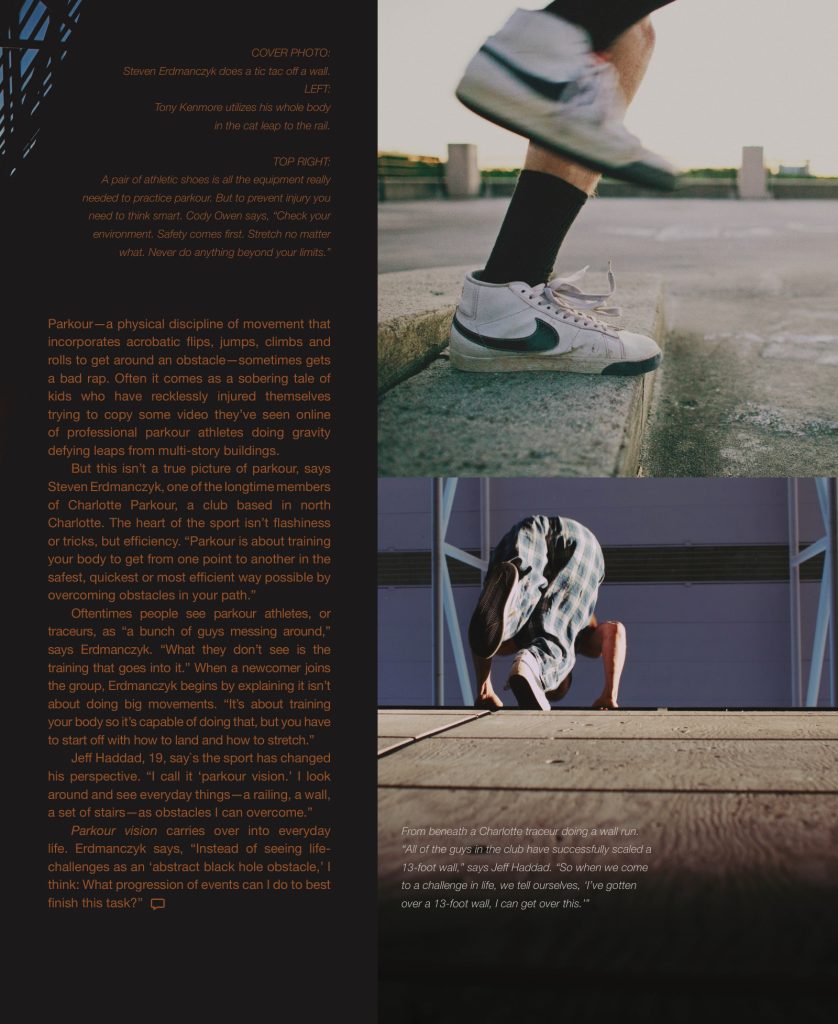
A pair of athletic shoes is all the equipment really
needed to practice parkour. But to prevent injury you
need to think smart. Cody Owen says, “Check your
environment. Safety comes first. Stretch no matter
what. Never do anything beyond your limits.”
Parkour—a physical discipline of movement that
incorporates acrobatic flips, jumps, climbs and
rolls to get around an obstacle—sometimes gets
a bad rap. Often it comes as a sobering tale of
kids who have recklessly injured themselves
trying to copy some video they’ve seen online
of professional parkour athletes doing gravity
defying leaps from multi-story buildings.
But this isn’t a true picture of parkour, says
Steven Erdmanczyk, one of the longtime members
of Charlotte Parkour, a club based in north
Charlotte. The heart of the sport isn’t flashiness
or tricks, but efficiency. “Parkour is about training
your body to get from one point to another in the
safest, quickest or most efficient way possible by
overcoming obstacles in your path.”
Oftentimes people see parkour athletes, or
traceurs, as “a bunch of guys messing around,”
says Erdmanczyk. “What they don’t see is the
training that goes into it.” When a newcomer joins
the group, Erdmanczyk begins by explaining it isn’t
about doing big movements. “It’s about training
your body so it’s capable of doing that, but you have
to start off with how to land and how to stretch.”
Jeff Haddad, 19, say`s the sport has changed
his perspective. “I call it ‘parkour vision.’ I look
around and see everyday things—a railing, a wall,
a set of stairs—as obstacles I can overcome.”
Parkour vision carries over into everyday From beneath a Charlotte traceur doing a wall run.
life. Erdmanczyk says, “Instead of seeing life- “All of the guys in the club have successfully scaled a
challenges as an ‘abstract black hole obstacle,’ I 13-foot wall,” says Jeff Haddad. “So when we come
think: What progression of events can I do to best to a challenge in life, we tell ourselves, ‘I’ve gotten
finish this task?” over a 13-foot wall, I can get over this.’”
SPEAK UP MAGAZINE
Page 16
16
TOP LEFT:
Steven Erdmanczyk easily vaults over a railing. While
the sport carries inherent risks, data from Parkour
Visions, a nonprofit club based in Seattle, showed
a low injury rate of 1.3 injuries per 1,000 parkour
practice hours—far less than traditional sports.
BOTTOM LEFT:
Renato Varga performs a precision jump over a
stairwell. “There’s freedom and fun in what we’re
doing—we get to be creative. Stairs aren’t just
stairs…they’re a thing you can run up and flip off.”
RIGHT:
“Parkour is basically play-based exercise,” says
Erdmanczyk. “A lot of people don’t like exercise
because they think it’s work or don’t like the gym.
With Parkour you just go out and
find something to climb on.”
SPEAK UP MAGAZINE
Page 18
18
LEFT:
Tony Kenmore loves the adrenaline
rush that comes with completing a
new challenge. “I’ve been actively
involved with parkour for almost
two years. But I’ve been doing the
things people would call parkour or
freerunning all my life. When I grew
up there wasn’t much to do—so we
just climbed trees, jumped off things
and played chicken with ladders.”
Here he backflips off a wall.
RIGHT: CHARLOTTE PARKOUR:
At the top of a parking garage, For information on classes, practice
Renato Varga gap jumps over a times and parkour theory, go to
five-story chasm. www.charlotteparkour.com
SPEAK UP MAGAZINE
Page 20
20
PIONEERS
URBAN
NEEDING MO(O)RE
how the answer to one question became a
solution for Charlotte’s chronically homeless
story by Keia Mastrianni & photography by Dustin Manning, Norman Latva
ABOVE CENTER: “You mean to tell me, you do all this at the time was chronically homeless.
Moore Place, home to many good in the day and then lock them out “That book haunted me,” Izard
to the bad at night? Does that make shares. As she tells it, the book kept
ABOVE RIGHT: any sense to you?” her awake at night until one day she
Denver Moore Kathy Izard, Urban Ministry Center emailed the authors asking them to
(UMC) volunteer and former board speak at the UMC. To her surprise, Hall
member, vividly remembers the day returned her email and agreed to come.
Denver Moore spoke these words. It What followed was a luncheon
was a question she had never asked on November 16, 2007, which would
herself in 15 years of volunteering— become the first of the annual fundraising
and one that would subsequently help True Blessings Luncheons. The day
create a housing project never before before the event, Kathy took Denver
seen in the Queen City. Since January, on a tour of the UMC that showcased
85 of Charlotte’s chronically homeless the services offered there, including the
adults have called Moore Place home. soup kitchen, Artworks program and
“Meeting Denver Moore changed community garden.
my path in ways I never saw coming” She describes Moore as a man of
says Izard. few words. “He doesn’t speak much, but
It started when Kathy read Same when he does, it seems to come from
“Kind of Different as Me,” by Ron Hall an otherworldly place.” During the tour,
and Denver Moore. It told the story of Denver kept his hands in his pockets,
an unlikely friendship between Hall, an staying silent. Finally, he spoke.
affluent art collector, and Moore, who “Where are the beds?”
SPEAK UP MAGAZINE
Page 21
21
URBAN
PIONEERS
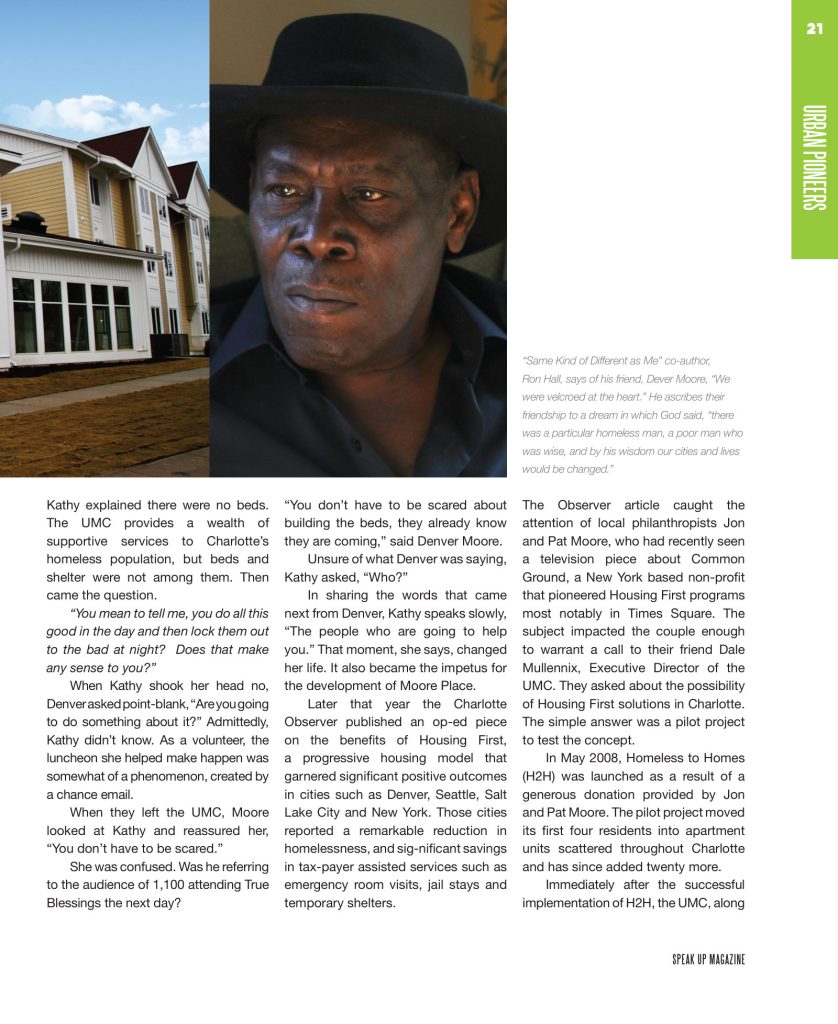
“Same Kind of Different as Me” co-author,
Ron Hall, says of his friend, Dever Moore, “We
were velcroed at the heart.” He ascribes their
friendship to a dream in which God said, “there
was a particular homeless man, a poor man who
was wise, and by his wisdom our cities and lives
would be changed.”
Kathy explained there were no beds. “You don’t have to be scared about The Observer article caught the
The UMC provides a wealth of building the beds, they already know attention of local philanthropists Jon
supportive services to Charlotte’s they are coming,” said Denver Moore. and Pat Moore, who had recently seen
homeless population, but beds and Unsure of what Denver was saying, a television piece about Common
shelter were not among them. Then Kathy asked, “Who?” Ground, a New York based non-profit
came the question. In sharing the words that came that pioneered Housing First programs
“You mean to tell me, you do all this next from Denver, Kathy speaks slowly, most notably in Times Square. The
good in the day and then lock them out “The people who are going to help subject impacted the couple enough
to the bad at night? Does that make you.” That moment, she says, changed to warrant a call to their friend Dale
any sense to you?” her life. It also became the impetus for Mullennix, Executive Director of the
When Kathy shook her head no, the development of Moore Place. UMC. They asked about the possibility
Denver asked point-blank, “Are you going Later that year the Charlotte of Housing First solutions in Charlotte.
to do something about it?” Admittedly, Observer published an op-ed piece The simple answer was a pilot project
Kathy didn’t know. As a volunteer, the on the benefits of Housing First, to test the concept.
luncheon she helped make happen was a progressive housing model that In May 2008, Homeless to Homes
somewhat of a phenomenon, created by garnered significant positive outcomes (H2H) was launched as a result of a
a chance email. in cities such as Denver, Seattle, Salt generous donation provided by Jon
When they left the UMC, Moore Lake City and New York. Those cities and Pat Moore. The pilot project moved
looked at Kathy and reassured her, reported a remarkable reduction in its first four residents into apartment
“You don’t have to be scared.” homelessness, and sig-nificant savings units scattered throughout Charlotte
She was confused. Was he referring in tax-payer assisted services such as and has since added twenty more.
to the audience of 1,100 attending True emergency room visits, jail stays and Immediately after the successful
Blessings the next day? temporary shelters. implementation of H2H, the UMC, along
SPEAK UP MAGAZINE
Page 22
22
with key individuals in the community, within a 20-block radius. Chambre,
got to work on Moore Place. The UMC a native Charlottean, soon returned
recruited Common Ground to assist. home to become the Director of
Representing the New York non-profit Housing Programs for the UMC.
was Caroline Chambre, who served as The opportunity to contribute to
technical advisor to the survey. bringing a Housing First model to herPIONEERS Chambre came with extensive hometown was one she could not miss.
experience, having managed a per- Since then Chambre, joined by
manent supportive housing building many Charlotteans, has nurtured theURBAN
in Times Square that single-handedly housing development to fruition. “Moore
reduced homelessness by 87 percent Place is an opportunity for Charlotte to
say that homelessness is a solvable
problem,” says Chambre.
To Chambre, Moore Place is a
viable beginning, something that
can be replicated. To Jon and Pat
Moore, it’s the hoped-for fruit of their
seed money. To Kathy Izard, it’s the
miracle she never dreamed of until a
question. And to Denver Moore, who
passed away March 2012, it was the
answer he was looking for: a new
housing frontier for the homeless in
Charlotte.
TOP CENTER:
Tenant Samuel Anthony
OTHER IMAGES:
Commonplace
amenities make a world
of difference to those
who have been without.
SPEAK UP MAGAZINE
Page 23
23
John Mark McMillan looks like a fearsome
bearded giant. If you meet him, chances
are he’s the tallest person you’ll see that
day—at six feet four inches, he towers
above most humans. John Mark is the MUSIC kind of guy you’d probably pick to be on
your side in a basketball game, reaching
match or street fight. “Even if he can’t
throw a good punch, he’ll scratch ‘em
with his beard!”
His stage presence supports this
impression. At a recent concert in Charlotte,
his economy of speech contrasted with the
over-shares that mark many song intros.
Of one song, he said, “This is Economy,”
stepped back from the microphone, looked
at his band-mates, banged hard on the
guitar and yelled, “It’s not about money!”
John Mark sings and plays rhythmic
rock and roll music with a gospel element.
His voice is deep and powerful, with a
john mark mcmillan the interview
by Matt Shaw
photos provided by John Mark McMillan
SPEAK UP MAGAZINE
Page 24
24
mournful urgency. “Raise your voice, chase away John Mark: Absolutely. Nothing is perfect. But even if a small
the ghost, the pain the haunts the heart, the things chunk of that tourism results in someone doing something, it’s worth
we fear the most…” it. I think it’s really important that people see the world. Anything that
Up close his eyes reveal a gentle and warm helps educate us as to how other people live is a good thing. Especially
personality. They twinkle and crinkle above a because more people are living the way people I met in Uganda live. The
generous face that’s quick to spread into smile. most shocking thing on that trip was how unbelievably full of life and joyMUSIC His presence bespeaks a relaxed humility. He they were. They had nothing and yet they were very happy people.
showed up for this interview on a hot Charlotte
day wearing flip flops, dress pants rolled un- Speak Up: A couple years ago you were involved in a project
evenly up to his ankles and a cardigan sweater called, “I Dreamed There Was a Fountain” for which you wrote the title
over a deep v-neck t-shirt. track. What was that?
Speak Up: As a well-known musician, John Mark: I had some friends that started digging wells
you’ve got a voice. What do you speak up for? in Africa. This friend of mine, Matt Peterson, wanted to end the water
crisis in the whole continent of Africa. He did the figures and it’s
John Mark: I’ve spoken up for people something like the money spent on one American Christmas would
in Africa who need water, and am currently eliminate the water crisis for an entire continent. So, they started
speaking up for needy children in developing selling bottled water [to raise funds for wells].
countries. As an artist I have a lot of different I wanted to help and I loved the idea of having a product to sell to
things to say within the art itself, but we’ve done generate funds and long-term momentum. So I got with some friends
specific things for those particular issues. of mine and we decided to do the album. We found people to donate
the mixing, sound mastering and studio time. All the artists donated
Speak Up: You’re an Artist Ambassador their work. It continues to generate money–they’ve dug a lot of wells
for Compassion. What does that mean? because of it.
John Mark: Basically I help spread Speak Up: How do you describe your music?
the word on what Compassion does. Their model
is to find children in developing countries and John Mark: Man, it’s always weird when you have to
connect them with people who can help fund their describe your own music because it’s like describing your own face.
journey. The goal is to help develop the children What do you look like? I know I’m tall, and I’m white. And I have a
holistically: economically, socially, spiritually and beard. You know what I mean?
in their education. I think we are sometimes folk rock, roots rock. Some just call it
I’ve met kids who have gone through the rock and roll. But there’s definitely gospel in what we do. Some people
whole system and become lawyers and doctors. call it worship music. A lot of the songs are written with the folk idea in
I’ve met kids who grew up in the dirt. Literally in mind. Most of the Economy album was written on an acoustic guitar,
the dirt. In Uganda they’ve had kids come out but then it ended up being much more rock-driven songs.
of the slums through the Compassion program
and become political leaders in the country. So Speak Up: On your blog you referred to a Malcolm Gladwell
they literally have an impact on poverty in a whole article that suggests the reason people start smoking cigarettes is
nation because of working with the children. because it is dangerous. And then you transition into talking about
Jesus–implying you think Jesus is dangerous.
Speak Up: You went to Uganda a few
years ago with Compassion. Some people give John Mark: He is dangerous! Malcolm Gladwell basically
short-term mission trips a hard time. They call proves, or in an article he appears to prove the reason people smoke
them “feel good tours” and say that you should is because it’s bad for you. People continue smoking because of the
spend your $3,000 differently. Do you think people mental, physical or chemical addiction, but the reason most people
should take trips to a third world like Uganda? start is because of the danger.
SPEAK UP MAGAZINE
Page 25
25
the money spent
on one American
John Mark recently reissued an expanded and
Christmas would
remastered version of his first album,
eliminate the
“The Song Inside the Sounds of Breaking Down.”
water crisis
To learn more and listen to his music, visit
for an entire
www.thejohnmark.com.
continent. MUSIC
I think sometimes in the modern church we’ve
made Jesus safe, but he’s not safe. When he walked
into the temple and turned over tables and whipped
people with cords, you know? People he loved
went to jail, people he loved died because they
believed in him. And I think sometimes we want to
make Christianity easy and safe. I think some of the
very attractive aspects of Christianity is that it is not.
I’ve got a buddy of mine who talks about art, and
this is what I was getting at with Jesus and cigarettes.
He says the girls you fall in love with are not the girls
who give it all away. The girls who keep some of their
mystery are the ones you value, pursue, and the ones
you want to marry. Girls who walk around showing
their stuff are not nearly as interesting. Because
you’ve seen it and there it is. No mystery.
Art is the same–if you give it all away, you
give the listener or viewer no opportunity to join
in the conversation. You give it to them, they have
it, they’re done–fast food. But if you give them
just a little bit, you give them the opportunity to
pursue, to come further.
Lots of times in church we want to have every
answer laid out on a platter. People walk in, take
and leave. Sometimes it might help the Christian
community at large not to have all the answers.
The concept of God is a mysterious thing for a
reason. He is mysterious. Christ is a mystery.
Speak Up: You sing a lot about blood.
The majority of your songs on your last few
albums refer to blood explicitly.
John Mark: Yes. It’s funny, a lot
of people refer to the same pictures in their
SPEAK UP MAGAZINE
Page 26
26
writing. Look at Springsteen–he’s always singing about the road,
the street, cars, buses, transportation. Springsteen said it was
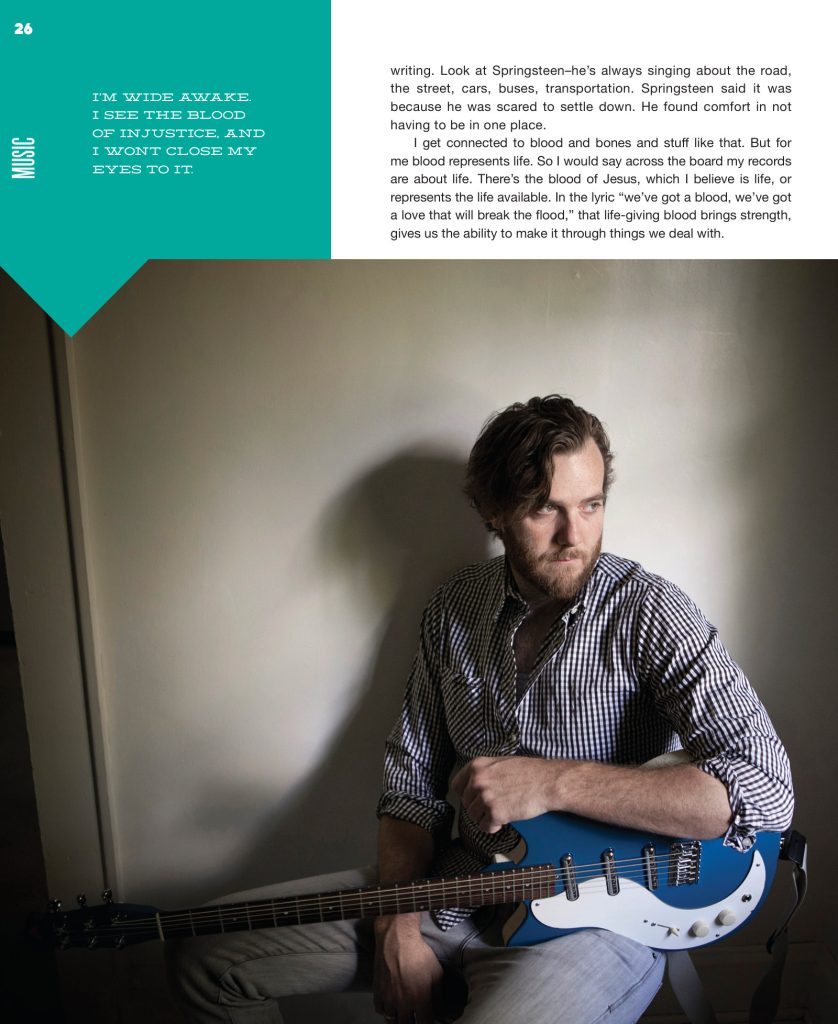
I’m wide awake.
because he was scared to settle down. He found comfort in not
I see the blood
having to be in one place.
of injustice, and
I get connected to blood and bones and stuff like that. But for
I wont close my
me blood represents life. So I would say across the board my recordsMUSIC eyes to it. are about life. There’s the blood of Jesus, which I believe is life, or
represents the life available. In the lyric “we’ve got a blood, we’ve got
a love that will break the flood,” that life-giving blood brings strength,
gives us the ability to make it through things we deal with.
SPEAK UP MAGAZINE
Page 27
27
But other lyrics like “blood on the promenade” speak of injustice, and a lot–not like Atlanta or Orlando–but there’s good
we all see it. It’s so clear it’s almost invisible. There’s blood on the music coming into Charlotte. It’s growing. And the
promenade, and when you grow up seeing something, it’s like it’s not culture in Charlotte is growing.
there. If you grow up seeing poverty, you don’t really see it. So in that I’d love to see Charlotte have an identity. I
case my mention of blood on the promenade is saying, “I’m here, I’m can only say this because I love Charlotte and I’ve
alive, I see it. I’m wide awake.” I see the blood of injustice, and I wont been here my whole life–Charlotte is very much a MUSICclose my eyes to it. city without an identity. Most people here weren’t
born in Charlotte. They might go root for the
Speak Up: In the video promo for “Economy” you said, “We’ve Panthers, but if the Panthers play the team where
had close friends pass away, we’ve seen divorce and some of us have they’re from, they turn against them. Charlotte has
had miscarriages.” Then later, “We’re kind of crushed but not destroyed loyalty issues. I’d love to see Charlotte become a
and there’s a lot of hope on this album.” Can you tell about a track that place where we are excited about who we are as a
you see as hopeful? community, as a people. Support and root for each
other–not just in sports, but in every area. To see
John Mark: Almost every song on the album was written people really get behind Charlotte and take pride
with a person I know in mind. Not that it’s written for them, like I’m and ownership in it, and see an identity develop.
singing to them, but I was looking at their situation and thinking, “How
could I sing from their perspective?” So I think there’s hope on the Speak Up: If someone were to visit
album. The album begins kind of tongue-in-cheek, “The devil’s dealing Charlotte and you were their tour guide, where
dirty in broken hearts and counterfeit currency.” And it ends with “You would you take them?
have called us loved and you have called us wanted; one time we were
bruised, we were bankrupt and haunted.” Basically, to me a lot of the John Mark: I would take them to
hope is the Christian hope, believing there is something more for us. Zada Jane’s for breakfast. The Diamond diner. Or
Pinky’s—I love Pinky’s. It depends—a lot of people
Speak Up: Have you told those people that you were thinking from out West will not eat fried pickles. They can’t
of their situation? take the fried food.
What else? I haven’t been out much since we
John Mark: No. Some of them tell me their favorite song had kids. There’s good music at the Gin Mill; we
and I’ll think, “I know that’s your favorite song, because I wrote it for go there once in a while to hear people play and
you.” But I don’t say that yet. I don’t think any of them know. sing. Freedom Park is also great.
Speak Up: Many people may sing a song of yours that have Speak Up: And where would you take
never even heard of you: “How He Loves.” What’s the origin of that? them to church?
John Mark: I wrote that song right after a friend of mine John Mark: I go to church at Queen
passed away in a car accident. I was sort of out of my mind. I’ve City Church on Sunday nights at the Visualite
always dealt with my issues through song. So I had a couple lines in a Theater, where my dad is the pastor. I’d bring
journal and thought it sounded like something I wanted to sing. I took them there since those are my people and the
those lines and sat down and wrote most of the song the day after he ones I have relationships with–it’s where I feel
died. It’s interesting how that song became such a popular song, out welcome. I walk in and I know people’s stories.
of a bad situation. Sometimes I don’t want to say their stories–
Speak Up: You’re from Charlotte and you live here. What Speak Up: –like, “Hey there’s the guy I
hopes do you have for the city? wrote ‘Economy’ for.”
John Mark: When I was in high school we would joke about John Mark: (laugh) Exactly. I love it be
how there is no music in Charlotte. That seems to be changing. There’s cause it feels like home to me. Just down home.
SPEAK UP MAGAZINE
Page 28
28
STORY
VENDOR
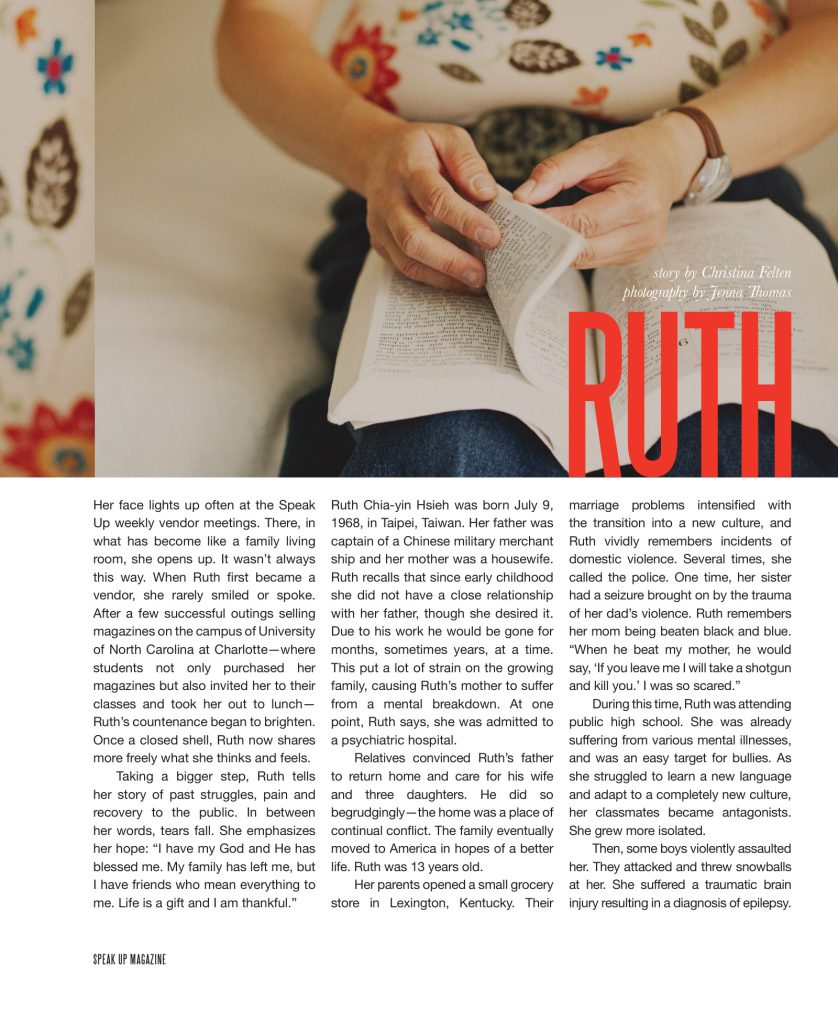
story by Christina Felten
photography by Jenna Thomas
Her face lights up often at the Speak Ruth Chia-yin Hsieh was born July 9, RUTHmarriage problems intensified with
Up weekly vendor meetings. There, in 1968, in Taipei, Taiwan. Her father was the transition into a new culture, and
what has become like a family living captain of a Chinese military merchant Ruth vividly remembers incidents of
room, she opens up. It wasn’t always ship and her mother was a housewife. domestic violence. Several times, she
this way. When Ruth first became a Ruth recalls that since early childhood called the police. One time, her sister
vendor, she rarely smiled or spoke. she did not have a close relationship had a seizure brought on by the trauma
After a few successful outings selling with her father, though she desired it. of her dad’s violence. Ruth remembers
magazines on the campus of University Due to his work he would be gone for her mom being beaten black and blue.
of North Carolina at Charlotte—where months, sometimes years, at a time. “When he beat my mother, he would
students not only purchased her This put a lot of strain on the growing say, ‘If you leave me I will take a shotgun
magazines but also invited her to their family, causing Ruth’s mother to suffer and kill you.’ I was so scared.”
classes and took her out to lunch— from a mental breakdown. At one During this time, Ruth was attending
Ruth’s countenance began to brighten. point, Ruth says, she was admitted to public high school. She was already
Once a closed shell, Ruth now shares a psychiatric hospital. suffering from various mental illnesses,
more freely what she thinks and feels. Relatives convinced Ruth’s father and was an easy target for bullies. As
Taking a bigger step, Ruth tells to return home and care for his wife she struggled to learn a new language
her story of past struggles, pain and and three daughters. He did so and adapt to a completely new culture,
recovery to the public. In between begrudgingly—the home was a place of her classmates became antagonists.
her words, tears fall. She emphasizes continual conflict. The family eventually She grew more isolated.
her hope: “I have my God and He has moved to America in hopes of a better Then, some boys violently assaulted
blessed me. My family has left me, but life. Ruth was 13 years old. her. They attacked and threw snowballs
I have friends who mean everything to Her parents opened a small grocery at her. She suffered a traumatic brain
me. Life is a gift and I am thankful.” store in Lexington, Kentucky. Their injury resulting in a diagnosis of epilepsy.
SPEAK UP MAGAZINE
Page 29
29
Ruth spent the next years living in It used to be that people would say
government housing and on the streets. ‘you’re a nobody’ and it would define
At 21, she was pregnant and alone. me. Now I don’t have to pretend to be
Admitted to a psychiatric ward, she somebody else, I can be me. Being
stayed until the birth of her daughter, unique and different is a very important VENDOR Sarah. Social Services arranged for part of my life. I used to want sympathy,
the baby to be adopted as Ruth had but I have learned to be strong on my been deemed incapable of caring own and to be closer with God. ” STORY
for Sarah. This separation caused Ruth admits, it’s not always easy.
unspeakable pain, and Ruth tried to She tries to take it one day at a time.
commit suicide several times in the “I’m still in the trauma sometimes,
aftermath of her daughter’s birth. “I because it’s like part of your brain. The
constantly overdosed over the next layers peel off, and it all comes back.
several years. I was in and out of the In those moments, when the pain is
psychiatric ward.” intense, I pray. I pray God will take it
Eventually, Ruth’s sisters married away. That He will be my miracle and
and one of them moved with her mother save me from my thoughts. Without
to Charlotte. Her sister wanted to help God I couldn’t make it. Really, I should
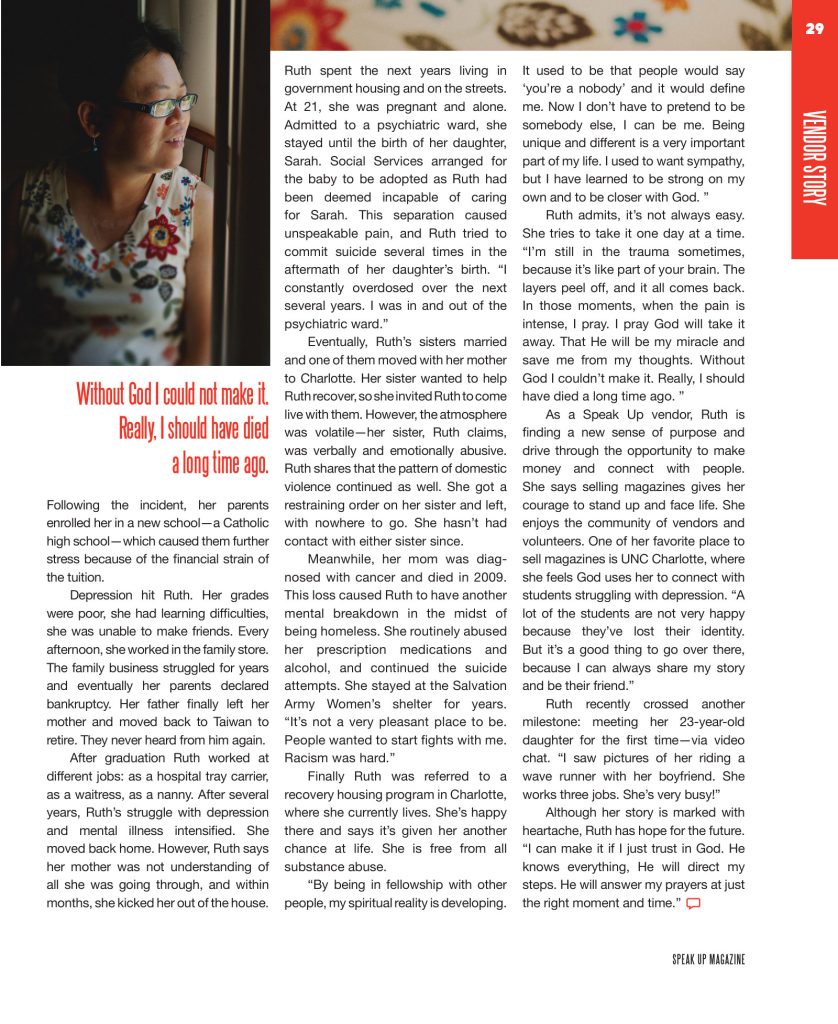
Ruth recover, so she invited Ruth to come have died a long time ago. ” Without God I could not make it.
live with them. However, the atmosphere As a Speak Up vendor, Ruth is
was volatile—her sister, Ruth claims, finding a new sense of purpose and Really, I should have died
was verbally and emotionally abusive. drive through the opportunity to make
a long time ago. Ruth shares that the pattern of domestic money and connect with people.
violence continued as well. She got a She says selling magazines gives her
Following the incident, her parents restraining order on her sister and left, courage to stand up and face life. She
enrolled her in a new school—a Catholic with nowhere to go. She hasn’t had enjoys the community of vendors and
high school—which caused them further contact with either sister since. volunteers. One of her favorite place to
stress because of the financial strain of Meanwhile, her mom was diag- sell magazines is UNC Charlotte, where
the tuition. nosed with cancer and died in 2009. she feels God uses her to connect with
Depression hit Ruth. Her grades This loss caused Ruth to have another students struggling with depression. “A
were poor, she had learning difficulties, mental breakdown in the midst of lot of the students are not very happy
she was unable to make friends. Every being homeless. She routinely abused because they’ve lost their identity.
afternoon, she worked in the family store. her prescription medications and But it’s a good thing to go over there,
The family business struggled for years alcohol, and continued the suicide because I can always share my story
and eventually her parents declared attempts. She stayed at the Salvation and be their friend.”
bankruptcy. Her father finally left her Army Women’s shelter for years. Ruth recently crossed another
mother and moved back to Taiwan to “It’s not a very pleasant place to be. milestone: meeting her 23-year-old
retire. They never heard from him again. People wanted to start fights with me. daughter for the first time—via video
After graduation Ruth worked at Racism was hard.” chat. “I saw pictures of her riding a
different jobs: as a hospital tray carrier, Finally Ruth was referred to a wave runner with her boyfriend. She
as a waitress, as a nanny. After several recovery housing program in Charlotte, works three jobs. She’s very busy!”
years, Ruth’s struggle with depression where she currently lives. She’s happy Although her story is marked with
and mental illness intensified. She there and says it’s given her another heartache, Ruth has hope for the future.
moved back home. However, Ruth says chance at life. She is free from all “I can make it if I just trust in God. He
her mother was not understanding of substance abuse. knows everything, He will direct my
all she was going through, and within “By being in fellowship with other steps. He will answer my prayers at just
months, she kicked her out of the house. people, my spiritual reality is developing. the right moment and time.”
SPEAK UP MAGAZINE
Page 30
ife can be a huge struggle most
of the time, and for years it was a
struggle for me. I’ve gradually been
learning what causes that struggle,L LIVE WELL
and what works in making life easier,
better, smoother.
Life can feel effortless, like you’re 7 Little Things that
gliding along, if you learn to swim
smoothly, to glide, to stop fighting
the waters of life and start using them Make Life Effortless
to buoy you up. I stopped thrashing
by Leo Babauta
and fighting, and started gliding and
enjoying the swim.
Below is a list of a few things you can 4. Clean as you go. with right now. Learn to focus completely
do now, to make life feel more effortless. Put things away when you’re done. on doing that one thing. Pay attention to
Take what you want from it. I find these Wash your bowl. Wipe the counters the life in the middle of each moment. Be
things work, but your mileage will vary. clean as you pass them. Sweep up joyful in it, grateful you’re able to do that
dirt when you notice it. By cleaning a task. You’ll learn that anything can be an
1. Do less. little bit at a time, the mess never gets amazing experience, a miracle. With the
This is my productivity mantra, and it’s too big, and cleaning up becomes people in your life—your kids especially—
counterintuitive. I actually don’t believe a breeze. This applies to everything look at them, listen to them, shut off the
in productivity, but instead believe in in life, not just cleaning (it’s all about mobile device, close the laptop, turn off
doing the important things. Do less, and action now, rather than later). the TV, and really pay attention. Realize
you’ll force yourself to choose between life is short and precious, and appreciate
what’s just busywork, and what really 5. Make small, gradual changes. what is right in front of you.
matters. Cut out the wasted activity to Most people are too impatient to follow
become more efficient and fluid. Life then this advice—they want to do everything 7. Be compassionate.
becomes effortless, as you accomplish at once. We have so many changes I believe compassion to be one of
big things while being less busy. to make, but we don’t want to wait a the few things we can practice that
year for it all to happen. As a result, we will bring immediate and long-term
2. Have less. often fail and then feel crappy about happiness to our lives. It makes dealing
Start asking yourself if you really need it. Or we don’t start at all because so with others much more effortless. It is
everything you have, or if you just many big changes is intimidating and an instant connector. Not only does it
have it out of fear. Start to let go of overwhelming. I’ve learned the hard improve the lives of others, but people
what you have, so it doesn’t own you. way that small changes are incredibly will like you more, and you’ll feel better
And then, as you have less, you feel powerful, and they last longer. Gradual about yourself. Make every dealing
lighter. It’s wonderful. change leads to huge change, but with another human being one where
slowly, and in a way that sticks. you practice compassion.
3. Let the little things go.
People who struggle often fight over 6. Be fully present.
little things. We obsess over things that No matter how out-of-control your day Leo Babauta is the creator of zenhabits.net and
don’t really matter. We create resistance is, the act of being present can become the author of many books on simplicity and
instead of letting things slide off of us. an oasis in the traffic of your life. It allows productivity. He is pictured above with Seth, one
Let the little things go, breathe, and everything else to fade away, leaving of his six children. Leo resides with his family in
move on to the important things. only you and whatever you’re dealing San Francisco, CA. (Photo by Eartha Goodwin)
SPEAK UP MAGAZINE
Page 31
SPONSORS:
803.487.4607
freedomgroups.com healthyhomemkt.com iamthatlady.com
lakeshorecf.com legaledgecharlotte.com robertburbank.legalshield.com
purplepenworks.com redwhiteandgreenphotography.com justatwig.com
Rob Burbank for spending hundreds Thank you friends, family and supporters. Thank you,
of hours with magazine vendors, dear donors, too many to name, who’ve given dona
recruiting volunteers, and passionately tions ranging from 35 cents to $1,000—without you,
spreading the word about Speak Up. there wouldn’t be any Speak Up. Special thanks toThank You
Thank you Jenna Thomas for your ever-ready camera and Carol Bill and Deb, Phil and Marilyn, Bruce and Kathy, Steve
Lantis for your brilliant design of this magazine. Thank you Sue Oxley and Peggi, Cal and Lea, Troy and Christina, Josh and
for the administrative help; thanks Megan Van Fleet for giving so many Jesse, Chris and Cheryl, Seth and Haley, Owen and
hours, rides and smiles to vendors in need. Brent Christy, your video Lauren, Brian and Joy, Lindsay, Steven, Jason.
work has been awesome and generous, thank you. Traci Panik, thanks Thank you Mike Broderick and Classic. Thanks
for investing yourself over the summer toward design, marketing and Carlos, Cesar, Lisa, Robert, Keri, David and our
time with Speak Up vendors. good friends at Area 15.
SPEAK UP MAGAZINE
Page 32
Dear Sponsors, Thank You for Believing.
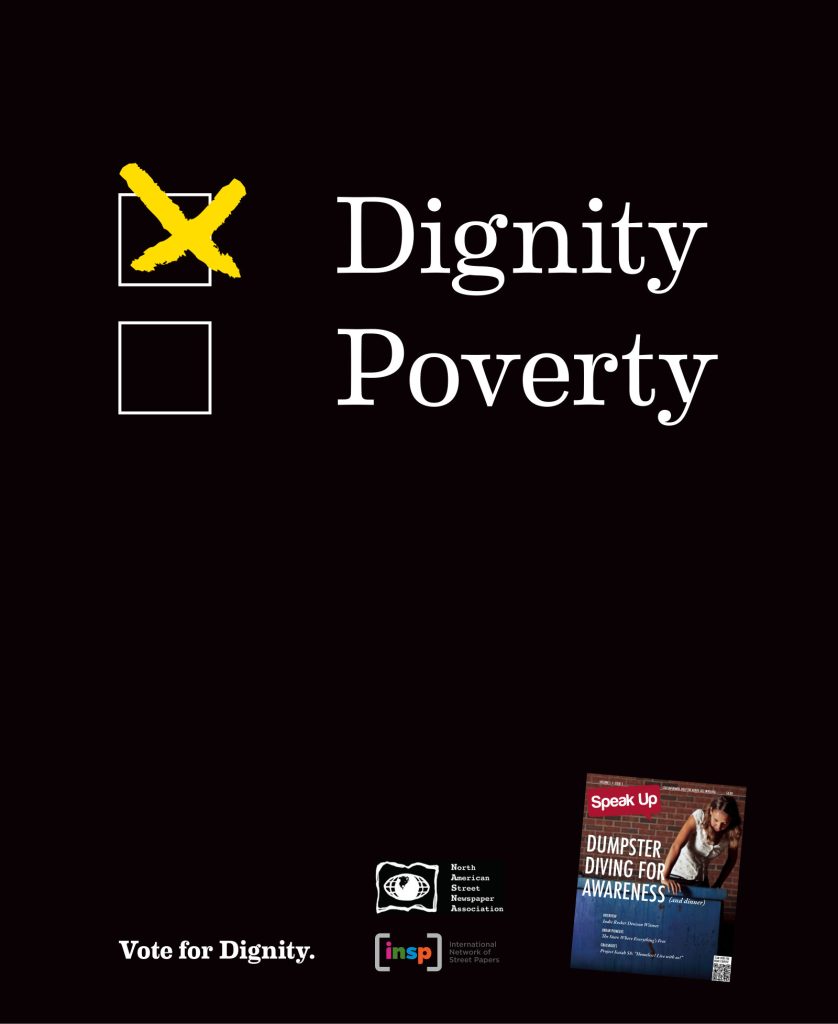
Dignity
Poverty
VOLUME 1 • ISSUE 1
STAY INFORMED. HELP THE NEEDY. GET INVOLVED. $3.00
DUMPSTER
DIVING FOR
(and dinner) Become a sponsor of Speak Up Magazine, Inc. All supportAWARENESSis tax-deductible.
INTERVIEW
Indie Rocker Denison Witmer
URBAN PIONEERS
The Store Where Everything’s Free
GRASSROOTS
Project Isaiah 58: NC“Homeless? Live28206with us!” MORESCAN CODECONTENTFOR SPEAK UPVotewww.speakupmag.orgMAGAZINE for Dignity. • 516 E. 15th Street, 11G, Charlotte,
Speak Up • Issue 1 • 1
Speak Up • Issue 1 • 1