

1 / 24
Read as text
Page 1
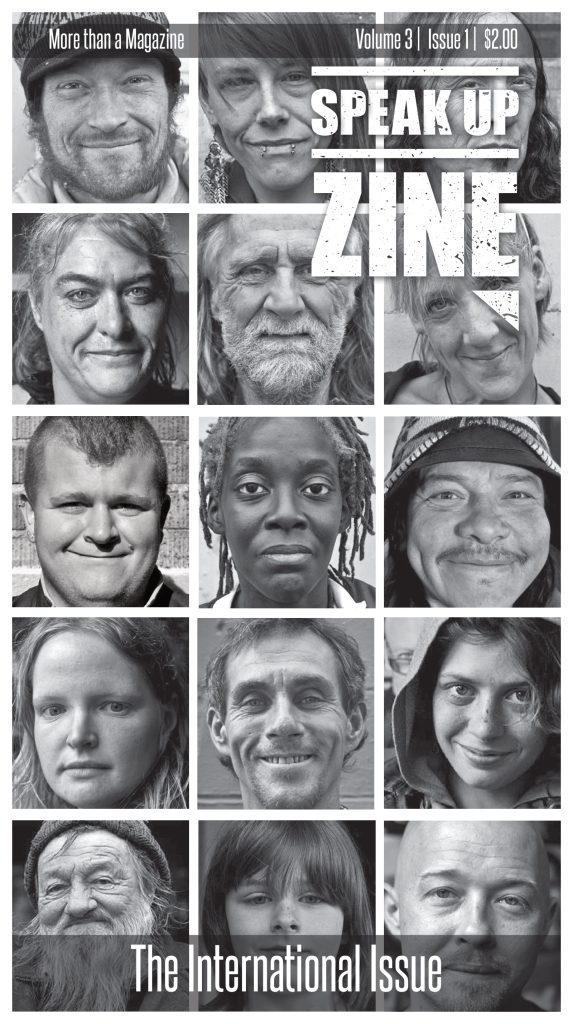
More than a Magazine Volume 3 | Issue 1 | $2.00
The International Issue
Page 2
4 INSP Map INSP
5 Poland Dagmara Walczyk
6 Switzerland Beiene Berhane
7 Slovakia Laura Smith
12 England Forest & Lobb
16 Australia Greg
17 Charlotte, NC Ruth Hsieh
18 Seattle Real Change Staff
22 Denmark Søren Lambæk
EDITING
Peggi Knowe
Matt Shaw
Leah Burnett
Bill Shaw
LAYOUT AND DESIGN
Maria Belen Valdivieso
www.speakuptc.com WRITING WORKSHOPS
billshaw@speakupmag.org 10AM Saturday at Brew
5-8PM Tuesday at Horizon Books
PO Box 285
Traverse City, MI 49685
Page 3
SPEAK UP OFFERS PEOPLE ON THE
STREETS A CHANCE TO EARN IMMEDIATE
INCOME BY SELLING A MAGAZINE
THAT THEY HAVE WRITTEN.
More than a Magazine
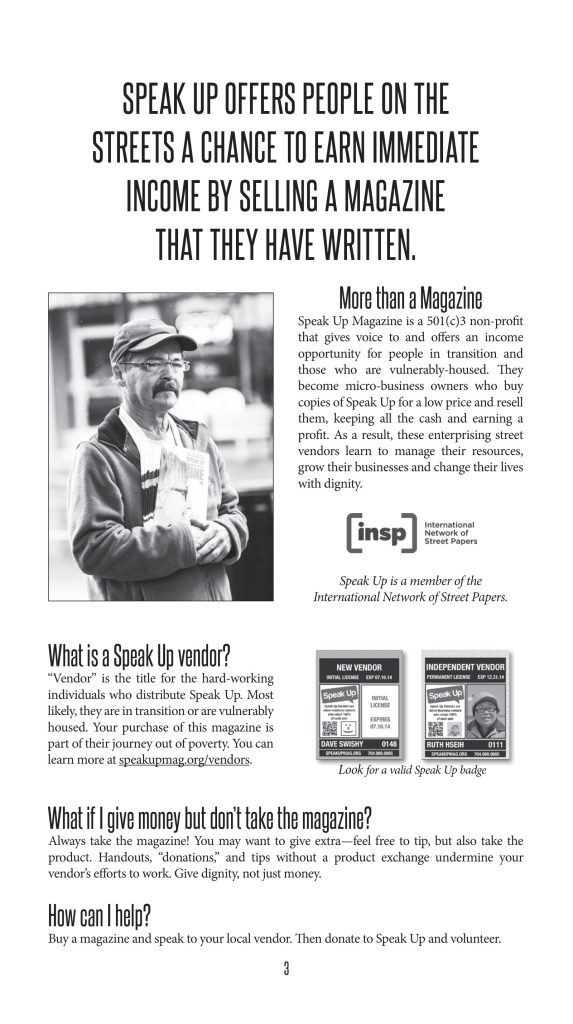
Speak Up Magazine is a 501(c)3 non-profit
that gives voice to and offers an income
opportunity for people in transition and
those who are vulnerably-housed. They
become micro-business owners who buy
copies of Speak Up for a low price and resell
them, keeping all the cash and earning a
profit. As a result, these enterprising street
vendors learn to manage their resources,
grow their businesses and change their lives
with dignity.
Speak Up is a member of the
International Network of Street Papers.
What is a Speak Up vendor?
“Vendor” is the title for the hard-working
individuals who distribute Speak Up. Most
likely, they are in transition or are vulnerably
housed. Your purchase of this magazine is
part of their journey out of poverty. You can
learn more at speakupmag.org/vendors.
Look for a valid Speak Up badge
What if I give money but don’t take the magazine?
Always take the magazine! You may want to give extra—feel free to tip, but also take the
product. Handouts, “donations,” and tips without a product exchange undermine your
vendor’s efforts to work. Give dignity, not just money.
How can I help?
Buy a magazine and speak to your local vendor. Then donate to Speak Up and volunteer.
3
Page 4
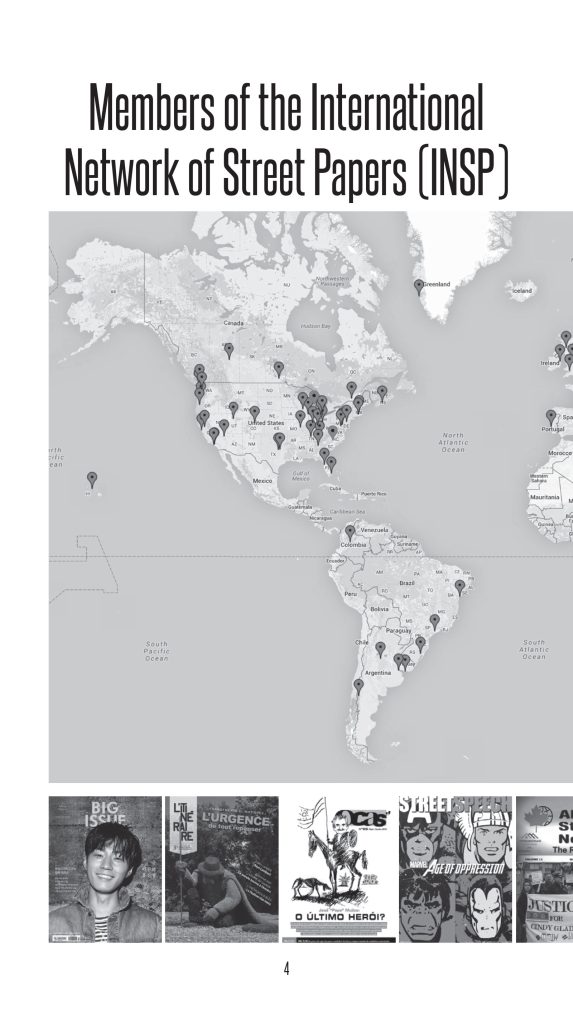
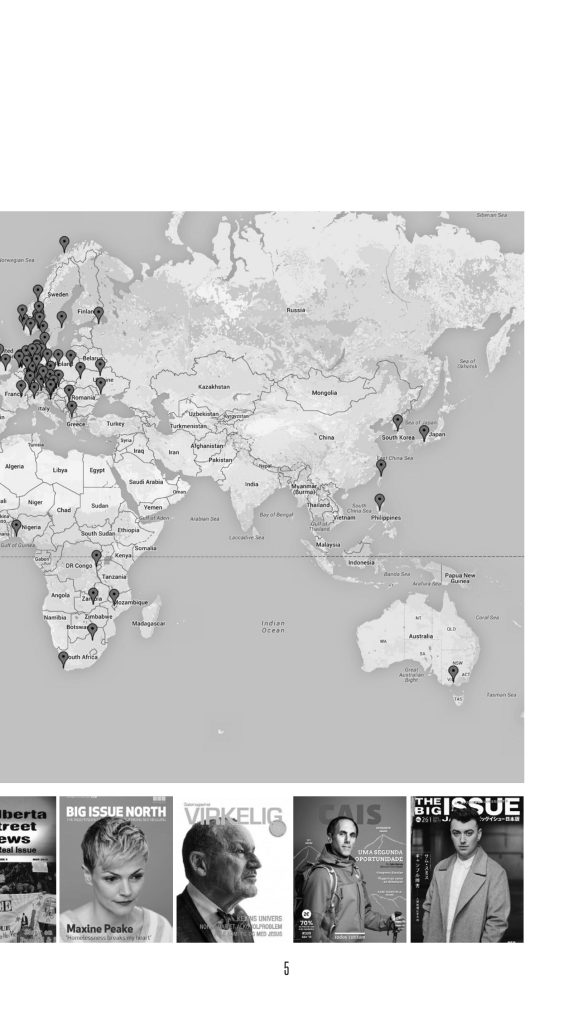
Members of the International
Network of Street Papers (INSP)
4
Page 6
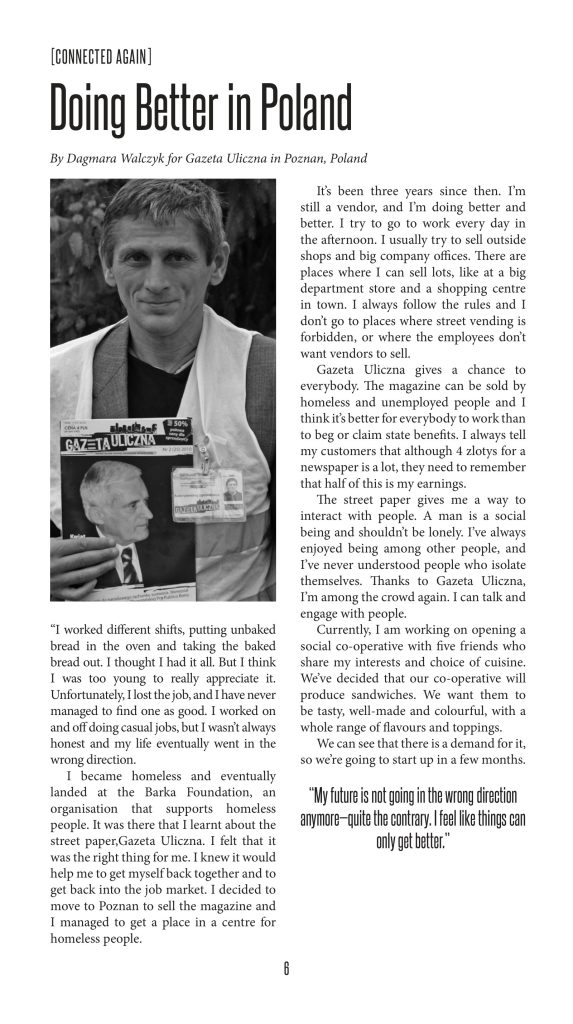
[CONNECTED AGAIN]
Doing Better in Poland
By Dagmara Walczyk for Gazeta Uliczna in Poznan, Poland
It’s been three years since then. I’m
still a vendor, and I’m doing better and
better. I try to go to work every day in
the afternoon. I usually try to sell outside
shops and big company offices. There are
places where I can sell lots, like at a big
department store and a shopping centre
in town. I always follow the rules and I
don’t go to places where street vending is
forbidden, or where the employees don’t
want vendors to sell.
Gazeta Uliczna gives a chance to
everybody. The magazine can be sold by
homeless and unemployed people and I
think it’s better for everybody to work than
to beg or claim state benefits. I always tell
my customers that although 4 zlotys for a
newspaper is a lot, they need to remember
that half of this is my earnings.
The street paper gives me a way to
interact with people. A man is a social
being and shouldn’t be lonely. I’ve always
enjoyed being among other people, and
I’ve never understood people who isolate
themselves. Thanks to Gazeta Uliczna,
I’m among the crowd again. I can talk and
engage with people.
“I worked different shifts, putting unbaked Currently, I am working on opening a
bread in the oven and taking the baked social co-operative with five friends who
bread out. I thought I had it all. But I think share my interests and choice of cuisine.
I was too young to really appreciate it. We’ve decided that our co-operative will
Unfortunately, I lost the job, and I have never produce sandwiches. We want them to
managed to find one as good. I worked on be tasty, well-made and colourful, with a
and off doing casual jobs, but I wasn’t always whole range of flavours and toppings.
honest and my life eventually went in the We can see that there is a demand for it,
wrong direction. so we’re going to start up in a few months.
I became homeless and eventually
landed at the Barka Foundation, an “My future is not going in the wrong direction
organisation that supports homeless anymore—quite the contrary. I feel like things canpeople. It was there that I learnt about the
street paper,Gazeta Uliczna. I felt that it only get better.”
was the right thing for me. I knew it would
help me to get myself back together and to
get back into the job market. I decided to
move to Poznan to sell the magazine and
I managed to get a place in a centre for
homeless people.
6
Page 7
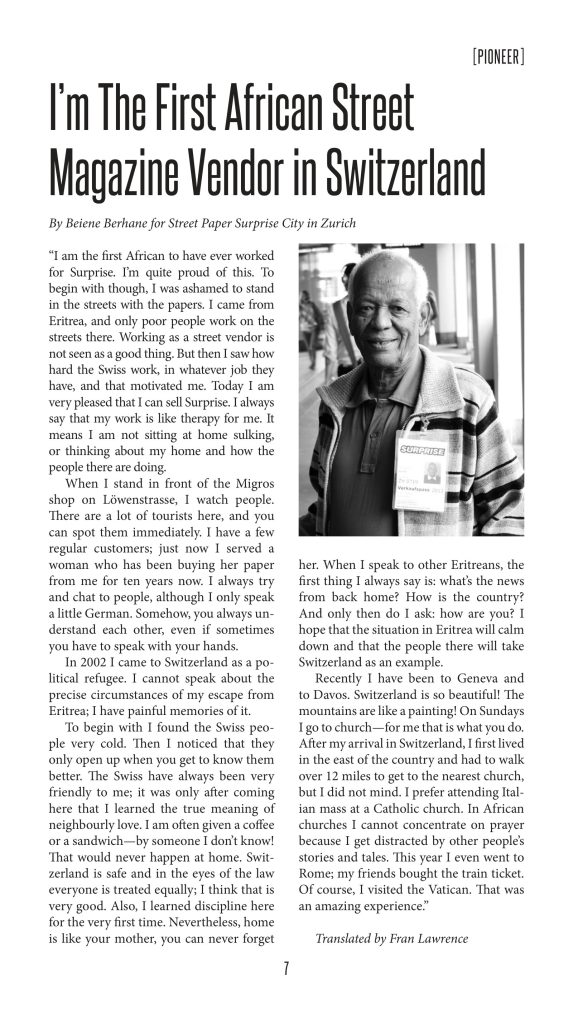
[PIONEER]
I’m The First African Street
Magazine Vendor in Switzerland
By Beiene Berhane for Street Paper Surprise City in Zurich
“I am the first African to have ever worked
for Surprise. I’m quite proud of this. To
begin with though, I was ashamed to stand
in the streets with the papers. I came from
Eritrea, and only poor people work on the
streets there. Working as a street vendor is
not seen as a good thing. But then I saw how
hard the Swiss work, in whatever job they
have, and that motivated me. Today I am
very pleased that I can sell Surprise. I always
say that my work is like therapy for me. It
means I am not sitting at home sulking,
or thinking about my home and how the
people there are doing.
When I stand in front of the Migros
shop on Löwenstrasse, I watch people.
There are a lot of tourists here, and you
can spot them immediately. I have a few
regular customers; just now I served a
woman who has been buying her paper her. When I speak to other Eritreans, the
from me for ten years now. I always try first thing I always say is: what’s the news
and chat to people, although I only speak from back home? How is the country?
a little German. Somehow, you always un And only then do I ask: how are you? I
derstand each other, even if sometimes hope that the situation in Eritrea will calm
you have to speak with your hands. down and that the people there will take
In 2002 I came to Switzerland as a po Switzerland as an example.
litical refugee. I cannot speak about the Recently I have been to Geneva and
precise circumstances of my escape from to Davos. Switzerland is so beautiful! The
Eritrea; I have painful memories of it. mountains are like a painting! On Sundays
To begin with I found the Swiss peo I go to church—for me that is what you do.
ple very cold. Then I noticed that they After my arrival in Switzerland, I first lived
only open up when you get to know them in the east of the country and had to walk
better. The Swiss have always been very over 12 miles to get to the nearest church,
friendly to me; it was only after coming but I did not mind. I prefer attending Ital
here that I learned the true meaning of ian mass at a Catholic church. In African
neighbourly love. I am often given a coffee churches I cannot concentrate on prayer
or a sandwich—by someone I don’t know! because I get distracted by other people’s
That would never happen at home. Swit stories and tales. This year I even went to
zerland is safe and in the eyes of the law Rome; my friends bought the train ticket.
everyone is treated equally; I think that is Of course, I visited the Vatican. That was
very good. Also, I learned discipline here an amazing experience.”
for the very first time. Nevertheless, home
is like your mother, you can never forget Translated by Fran Lawrence
7
Page 8
[SOCIAL ENTERPRISE]
Homeless luggage porters in
Slovakia are lifting themselves out
of debt
By Laura Smith
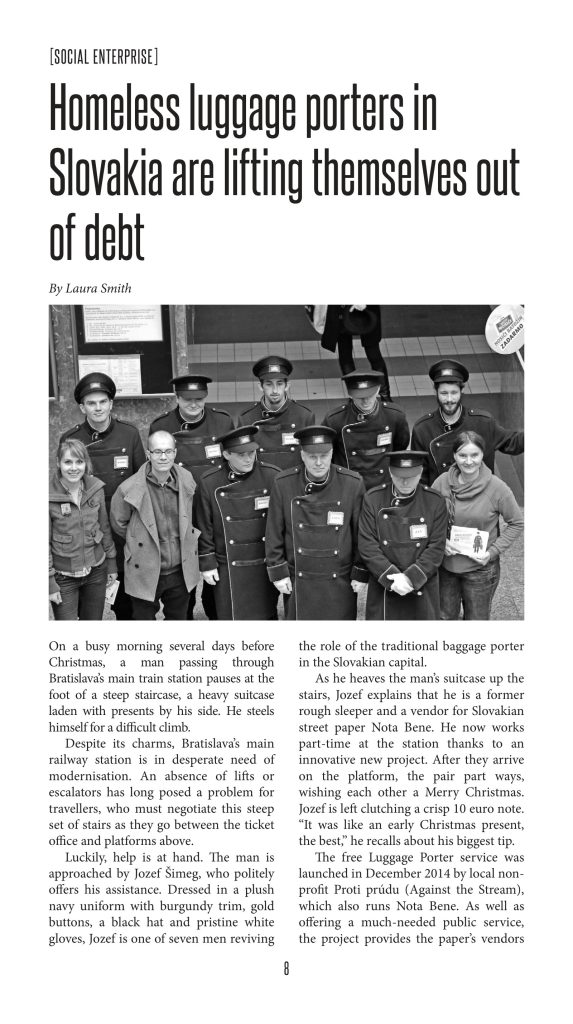
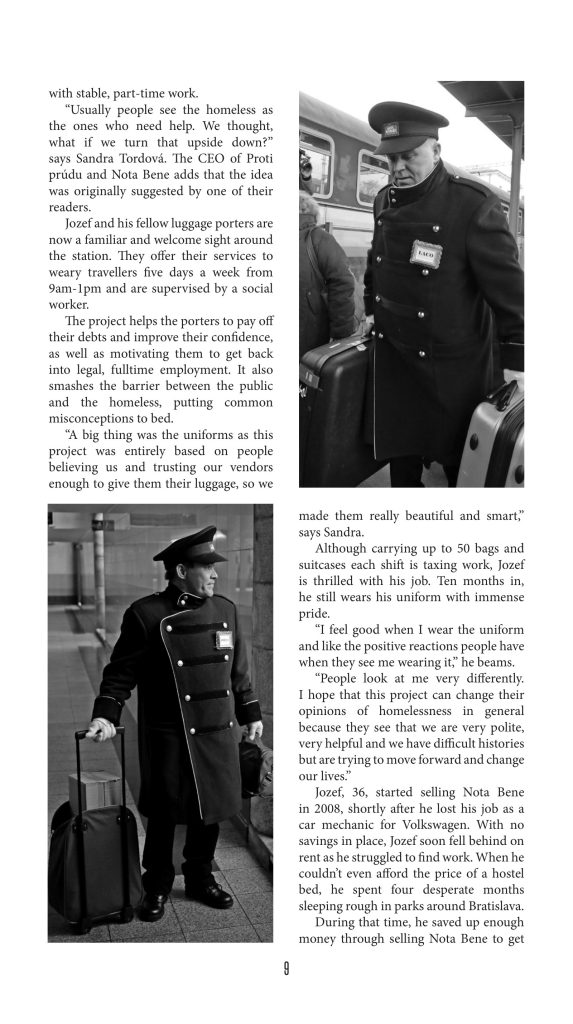
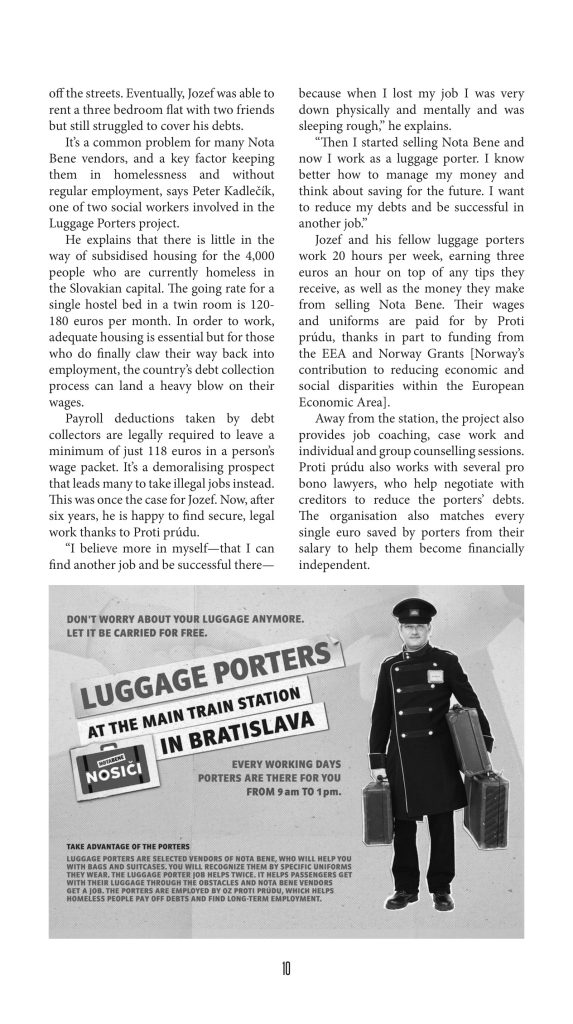
On a busy morning several days before the role of the traditional baggage porter
Christmas, a man passing through in the Slovakian capital.
Bratislava’s main train station pauses at the As he heaves the man’s suitcase up the
foot of a steep staircase, a heavy suitcase stairs, Jozef explains that he is a former
laden with presents by his side. He steels rough sleeper and a vendor for Slovakian
himself for a difficult climb. street paper Nota Bene. He now works
Despite its charms, Bratislava’s main part-time at the station thanks to an
railway station is in desperate need of innovative new project. After they arrive
modernisation. An absence of lifts or on the platform, the pair part ways,
escalators has long posed a problem for wishing each other a Merry Christmas.
travellers, who must negotiate this steep Jozef is left clutching a crisp 10 euro note.
set of stairs as they go between the ticket “It was like an early Christmas present,
office and platforms above. the best,” he recalls about his biggest tip.
Luckily, help is at hand. The man is The free Luggage Porter service was
approached by Jozef Šimeg, who politely launched in December 2014 by local non-
offers his assistance. Dressed in a plush profit Proti prúdu (Against the Stream),
navy uniform with burgundy trim, gold which also runs Nota Bene. As well as
buttons, a black hat and pristine white offering a much-needed public service,
gloves, Jozef is one of seven men reviving the project provides the paper’s vendors
8
Page 9
with stable, part-time work.
“Usually people see the homeless as
the ones who need help. We thought,
what if we turn that upside down?”
says Sandra Tordová. The CEO of Proti
prúdu and Nota Bene adds that the idea
was originally suggested by one of their
readers.
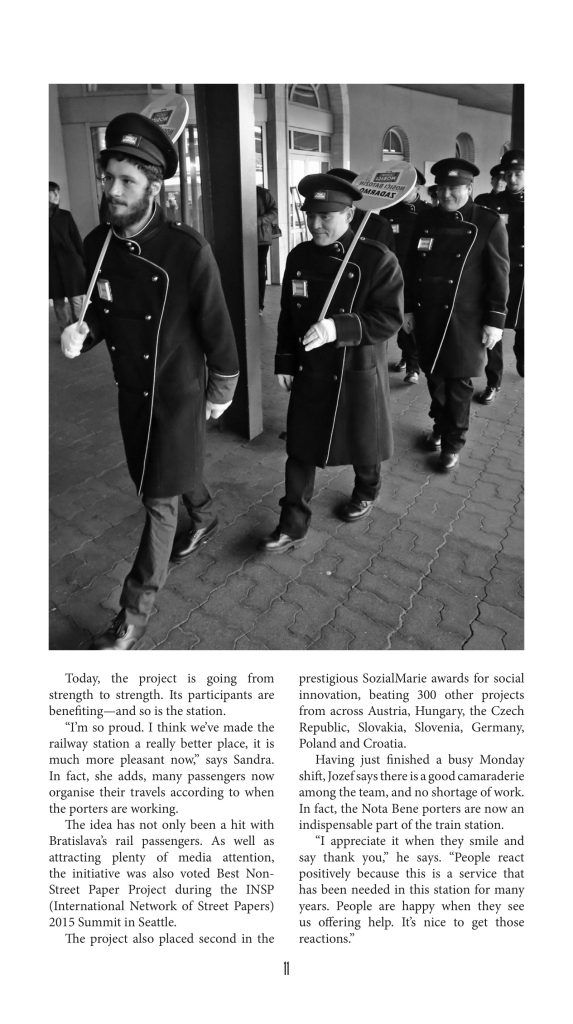
Jozef and his fellow luggage porters are
now a familiar and welcome sight around
the station. They offer their services to
weary travellers five days a week from
9am-1pm and are supervised by a social
worker.
The project helps the porters to pay off
their debts and improve their confidence,
as well as motivating them to get back
into legal, fulltime employment. It also
smashes the barrier between the public
and the homeless, putting common
misconceptions to bed.
“A big thing was the uniforms as this
project was entirely based on people
believing us and trusting our vendors
enough to give them their luggage, so we
made them really beautiful and smart,”
says Sandra.
Although carrying up to 50 bags and
suitcases each shift is taxing work, Jozef
is thrilled with his job. Ten months in,
he still wears his uniform with immense
pride.
“I feel good when I wear the uniform
and like the positive reactions people have
when they see me wearing it,” he beams.
“People look at me very differently.
I hope that this project can change their
opinions of homelessness in general
because they see that we are very polite,
very helpful and we have difficult histories
but are trying to move forward and change
our lives.”
Jozef, 36, started selling Nota Bene
in 2008, shortly after he lost his job as a
car mechanic for Volkswagen. With no
savings in place, Jozef soon fell behind on
rent as he struggled to find work. When he
couldn’t even afford the price of a hostel
bed, he spent four desperate months
sleeping rough in parks around Bratislava.
During that time, he saved up enough
money through selling Nota Bene to get
9
Page 10
off the streets. Eventually, Jozef was able to because when I lost my job I was very
rent a three bedroom flat with two friends down physically and mentally and was
but still struggled to cover his debts. sleeping rough,” he explains.
It’s a common problem for many Nota “Then I started selling Nota Bene and
Bene vendors, and a key factor keeping now I work as a luggage porter. I know
them in homelessness and without better how to manage my money and
regular employment, says Peter Kadlečík, think about saving for the future. I want
one of two social workers involved in the to reduce my debts and be successful in
Luggage Porters project. another job.”
He explains that there is little in the Jozef and his fellow luggage porters
way of subsidised housing for the 4,000 work 20 hours per week, earning three
people who are currently homeless in euros an hour on top of any tips they
the Slovakian capital. The going rate for a receive, as well as the money they make
single hostel bed in a twin room is 120- from selling Nota Bene. Their wages
180 euros per month. In order to work, and uniforms are paid for by Proti
adequate housing is essential but for those prúdu, thanks in part to funding from
who do finally claw their way back into the EEA and Norway Grants [Norway’s
employment, the country’s debt collection contribution to reducing economic and
process can land a heavy blow on their social disparities within the European
wages. Economic Area].
Payroll deductions taken by debt Away from the station, the project also
collectors are legally required to leave a provides job coaching, case work and
minimum of just 118 euros in a person’s individual and group counselling sessions.
wage packet. It’s a demoralising prospect Proti prúdu also works with several pro
that leads many to take illegal jobs instead. bono lawyers, who help negotiate with
This was once the case for Jozef. Now, after creditors to reduce the porters’ debts.
six years, he is happy to find secure, legal The organisation also matches every
work thanks to Proti prúdu. single euro saved by porters from their
“I believe more in myself—that I can salary to help them become financially
find another job and be successful there— independent.
10
Page 11
Today, the project is going from prestigious SozialMarie awards for social
strength to strength. Its participants are innovation, beating 300 other projects
benefiting—and so is the station. from across Austria, Hungary, the Czech
“I’m so proud. I think we’ve made the Republic, Slovakia, Slovenia, Germany,
railway station a really better place, it is Poland and Croatia.
much more pleasant now,” says Sandra. Having just finished a busy Monday
In fact, she adds, many passengers now shift, Jozef says there is a good camaraderie
organise their travels according to when among the team, and no shortage of work.
the porters are working. In fact, the Nota Bene porters are now an
The idea has not only been a hit with indispensable part of the train station.
Bratislava’s rail passengers. As well as “I appreciate it when they smile and
attracting plenty of media attention, say thank you,” he says. “People react
the initiative was also voted Best Non- positively because this is a service that
Street Paper Project during the INSP has been needed in this station for many
(International Network of Street Papers) years. People are happy when they see
2015 Summit in Seattle. us offering help. It’s nice to get those
The project also placed second in the reactions.”
11
Page 12
[DAWN TO DUSK]
A day in the life of a Big Issue
magazine vendor
By Adam Forest and Adrian Lobb for the The Big Issue in UK
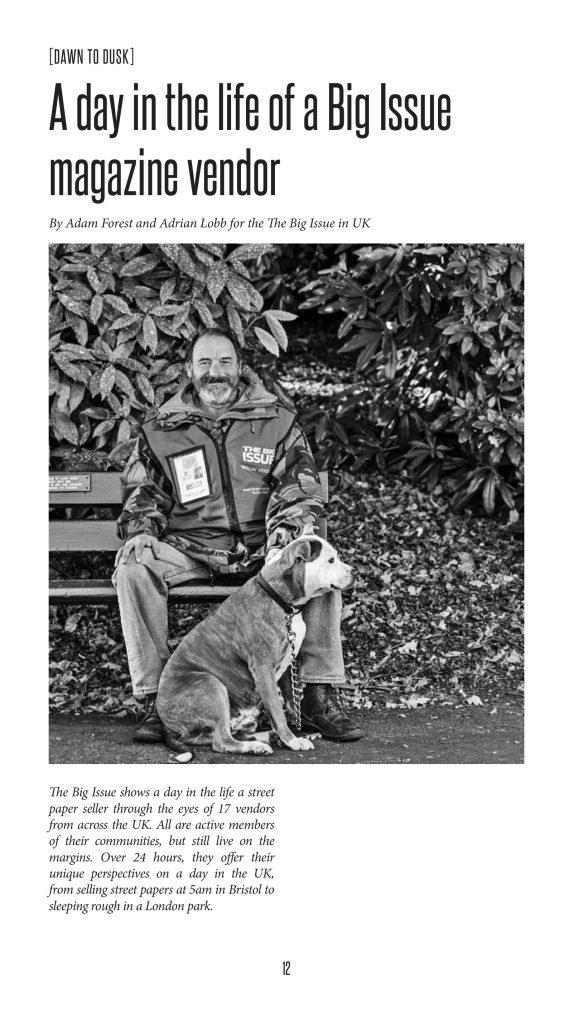
The Big Issue shows a day in the life a street
paper seller through the eyes of 17 vendors
from across the UK. All are active members
of their communities, but still live on the
margins. Over 24 hours, they offer their
unique perspectives on a day in the UK,
from selling street papers at 5am in Bristol to
sleeping rough in a London park.
12
Page 13
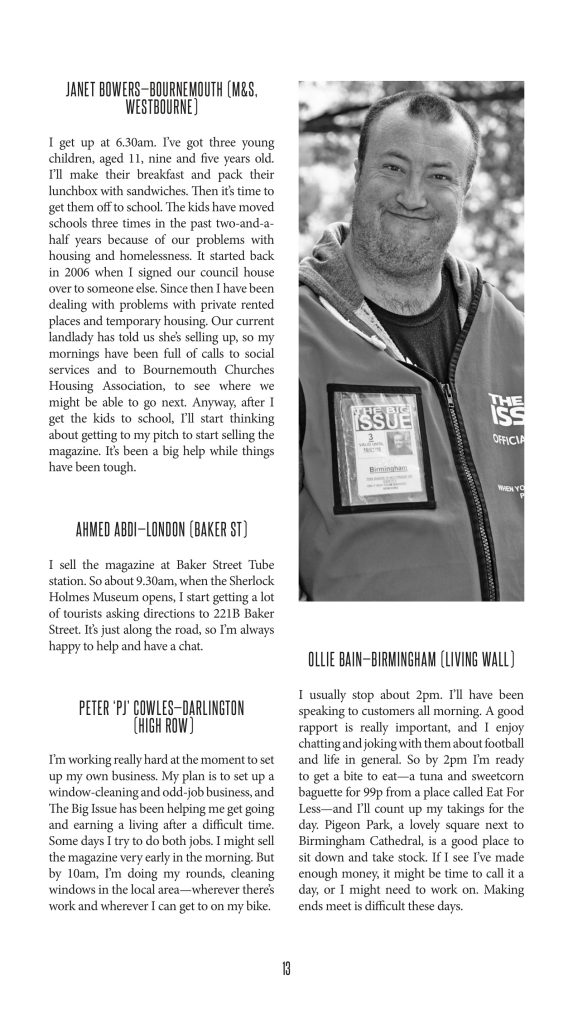
JANET BOWERS—BOURNEMOUTH (M&S,
WESTBOURNE)
I get up at 6.30am. I’ve got three young
children, aged 11, nine and five years old.
I’ll make their breakfast and pack their
lunchbox with sandwiches. Then it’s time to
get them off to school. The kids have moved
schools three times in the past two-and-a-
half years because of our problems with
housing and homelessness. It started back
in 2006 when I signed our council house
over to someone else. Since then I have been
dealing with problems with private rented
places and temporary housing. Our current
landlady has told us she’s selling up, so my
mornings have been full of calls to social
services and to Bournemouth Churches
Housing Association, to see where we
might be able to go next. Anyway, after I
get the kids to school, I’ll start thinking
about getting to my pitch to start selling the
magazine. It’s been a big help while things
have been tough.
AHMED ABDI—LONDON (BAKER ST)
I sell the magazine at Baker Street Tube
station. So about 9.30am, when the Sherlock
Holmes Museum opens, I start getting a lot
of tourists asking directions to 221B Baker
Street. It’s just along the road, so I’m always
happy to help and have a chat.
OLLIE BAIN—BIRMINGHAM (LIVING WALL)
I usually stop about 2pm. I’ll have been
PETER ‘PJ’ COWLES—DARLINGTON speaking to customers all morning. A good
(HIGH ROW) rapport is really important, and I enjoy
chatting and joking with them about football
I’m working really hard at the moment to set and life in general. So by 2pm I’m ready
up my own business. My plan is to set up a to get a bite to eat—a tuna and sweetcorn
window-cleaning and odd-job business, and baguette for 99p from a place called Eat For
The Big Issue has been helping me get going Less—and I’ll count up my takings for the
and earning a living after a difficult time. day. Pigeon Park, a lovely square next to
Some days I try to do both jobs. I might sell Birmingham Cathedral, is a good place to
the magazine very early in the morning. But sit down and take stock. If I see I’ve made
by 10am, I’m doing my rounds, cleaning enough money, it might be time to call it a
windows in the local area—wherever there’s day, or I might need to work on. Making
work and wherever I can get to on my bike. ends meet is difficult these days.
13
Page 14
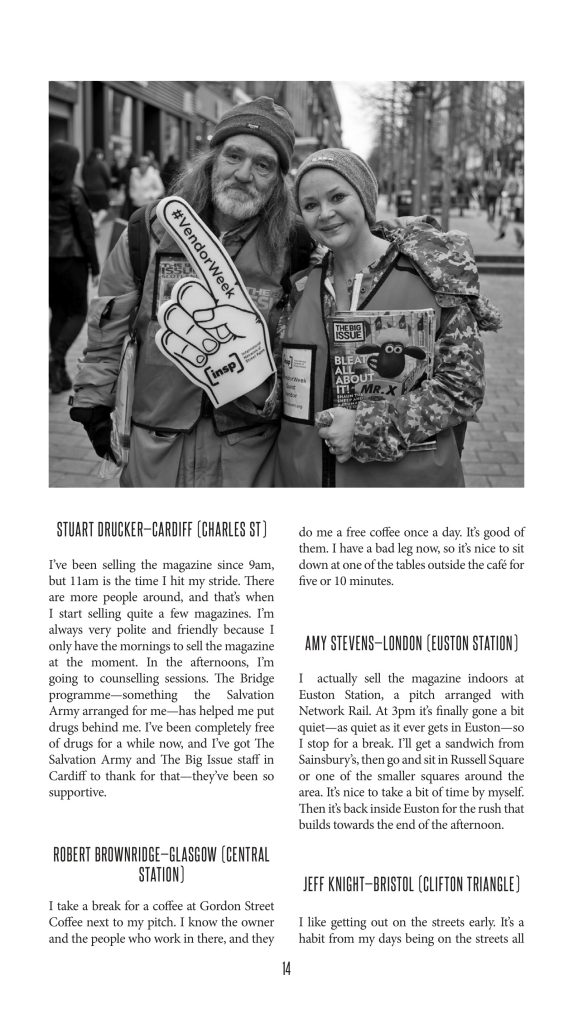
STUART DRUCKER—CARDIFF (CHARLES ST) do me a free coffee once a day. It’s good of
them. I have a bad leg now, so it’s nice to sit
I’ve been selling the magazine since 9am, down at one of the tables outside the café for
but 11am is the time I hit my stride. There five or 10 minutes.
are more people around, and that’s when
I start selling quite a few magazines. I’m
always very polite and friendly because I
only have the mornings to sell the magazine AMY STEVENS—LONDON (EUSTON STATION)
at the moment. In the afternoons, I’m
going to counselling sessions. The Bridge I actually sell the magazine indoors at
programme—something the Salvation Euston Station, a pitch arranged with
Army arranged for me—has helped me put Network Rail. At 3pm it’s finally gone a bit
drugs behind me. I’ve been completely free quiet—as quiet as it ever gets in Euston—so
of drugs for a while now, and I’ve got The I stop for a break. I’ll get a sandwich from
Salvation Army and The Big Issue staff in Sainsbury’s, then go and sit in Russell Square
Cardiff to thank for that—they’ve been so or one of the smaller squares around the
supportive. area. It’s nice to take a bit of time by myself.
Then it’s back inside Euston for the rush that
builds towards the end of the afternoon.
ROBERT BROWNRIDGE—GLASGOW (CENTRAL
STATION) JEFF KNIGHT—BRISTOL (CLIFTON TRIANGLE)
I take a break for a coffee at Gordon Street
Coffee next to my pitch. I know the owner I like getting out on the streets early. It’s a
and the people who work in there, and they habit from my days being on the streets all
14
Page 15
night, sleeping rough, even though I have Groundhog Day for me every day. By 10pm,
someone to stay with at the moment. I’ll I’m usually in my room. My room is small.
be out there at 5am, and I’ll start selling the There is a bed, a TV, a shelf for toiletries and
magazine to catch the kind of people around a wardrobe. By 11.30pm, I’m usually falling
very early in the morning. It’s good to get a asleep. I have been here eight months, and
smile and a “Good morning.” That gets the they are keen for me to move on to a self-
day started. contained flat of my own in a hostel. I don’t
know how long it will take—it could be next
week, next month or next year. It’s a waiting
game.
JACK RICHARDSON—BRISTOL (PARK ST)
Since Christmas, I’ve been living with a
wonderful lady who offered to put me up. So KEITH DONOHOE—LONDON (COVENT GARDEN)
I’ve been able to spend my evenings with her
or working on my Open University degree I’m sleeping rough in a park in south-east
in sociology and psychology. At around London, not far from the river. I was staying
8pm, I’ll start reading and researching. At in a room, but it was too expensive. I need to
the moment I’m looking into the barriers be in London so I can see my young son. It
socially isolated people face engaging with can be tough getting to sleep on a park bench
services. It’s the first time in an awfully long in London. I have two sleeping bags—one
time I’ve been able to stretch my brain. I’m to put under myself and one to get inside.
trying to keep Big Issue sales up to keep my But it’s getting cold at night, so I usually
head above water while I work towards my only get a couple of hours’ sleep, from about
degree. 3am until about 5am. I do a bit of reading
at night. It’s quite brightly lit in the park, so
I’ll read the newspapers and then I’m tired
enough to fall asleep. Before you know it, it’s
ALAN MASSEY—WORCESTER (THE CROSS) time to get up and out and on with the day.
I’m safely back in my tent by 9pm. For the
past two years, I’ve been sleeping in a tent
15 minutes’ walk outside Worcester. It’s
tucked away in a quiet place where no one
bothers me. I’m an avid reader, and I’ve got
a battery-powered lamp so I can read at
night. I’m a big Stephen King fan, and I’ve
just started one of his thrillers called Mr
Mercedes. I make myself a cup of tea on my
gas stove burner and read until I fall asleep.
There’s a road about 30ft above the tent, so
I can hear the distant sound of traffic. But
by 11pm it’s gone pretty quiet, so I usually
get a good night’s sleep right through until
about 6am.
SAMMY REA—DUNDEE (KEILLER CENTRE)
I share a small resettlement flat in a hostel
with one other person. Thankfully we get
on like a house on fire. It is pretty much like
15
Page 16
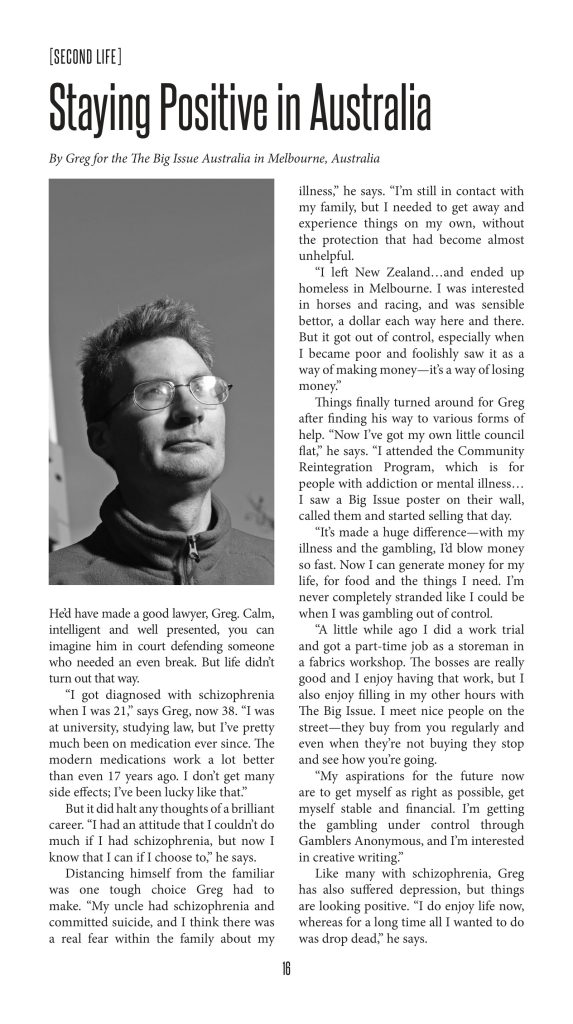
[SECOND LIFE]
Staying Positive in Australia
By Greg for the The Big Issue Australia in Melbourne, Australia
illness,” he says. “I’m still in contact with
my family, but I needed to get away and
experience things on my own, without
the protection that had become almost
unhelpful.
“I left New Zealand…and ended up
homeless in Melbourne. I was interested
in horses and racing, and was sensible
bettor, a dollar each way here and there.
But it got out of control, especially when
I became poor and foolishly saw it as a
way of making money—it’s a way of losing
money.”
Things finally turned around for Greg
after finding his way to various forms of
help. “Now I’ve got my own little council
flat,” he says. “I attended the Community
Reintegration Program, which is for
people with addiction or mental illness…
I saw a Big Issue poster on their wall,
called them and started selling that day.
“It’s made a huge difference—with my
illness and the gambling, I’d blow money
so fast. Now I can generate money for my
life, for food and the things I need. I’m
never completely stranded like I could be
He’d have made a good lawyer, Greg. Calm, when I was gambling out of control.
intelligent and well presented, you can “A little while ago I did a work trial
imagine him in court defending someone and got a part-time job as a storeman in
who needed an even break. But life didn’t a fabrics workshop. The bosses are really
turn out that way. good and I enjoy having that work, but I
“I got diagnosed with schizophrenia also enjoy filling in my other hours with
when I was 21,” says Greg, now 38. “I was The Big Issue. I meet nice people on the
at university, studying law, but I’ve pretty street—they buy from you regularly and
much been on medication ever since. The even when they’re not buying they stop
modern medications work a lot better and see how you’re going.
than even 17 years ago. I don’t get many “My aspirations for the future now
side effects; I’ve been lucky like that.” are to get myself as right as possible, get
But it did halt any thoughts of a brilliant myself stable and financial. I’m getting
career. “I had an attitude that I couldn’t do the gambling under control through
much if I had schizophrenia, but now I Gamblers Anonymous, and I’m interested
know that I can if I choose to,” he says. in creative writing.”
Distancing himself from the familiar Like many with schizophrenia, Greg
was one tough choice Greg had to has also suffered depression, but things
make. “My uncle had schizophrenia and are looking positive. “I do enjoy life now,
committed suicide, and I think there was whereas for a long time all I wanted to do
a real fear within the family about my was drop dead,” he says.
16
Page 17
[BLESSED]
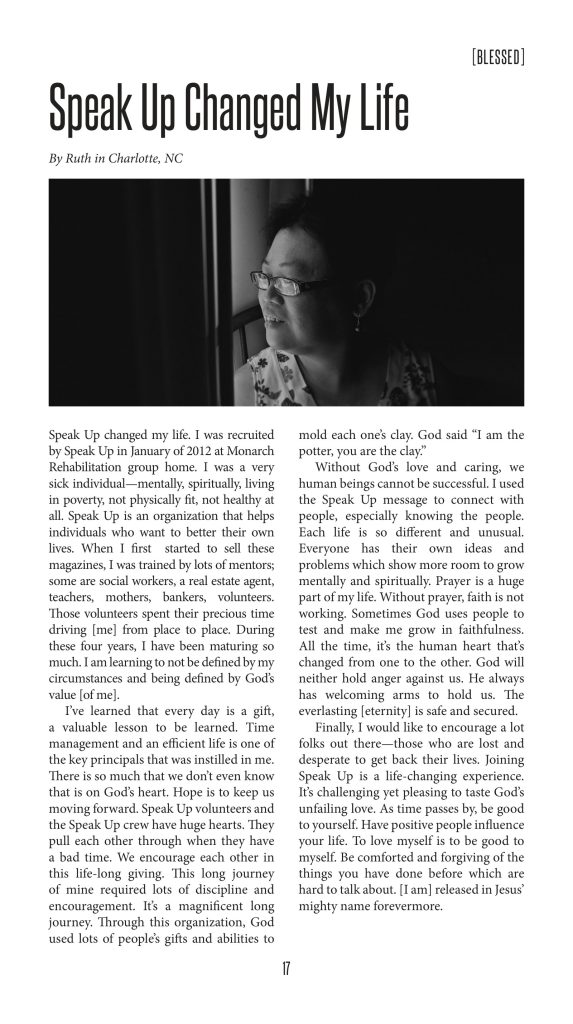
Speak Up Changed My Life
By Ruth in Charlotte, NC
Speak Up changed my life. I was recruited mold each one’s clay. God said “I am the
by Speak Up in January of 2012 at Monarch potter, you are the clay.”
Rehabilitation group home. I was a very Without God’s love and caring, we
sick individual—mentally, spiritually, living human beings cannot be successful. I used
in poverty, not physically fit, not healthy at the Speak Up message to connect with
all. Speak Up is an organization that helps people, especially knowing the people.
individuals who want to better their own Each life is so different and unusual.
lives. When I first started to sell these Everyone has their own ideas and
magazines, I was trained by lots of mentors; problems which show more room to grow
some are social workers, a real estate agent, mentally and spiritually. Prayer is a huge
teachers, mothers, bankers, volunteers. part of my life. Without prayer, faith is not
Those volunteers spent their precious time working. Sometimes God uses people to
driving [me] from place to place. During test and make me grow in faithfulness.
these four years, I have been maturing so All the time, it’s the human heart that’s
much. I am learning to not be defined by my changed from one to the other. God will
circumstances and being defined by God’s neither hold anger against us. He always
value [of me]. has welcoming arms to hold us. The
I’ve learned that every day is a gift, everlasting [eternity] is safe and secured.
a valuable lesson to be learned. Time Finally, I would like to encourage a lot
management and an efficient life is one of folks out there—those who are lost and
the key principals that was instilled in me. desperate to get back their lives. Joining
There is so much that we don’t even know Speak Up is a life-changing experience.
that is on God’s heart. Hope is to keep us It’s challenging yet pleasing to taste God’s
moving forward. Speak Up volunteers and unfailing love. As time passes by, be good
the Speak Up crew have huge hearts. They to yourself. Have positive people influence
pull each other through when they have your life. To love myself is to be good to
a bad time. We encourage each other in myself. Be comforted and forgiving of the
this life-long giving. This long journey things you have done before which are
of mine required lots of discipline and hard to talk about. [I am] released in Jesus’
encouragement. It’s a magnificent long mighty name forevermore.
journey. Through this organization, God
used lots of people’s gifts and abilities to
17
Page 18
[EYE OF THE BEHOLDER]
Through images and art, Rex
Hohlbein is changing perceptions
of homelessness
By Staff for Real Change Newspaper in Seattle
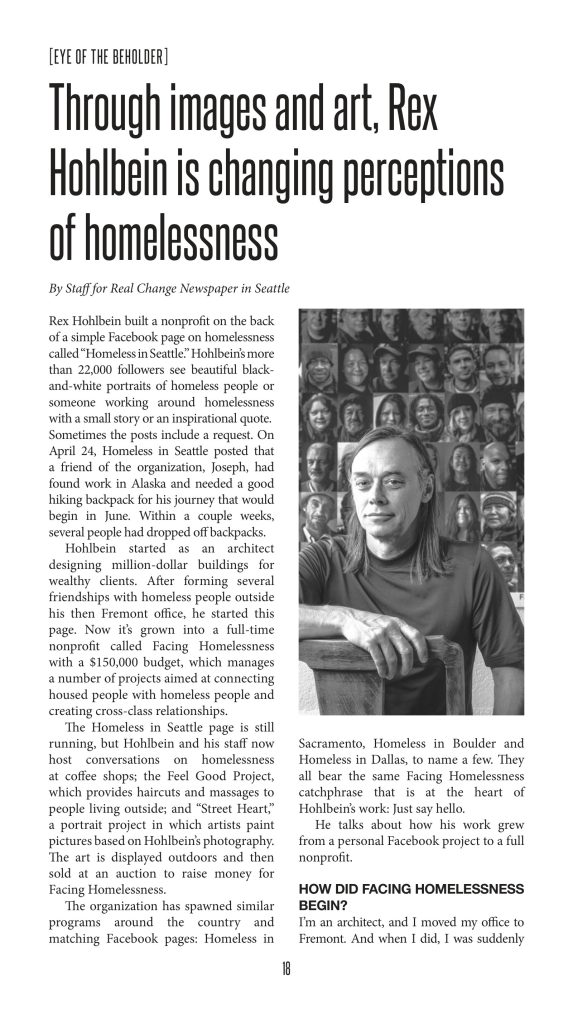
Rex Hohlbein built a nonprofit on the back
of a simple Facebook page on homelessness
called “Homeless in Seattle.” Hohlbein’s more
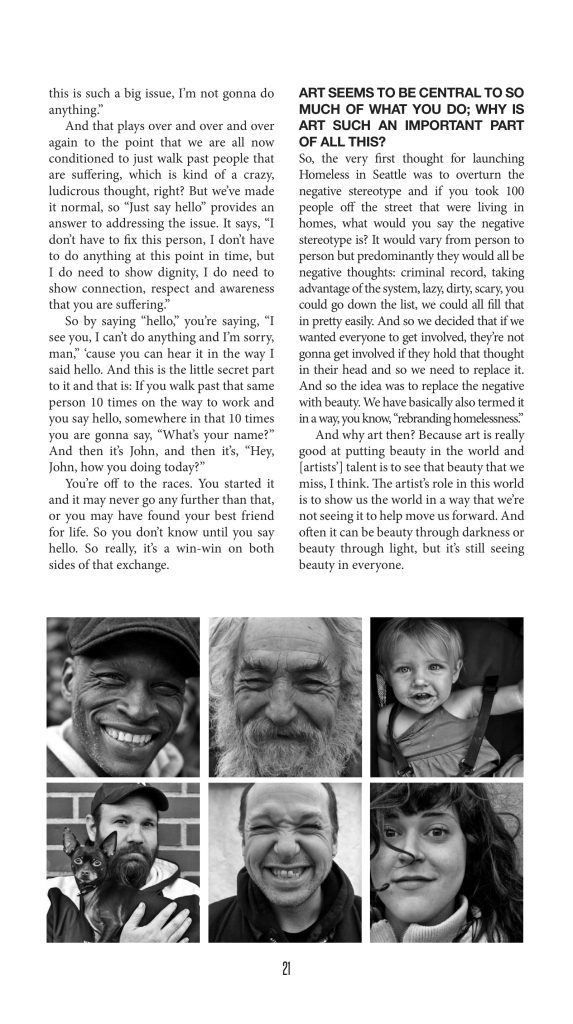
than 22,000 followers see beautiful black-
and-white portraits of homeless people or
someone working around homelessness
with a small story or an inspirational quote.
Sometimes the posts include a request. On
April 24, Homeless in Seattle posted that
a friend of the organization, Joseph, had
found work in Alaska and needed a good
hiking backpack for his journey that would
begin in June. Within a couple weeks,
several people had dropped off backpacks.
Hohlbein started as an architect
designing million-dollar buildings for
wealthy clients. After forming several
friendships with homeless people outside
his then Fremont office, he started this
page. Now it’s grown into a full-time
nonprofit called Facing Homelessness
with a $150,000 budget, which manages
a number of projects aimed at connecting
housed people with homeless people and
creating cross-class relationships.
The Homeless in Seattle page is still
running, but Hohlbein and his staff now Sacramento, Homeless in Boulder and
host conversations on homelessness Homeless in Dallas, to name a few. They
at coffee shops; the Feel Good Project, all bear the same Facing Homelessness
which provides haircuts and massages to catchphrase that is at the heart of
people living outside; and “Street Heart,” Hohlbein’s work: Just say hello.
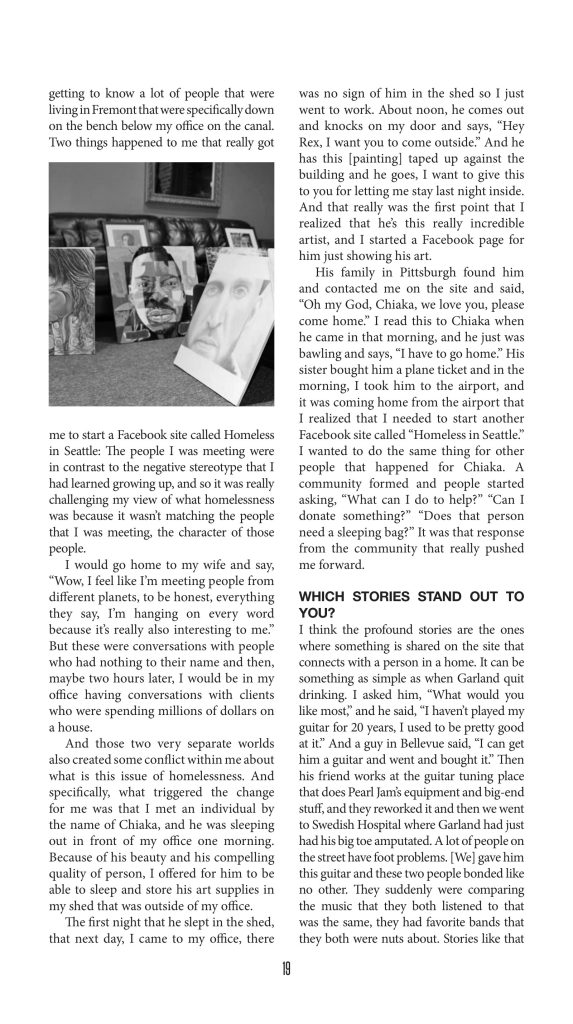
a portrait project in which artists paint He talks about how his work grew
pictures based on Hohlbein’s photography. from a personal Facebook project to a full
The art is displayed outdoors and then nonprofit.
sold at an auction to raise money for
Facing Homelessness. HOW DID FACING HOMELESSNESS
The organization has spawned similar BEGIN?
programs around the country and I’m an architect, and I moved my office to
matching Facebook pages: Homeless in Fremont. And when I did, I was suddenly
18
Page 19
getting to know a lot of people that were was no sign of him in the shed so I just
living in Fremont that were specifically down went to work. About noon, he comes out
on the bench below my office on the canal. and knocks on my door and says, “Hey
Two things happened to me that really got Rex, I want you to come outside.” And he
has this [painting] taped up against the
building and he goes, I want to give this
to you for letting me stay last night inside.
And that really was the first point that I
realized that he’s this really incredible
artist, and I started a Facebook page for
him just showing his art.
His family in Pittsburgh found him
and contacted me on the site and said,
“Oh my God, Chiaka, we love you, please
come home.” I read this to Chiaka when
he came in that morning, and he just was
bawling and says, “I have to go home.” His
sister bought him a plane ticket and in the
morning, I took him to the airport, and
it was coming home from the airport that
I realized that I needed to start another
me to start a Facebook site called Homeless Facebook site called “Homeless in Seattle.”
in Seattle: The people I was meeting were I wanted to do the same thing for other
in contrast to the negative stereotype that I people that happened for Chiaka. A
had learned growing up, and so it was really community formed and people started
challenging my view of what homelessness asking, “What can I do to help?” “Can I
was because it wasn’t matching the people donate something?” “Does that person
that I was meeting, the character of those need a sleeping bag?” It was that response
people. from the community that really pushed
I would go home to my wife and say, me forward.
“Wow, I feel like I’m meeting people from
different planets, to be honest, everything WHICH STORIES STAND OUT TO
they say, I’m hanging on every word YOU?
because it’s really also interesting to me.” I think the profound stories are the ones
But these were conversations with people where something is shared on the site that
who had nothing to their name and then, connects with a person in a home. It can be
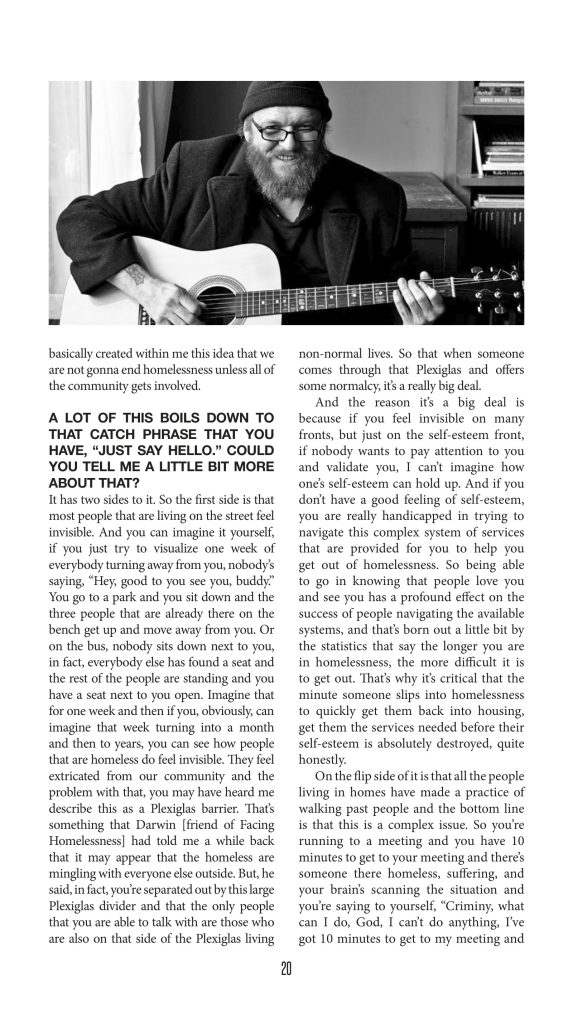
maybe two hours later, I would be in my something as simple as when Garland quit
office having conversations with clients drinking. I asked him, “What would you
who were spending millions of dollars on like most,” and he said, “I haven’t played my
a house. guitar for 20 years, I used to be pretty good
And those two very separate worlds at it.” And a guy in Bellevue said, “I can get
also created some conflict within me about him a guitar and went and bought it.” Then
what is this issue of homelessness. And his friend works at the guitar tuning place
specifically, what triggered the change that does Pearl Jam’s equipment and big-end
for me was that I met an individual by stuff, and they reworked it and then we went
the name of Chiaka, and he was sleeping to Swedish Hospital where Garland had just
out in front of my office one morning. had his big toe amputated. A lot of people on
Because of his beauty and his compelling the street have foot problems. [We] gave him
quality of person, I offered for him to be this guitar and these two people bonded like
able to sleep and store his art supplies in no other. They suddenly were comparing
my shed that was outside of my office. the music that they both listened to that
The first night that he slept in the shed, was the same, they had favorite bands that
that next day, I came to my office, there they both were nuts about. Stories like that
19
Page 20
basically created within me this idea that we non-normal lives. So that when someone
are not gonna end homelessness unless all of comes through that Plexiglas and offers
the community gets involved. some normalcy, it’s a really big deal.
And the reason it’s a big deal is
A LOT OF THIS BOILS DOWN TO because if you feel invisible on many
THAT CATCH PHRASE THAT YOU fronts, but just on the self-esteem front,
HAVE, “JUST SAY HELLO.” COULD if nobody wants to pay attention to you
YOU TELL ME A LITTLE BIT MORE and validate you, I can’t imagine how
ABOUT THAT? one’s self-esteem can hold up. And if you
It has two sides to it. So the first side is that don’t have a good feeling of self-esteem,
most people that are living on the street feel you are really handicapped in trying to
invisible. And you can imagine it yourself, navigate this complex system of services
if you just try to visualize one week of that are provided for you to help you
everybody turning away from you, nobody’s get out of homelessness. So being able
saying, “Hey, good to you see you, buddy.” to go in knowing that people love you
You go to a park and you sit down and the and see you has a profound effect on the
three people that are already there on the success of people navigating the available
bench get up and move away from you. Or systems, and that’s born out a little bit by
on the bus, nobody sits down next to you, the statistics that say the longer you are
in fact, everybody else has found a seat and in homelessness, the more difficult it is
the rest of the people are standing and you to get out. That’s why it’s critical that the
have a seat next to you open. Imagine that minute someone slips into homelessness
for one week and then if you, obviously, can to quickly get them back into housing,
imagine that week turning into a month get them the services needed before their
and then to years, you can see how people self-esteem is absolutely destroyed, quite
that are homeless do feel invisible. They feel honestly.
extricated from our community and the On the flip side of it is that all the people
problem with that, you may have heard me living in homes have made a practice of
describe this as a Plexiglas barrier. That’s walking past people and the bottom line
something that Darwin [friend of Facing is that this is a complex issue. So you’re
Homelessness] had told me a while back running to a meeting and you have 10
that it may appear that the homeless are minutes to get to your meeting and there’s
mingling with everyone else outside. But, he someone there homeless, suffering, and
said, in fact, you’re separated out by this large your brain’s scanning the situation and
Plexiglas divider and that the only people you’re saying to yourself, “Criminy, what
that you are able to talk with are those who can I do, God, I can’t do anything, I’ve
are also on that side of the Plexiglas living got 10 minutes to get to my meeting and
20
Page 21
this is such a big issue, I’m not gonna do ART SEEMS TO BE CENTRAL TO SO
anything.” MUCH OF WHAT YOU DO; WHY IS
And that plays over and over and over ART SUCH AN IMPORTANT PART
again to the point that we are all now OF ALL THIS?
conditioned to just walk past people that So, the very first thought for launching
are suffering, which is kind of a crazy, Homeless in Seattle was to overturn the
ludicrous thought, right? But we’ve made negative stereotype and if you took 100
it normal, so “Just say hello” provides an people off the street that were living in
answer to addressing the issue. It says, “I homes, what would you say the negative
don’t have to fix this person, I don’t have stereotype is? It would vary from person to
to do anything at this point in time, but person but predominantly they would all be
I do need to show dignity, I do need to negative thoughts: criminal record, taking
show connection, respect and awareness advantage of the system, lazy, dirty, scary, you
that you are suffering.” could go down the list, we could all fill that
So by saying “hello,” you’re saying, “I in pretty easily. And so we decided that if we
see you, I can’t do anything and I’m sorry, wanted everyone to get involved, they’re not
man,” ‘cause you can hear it in the way I gonna get involved if they hold that thought
said hello. And this is the little secret part in their head and so we need to replace it.
to it and that is: If you walk past that same And so the idea was to replace the negative
person 10 times on the way to work and with beauty. We have basically also termed it
you say hello, somewhere in that 10 times in a way, you know, “rebranding homelessness.”
you are gonna say, “What’s your name?” And why art then? Because art is really
And then it’s John, and then it’s, “Hey, good at putting beauty in the world and
John, how you doing today?” [artists’] talent is to see that beauty that we
You’re off to the races. You started it miss, I think. The artist’s role in this world
and it may never go any further than that, is to show us the world in a way that we’re
or you may have found your best friend not seeing it to help move us forward. And
for life. So you don’t know until you say often it can be beauty through darkness or
hello. So really, it’s a win-win on both beauty through light, but it’s still seeing
sides of that exchange. beauty in everyone.
21
Page 22
[STEPPING STONE]
A “Workhorse” in Denmark
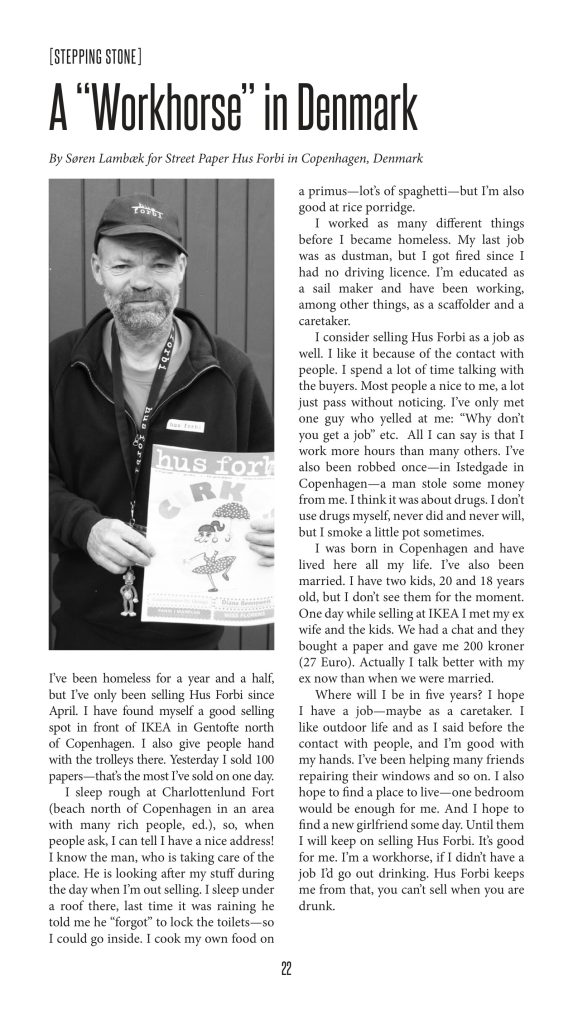
By Søren Lambæk for Street Paper Hus Forbi in Copenhagen, Denmark
a primus—lot’s of spaghetti—but I’m also
good at rice porridge.
I worked as many different things
before I became homeless. My last job
was as dustman, but I got fired since I
had no driving licence. I’m educated as
a sail maker and have been working,
among other things, as a scaffolder and a
caretaker.
I consider selling Hus Forbi as a job as
well. I like it because of the contact with
people. I spend a lot of time talking with
the buyers. Most people a nice to me, a lot
just pass without noticing. I’ve only met
one guy who yelled at me: “Why don’t
you get a job” etc. All I can say is that I
work more hours than many others. I’ve
also been robbed once—in Istedgade in
Copenhagen—a man stole some money
from me. I think it was about drugs. I don’t
use drugs myself, never did and never will,
but I smoke a little pot sometimes.
I was born in Copenhagen and have
lived here all my life. I’ve also been
married. I have two kids, 20 and 18 years
old, but I don’t see them for the moment.
One day while selling at IKEA I met my ex
wife and the kids. We had a chat and they
bought a paper and gave me 200 kroner
(27 Euro). Actually I talk better with my
I’ve been homeless for a year and a half, ex now than when we were married.
but I’ve only been selling Hus Forbi since Where will I be in five years? I hope
April. I have found myself a good selling I have a job—maybe as a caretaker. I
spot in front of IKEA in Gentofte north like outdoor life and as I said before the
of Copenhagen. I also give people hand contact with people, and I’m good with
with the trolleys there. Yesterday I sold 100 my hands. I’ve been helping many friends
papers—that’s the most I’ve sold on one day. repairing their windows and so on. I also
I sleep rough at Charlottenlund Fort hope to find a place to live—one bedroom
(beach north of Copenhagen in an area would be enough for me. And I hope to
with many rich people, ed.), so, when find a new girlfriend some day. Until them
people ask, I can tell I have a nice address! I will keep on selling Hus Forbi. It’s good
I know the man, who is taking care of the for me. I’m a workhorse, if I didn’t have a
place. He is looking after my stuff during job I’d go out drinking. Hus Forbi keeps
the day when I’m out selling. I sleep under me from that, you can’t sell when you are
a roof there, last time it was raining he drunk.
told me he “forgot” to lock the toilets—so
I could go inside. I cook my own food on
22
Page 23
SPONSORS
RE/MAX BAYSHORE PROPERTIES
“Because everyone needs a home”
bobbrick.com
watershedtc.org
PARTNERS
higherselfbookstore.com
swingshiftandthestars-tc.com
tcoexpress.com
PRINT THE NEXT ISSUE OF SPEAK UP
Your gift will create and sustain jobs, and give a voice to people in transition.
Online — speakuptc.com
By Mail — Speak Up, PO Box 285, Traverse City, MI 49685
Page 24
OPPORTUNITY
Income for those working
to stay off the streets
UNHEARD VOICES
A dedicated voice for our
marginalized neighbors
SOCIAL CHANGE
Cultural intersections
with people in transition