



1 / 32
Read as text
Page 1
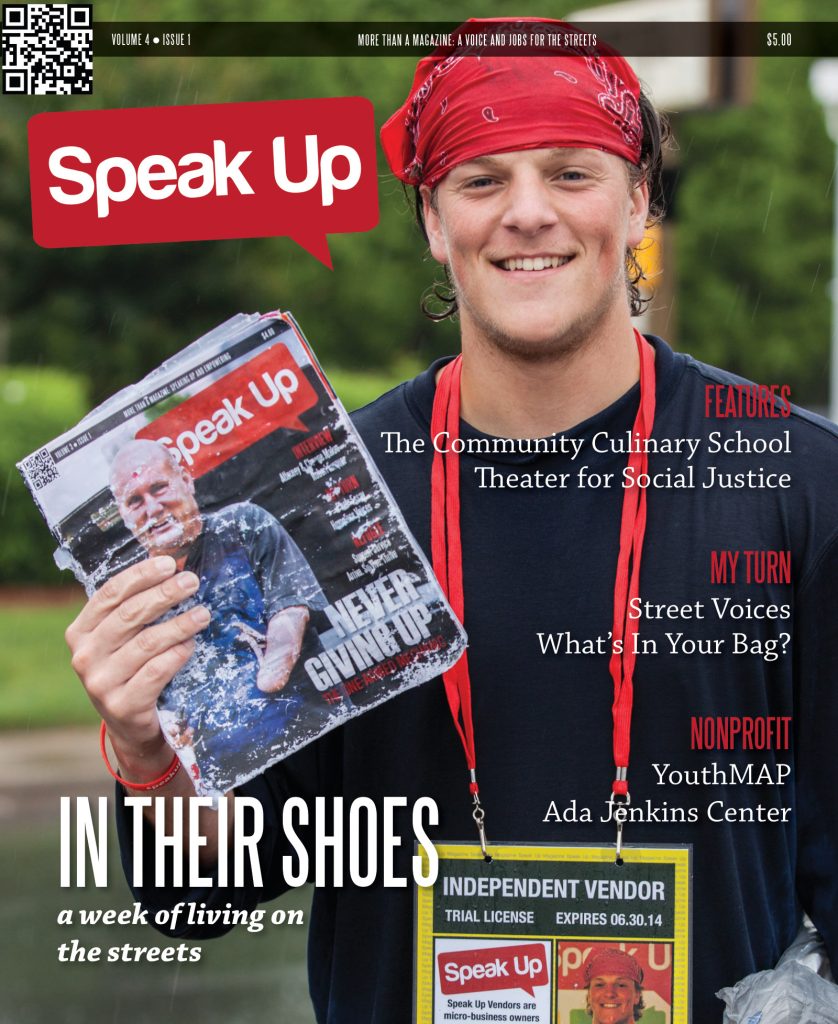
VOLUME 4 • ISSUE 1 MORE THAN A MAGAZINE: A VOICE AND JOBS FOR THE STREETS $5.00
FEATURES
The Community Culinary School
Theater for Social Justice
MY TURN
Street Voices
What’s In Your Bag?
NONPROFIT
YouthMAP
Ada Jenkins Center
IN THEIR SHOES
a week of living on
the streets
Page 2
THIS MAGAZINE CREATES JOBS AND
GIVES HOPE.
Editor-in-Chief Photographers
Noah Driver Chris Austin, Katie Holland, Scott
Cunningham, Bill Guidiz, Peyton Clark,
Lead Designer Ken Noblezada
Hannah Lieberman
Editors
Designers Ethan Faust, Kerry Honan, Lydia Bickell
DiemTiem Le and Cy Ferguson
Contributors
James Ni, Nate Casey, Gabriel Pureco,
Cy Ferguson, Philip Yu, Taylor Brendle,
Lydia Bickell, Morgan Mercer, Amy Lamb,
Will Vaughan
Spring 2015 Interns Board of Directors
Nate Casey, Will Vaughan, Noah Driver, Phil Felten
Jena Aldridge, Sabrina BP Lisa Koons
Bill Shaw
Executive Director Cesar Silva
Matt Shaw Eric Gorman
Street Editor Cover photo by Chris Austin
Harry Griffin
SPEAK UP MAGAZINE IS A 501(C)(3) PUBLIC CHARITY | WWW.SPEAKUPMAG.ORG| (704) 980-9885
Page 3
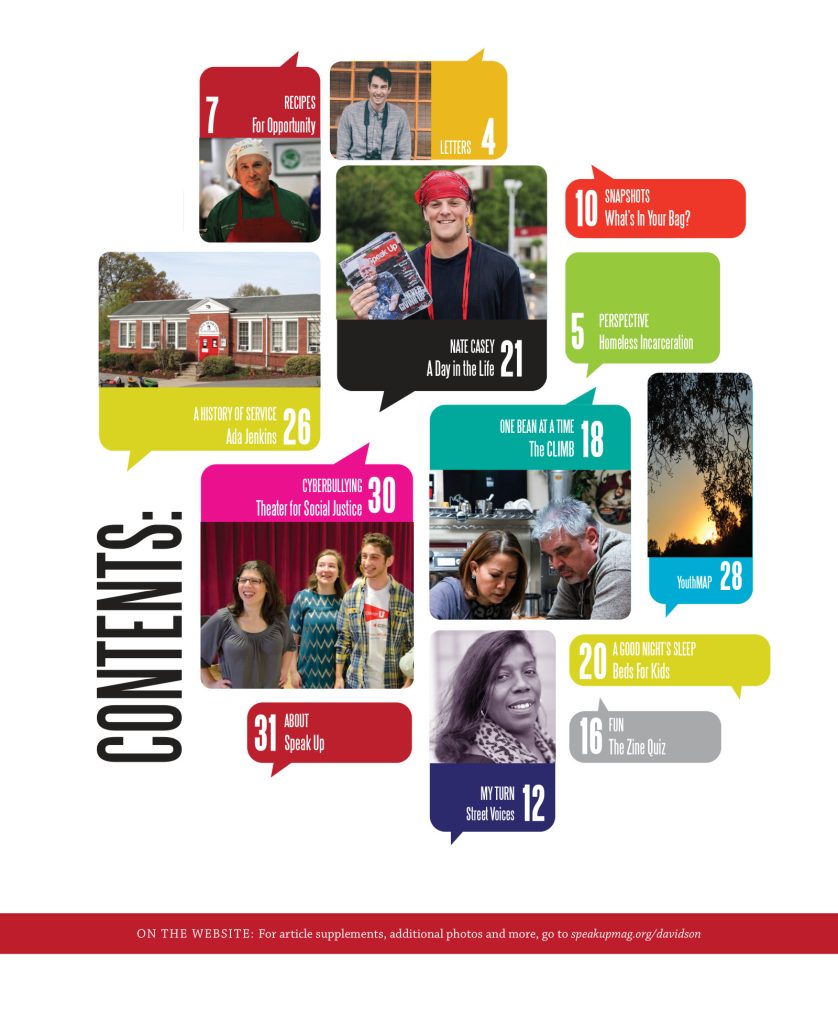
RECIPES
For Opportunity 7
LETTERS 4
SNAPSHOTS
What’s In Your Bag? 10
PERSPECTIVE
Homeless Incarceration NATE CASEY 5
A Day in the Life 21
A HISTORY OF SERVICE
ONE BEAN AT A TIME
Ada Jenkins 26 The CLIMB 18
CYBERBULLYING
Theater for Social Justice 30
YouthMAP 28
A GOOD NIGHT’S SLEEP
Beds For Kids 20
ABOUT FUN
Speak Up 31 16 The Zine QuizCONTENTS:
MY TURN
Street Voices 12
ON THE WEBSITE: For article supplements, additional photos and more, go to speakupmag.org/davidson
Page 4
4
graduate education. We knew right from
the start we were fortunate to have him.
After a successful summer of participat-
ing in the agony and ecstasy of nonprofit
homeless magazine publishing, he re-
turned to school as a full-time student. EXECUTIVE DIRECTOR Shortly after that, he pitched the idea of
forming a student group at school thatLETTERS letter would produce the next edition of Speak
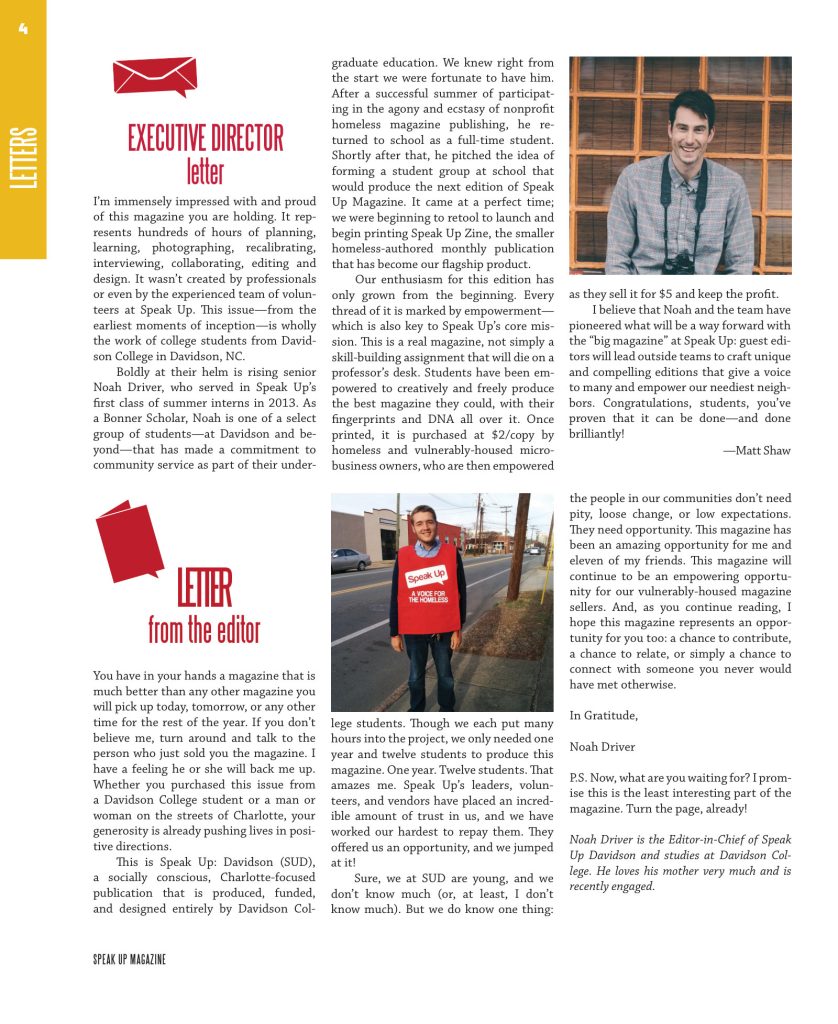
I’m immensely impressed with and proud Up Magazine. It came at a perfect time;
of this magazine you are holding. It rep- we were beginning to retool to launch and
resents hundreds of hours of planning, begin printing Speak Up Zine, the smaller
learning, photographing, recalibrating, homeless-authored monthly publication
interviewing, collaborating, editing and that has become our flagship product.
design. It wasn’t created by professionals Our enthusiasm for this edition has
or even by the experienced team of volun- only grown from the beginning. Every as they sell it for $5 and keep the profit.
teers at Speak Up. This issue—from the thread of it is marked by empowerment— I believe that Noah and the team have
earliest moments of inception—is wholly which is also key to Speak Up’s core mis- pioneered what will be a way forward with
the work of college students from David- sion. This is a real magazine, not simply a the “big magazine” at Speak Up: guest edi-
son College in Davidson, NC. skill-building assignment that will die on a tors will lead outside teams to craft unique
Boldly at their helm is rising senior professor’s desk. Students have been em- and compelling editions that give a voice
Noah Driver, who served in Speak Up’s powered to creatively and freely produce to many and empower our neediest neigh-
first class of summer interns in 2013. As the best magazine they could, with their bors. Congratulations, students, you’ve
a Bonner Scholar, Noah is one of a select fingerprints and DNA all over it. Once proven that it can be done—and done
group of students—at Davidson and be- printed, it is purchased at $2/copy by brilliantly!
yond—that has made a commitment to homeless and vulnerably-housed micro- —Matt Shaw
community service as part of their under- business owners, who are then empowered
the people in our communities don’t need
pity, loose change, or low expectations.
SpeakUp They need opportunity. This magazine has
been an amazing opportunity for me and
eleven of my friends. This magazine will
continue to be an empowering opportu-
nity for our vulnerably-housed magazine LETTER sellers. And, as you continue reading, I
hope this magazine represents an oppor- from the editor tunity for you too: a chance to contribute,
a chance to relate, or simply a chance to
connect with someone you never would You have in your hands a magazine that is
have met otherwise. much better than any other magazine you
will pick up today, tomorrow, or any other
In Gratitude, time for the rest of the year. If you don’t lege students. Though we each put many
believe me, turn around and talk to the hours into the project, we only needed one
Noah Driver person who just sold you the magazine. I year and twelve students to produce this
have a feeling he or she will back me up. magazine. One year. Twelve students. That
P.S. Now, what are you waiting for? I prom- Whether you purchased this issue from amazes me. Speak Up’s leaders, volun-
ise this is the least interesting part of the a Davidson College student or a man or teers, and vendors have placed an incred-
magazine. Turn the page, already! woman on the streets of Charlotte, your ible amount of trust in us, and we have
generosity is already pushing lives in posi- worked our hardest to repay them. They
Noah Driver is the Editor-in-Chief of Speak tive directions. offered us an opportunity, and we jumped
Up Davidson and studies at Davidson Col- This is Speak Up: Davidson (SUD), at it!
lege. He loves his mother very much and is a socially conscious, Charlotte-focused Sure, we at SUD are young, and we
recently engaged. publication that is produced, funded, don’t know much (or, at least, I don’t
and designed entirely by Davidson Col- know much). But we do know one thing:
SPEAK UP MAGAZINE
Page 5
5
AN IMPERFECT SOLUTION
THE TRAGEDY OF INCARCERATION PERSPECTIVE
fore arrest than a person in the general “If I get out the hole, I got to get a job
US population. This makes the homeless and work my time back and come home a little
incarceration rate, when race and gender sooner.”
are factored in, 4 to 6 times higher than The homelessness-incarceration cycle,
that of the general population. About 49% however, is not one that falls on the backs
of people on the streets have experienced of police officers, or even the flawed crimi-
some type of jail/prison time in their lives. nal justice system. Instead, it is embedded
The catch is that the homeless/incarcera- in the most basic sentiments of the major-
tion cycle is not a representation of much ity. Everywhere we look in major cities like
higher crime rates, but a reflection of the Charlotte, we can see instances of public
stigmas that surround both homeless and or police mistreatment of the homeless.
incarcerated individuals.
“When I do good, things go wrong. When I
cut up, everything is sweet like sugar.”
For instance, homelessness is per- Once they are released from
ceived as a threat to ‘civil society.’ It is seen
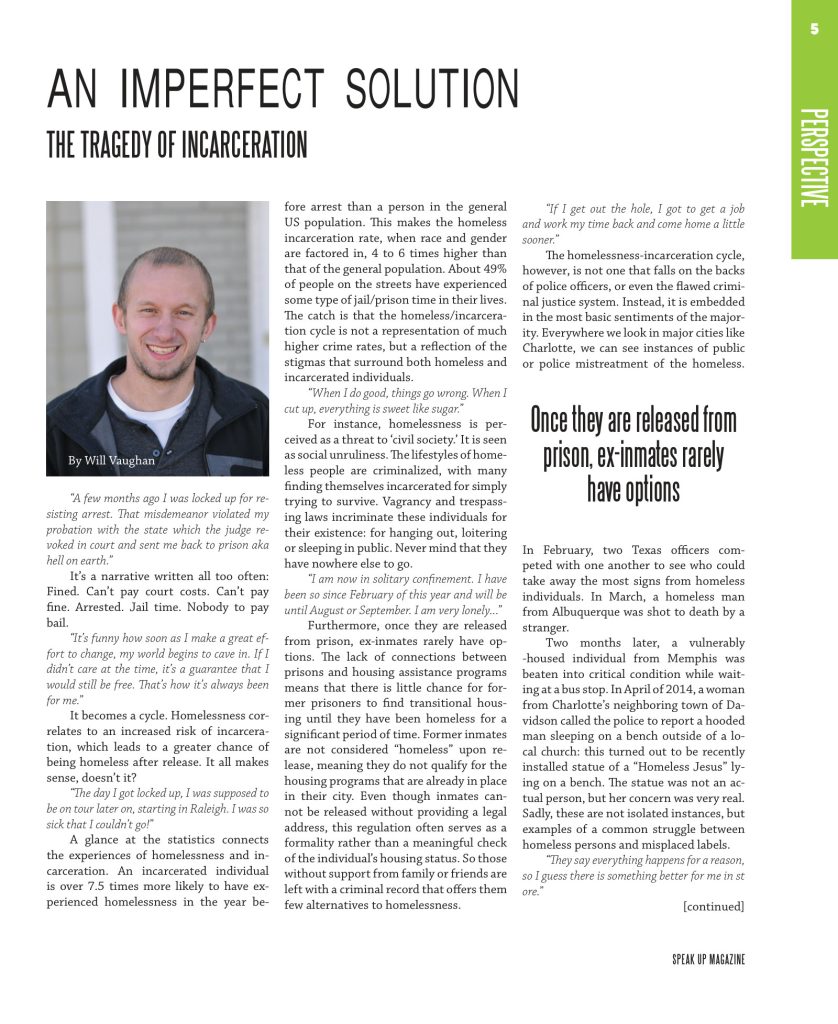
as social unruliness. The lifestyles of home- By Will Vaughan prison, ex-inmates rarely less people are criminalized, with many
finding themselves incarcerated for simply “A few months ago I was locked up for re- trying to survive. Vagrancy and trespass- have options
sisting arrest. That misdemeanor violated my ing laws incriminate these individuals for
probation with the state which the judge re- their existence: for hanging out, loitering
voked in court and sent me back to prison aka or sleeping in public. Never mind that they In February, two Texas officers com-
hell on earth.” have nowhere else to go. peted with one another to see who could
It’s a narrative written all too often: “I am now in solitary confinement. I have take away the most signs from homeless
Fined. Can’t pay court costs. Can’t pay been so since February of this year and will be individuals. In March, a homeless man
fine. Arrested. Jail time. Nobody to pay until August or September. I am very lonely…” from Albuquerque was shot to death by a
bail. Furthermore, once they are released stranger.
“It’s funny how soon as I make a great ef- from prison, ex-inmates rarely have op- Two months later, a vulnerably
fort to change, my world begins to cave in. If I tions. The lack of connections between -housed individual from Memphis was
didn’t care at the time, it’s a guarantee that I prisons and housing assistance programs beaten into critical condition while wait-
would still be free. That’s how it’s always been means that there is little chance for for- ing at a bus stop. In April of 2014, a woman
for me.” mer prisoners to find transitional hous- from Charlotte’s neighboring town of Da-
It becomes a cycle. Homelessness cor- ing until they have been homeless for a vidson called the police to report a hooded
relates to an increased risk of incarcera- significant period of time. Former inmates man sleeping on a bench outside of a lo-
tion, which leads to a greater chance of are not considered “homeless” upon re- cal church: this turned out to be recently
being homeless after release. It all makes lease, meaning they do not qualify for the installed statue of a “Homeless Jesus” ly-
sense, doesn’t it? housing programs that are already in place ing on a bench. The statue was not an ac-
“The day I got locked up, I was supposed to in their city. Even though inmates can- tual person, but her concern was very real.
be on tour later on, starting in Raleigh. I was so not be released without providing a legal Sadly, these are not isolated instances, but
sick that I couldn’t go!” address, this regulation often serves as a examples of a common struggle between
A glance at the statistics connects formality rather than a meaningful check homeless persons and misplaced labels.
the experiences of homelessness and in- of the individual’s housing status. So those “They say everything happens for a reason,
carceration. An incarcerated individual without support from family or friends are so I guess there is something better for me in st
is over 7.5 times more likely to have ex- left with a criminal record that offers them ore.”
perienced homelessness in the year be- few alternatives to homelessness. [continued]
SPEAK UP MAGAZINE
Page 6
6
our history. Still, reconfiguring our under-
standing of homelessness not as a crime,
but as an unfortunate situation can chip
away at the fear and uneasiness that de-
fine interactions with homeless individu-
als. At the very least, it can keep us from
dehumanizing the marginalized, the first
step toward broader destigmatization.
“Please, please pray for me…”PERSPECTIVE I am reminded of the work of Char-
lotte police officers Brad Hall and Bob
Goodwin, who work on CMPD’s homeless
affairs cases. The Charlotte Observer and
even USA Today have covered their com-
passionate actions toward homeless indi-
viduals throughout Charlotte. They have
no desire to bring homeless people to jail.
They simply want to make sure that all citi-
zens, regardless of housing, are safe inside
this city. Shouldn’t we all want that? We
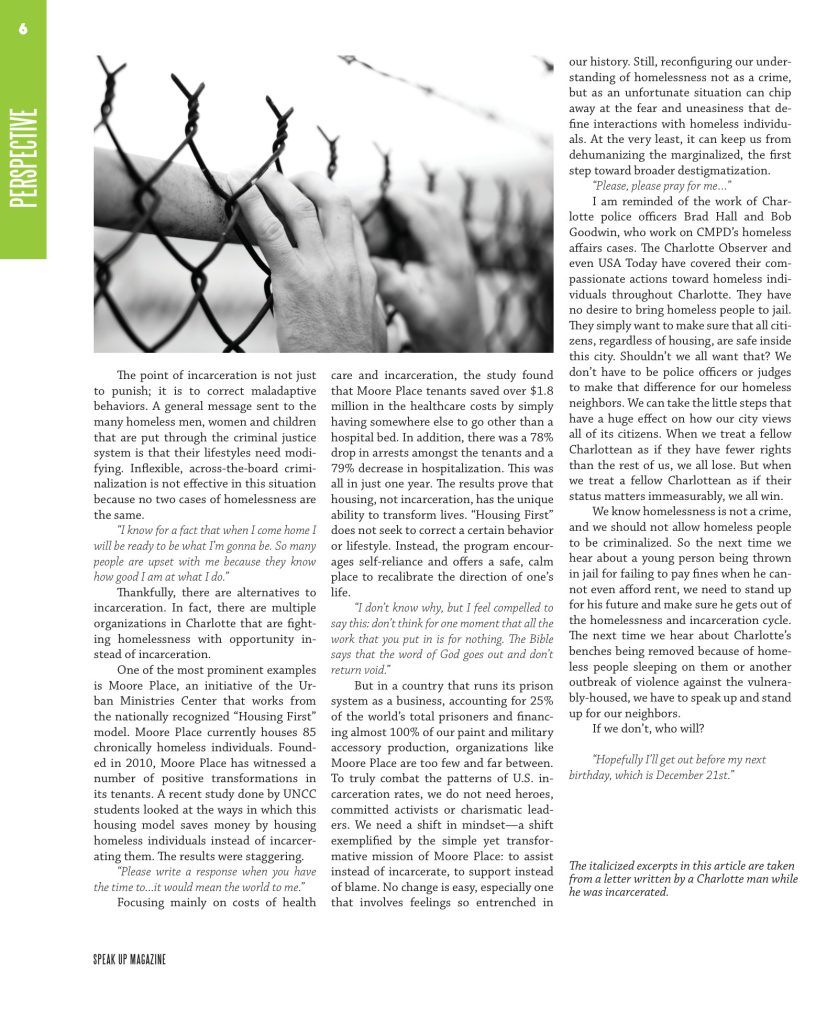
The point of incarceration is not just care and incarceration, the study found don’t have to be police officers or judges
to punish; it is to correct maladaptive that Moore Place tenants saved over $1.8 to make that difference for our homeless
behaviors. A general message sent to the million in the healthcare costs by simply neighbors. We can take the little steps that
many homeless men, women and children having somewhere else to go other than a have a huge effect on how our city views
that are put through the criminal justice hospital bed. In addition, there was a 78% all of its citizens. When we treat a fellow
system is that their lifestyles need modi- drop in arrests amongst the tenants and a Charlottean as if they have fewer rights
fying. Inflexible, across-the-board crimi- 79% decrease in hospitalization. This was than the rest of us, we all lose. But when
nalization is not effective in this situation all in just one year. The results prove that we treat a fellow Charlottean as if their
because no two cases of homelessness are housing, not incarceration, has the unique status matters immeasurably, we all win.
the same. ability to transform lives. “Housing First” We know homelessness is not a crime,
“I know for a fact that when I come home I does not seek to correct a certain behavior and we should not allow homeless people
will be ready to be what I’m gonna be. So many or lifestyle. Instead, the program encour- to be criminalized. So the next time we
people are upset with me because they know ages self-reliance and offers a safe, calm hear about a young person being thrown
how good I am at what I do.” place to recalibrate the direction of one’s in jail for failing to pay fines when he can-
Thankfully, there are alternatives to life. not even afford rent, we need to stand up
incarceration. In fact, there are multiple “I don’t know why, but I feel compelled to for his future and make sure he gets out of
organizations in Charlotte that are fight- say this: don’t think for one moment that all the the homelessness and incarceration cycle.
ing homelessness with opportunity in- work that you put in is for nothing. The Bible The next time we hear about Charlotte’s
stead of incarceration. says that the word of God goes out and don’t benches being removed because of home-
One of the most prominent examples return void.” less people sleeping on them or another
is Moore Place, an initiative of the Ur- But in a country that runs its prison outbreak of violence against the vulnera-
ban Ministries Center that works from system as a business, accounting for 25% bly-housed, we have to speak up and stand
the nationally recognized “Housing First” of the world’s total prisoners and financ- up for our neighbors.
model. Moore Place currently houses 85 ing almost 100% of our paint and military If we don’t, who will?
chronically homeless individuals. Found- accessory production, organizations like
ed in 2010, Moore Place has witnessed a Moore Place are too few and far between. “Hopefully I’ll get out before my next
number of positive transformations in To truly combat the patterns of U.S. in- birthday, which is December 21st.”
its tenants. A recent study done by UNCC carceration rates, we do not need heroes,
students looked at the ways in which this committed activists or charismatic lead-
housing model saves money by housing ers. We need a shift in mindset—a shift
homeless individuals instead of incarcer- exemplified by the simple yet transfor-
ating them. The results were staggering. mative mission of Moore Place: to assist
The italicized excerpts in this article are taken “Please write a response when you have instead of incarcerate, to support instead from a letter written by a Charlotte man while
the time to…it would mean the world to me.” of blame. No change is easy, especially one he was incarcerated.
Focusing mainly on costs of health that involves feelings so entrenched in
SPEAK UP MAGAZINE
Page 7
7
RECIPES
EMPOWERMENT FOR
OPPORTUNITY
Nonprofit culinary
school trains those
with barriers to
employment
By ARSALAAN HASHMI and NOAH DRIVER
Photography by NOAH DRIVER and PEYTON CLARK
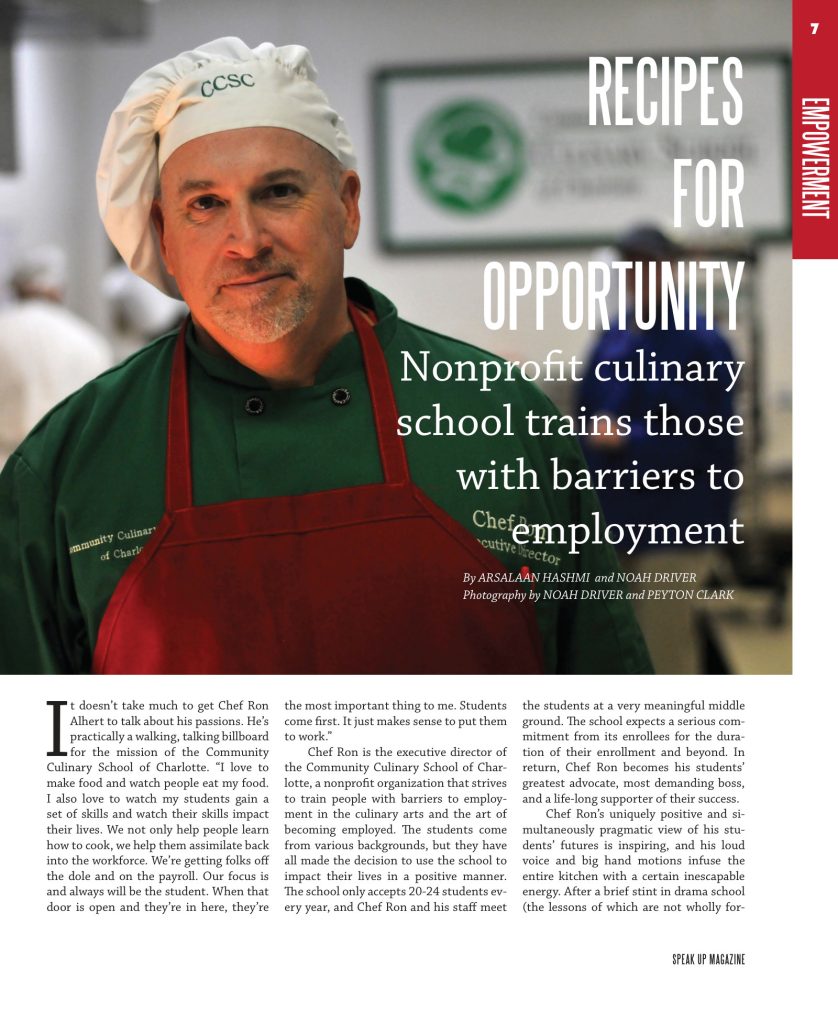
t doesn’t take much to get Chef Ron the most important thing to me. Students the students at a very meaningful middle
Alhert to talk about his passions. He’s come first. It just makes sense to put them ground. The school expects a serious com-
practically a walking, talking billboard to work.” mitment from its enrollees for the dura-
for the mission of the Community Chef Ron is the executive director of tion of their enrollment and beyond. In
Culinary School of Charlotte. “I love to the Community Culinary School of Char- return, Chef Ron becomes his students’I
make food and watch people eat my food. lotte, a nonprofit organization that strives greatest advocate, most demanding boss,
I also love to watch my students gain a to train people with barriers to employ- and a life-long supporter of their success.
set of skills and watch their skills impact ment in the culinary arts and the art of Chef Ron’s uniquely positive and si-
their lives. We not only help people learn becoming employed. The students come multaneously pragmatic view of his stu-
how to cook, we help them assimilate back from various backgrounds, but they have dents’ futures is inspiring, and his loud
into the workforce. We’re getting folks off all made the decision to use the school to voice and big hand motions infuse the
the dole and on the payroll. Our focus is impact their lives in a positive manner. entire kitchen with a certain inescapable
and always will be the student. When that The school only accepts 20-24 students ev- energy. After a brief stint in drama school
door is open and they’re in here, they’re ery year, and Chef Ron and his staff meet (the lessons of which are not wholly for-
SPEAK UP MAGAZINE
Page 8
8
EMPOWERMENT
gotten by the charismatic chef), Alhert fell In 2011, she lost her job and providing for These hopes turned into the newest divi-
in love with cooking and decided to make her children became increasingly difficult. sion of the Community Culinary School:
a career out of his passion. He worked his She was accepted, graduated and has been the Bistro Buggy! This mobile food cart
way up through hotel kitchens, eventually working at the culinary school as a pro- goes into “food deserts” in the Charlotte
becoming the executive chef for a hotel gram administrator ever since. Chef Ron area and offers high-quality, chef-pre-
chain. Then, he read about Community emphasizes that the goal is for the school pared meals for individuals and families
Culinary School and the work of its found- to be “completely run by alumni, run on its with limited food options. “Hard skills are
er, Chef Linda Vogler. own two feet.” He dreams of a day when making food, soft skills are learning social
He began work at the school soon af- he is replaced by one of his own students. skills and social responsibility,” Chef Ron
ter and replaced Vogler when she left a few I cannot think of a stronger recommenda- explains. “The food industry is hard, but
years later. In the sixteen years since, Chef tion for the quality of education that CCS the reward is people enjoying your prod-
Ron has helped turn CCS into an example students receive. uct. And when it’s people in your own
for other nonprofits all around Charlotte. Chef Ron’s work doesn’t stop at gradu- community who need you and your skills,
He has put the students at the center of ation day. In 2001, he and his staff decided it doesn’t get much better than that.”
his work from the beginning, and that to work away from reliance on donations The Bistro Buggy! was a great idea,
mission has paid off tremendously. With for the school’s continued operation. They but CCS needed funding to get more than
over 700 graduates working in kitchens created Encore Catering, the moneymak- one of the $20,000 carts on the road. So,
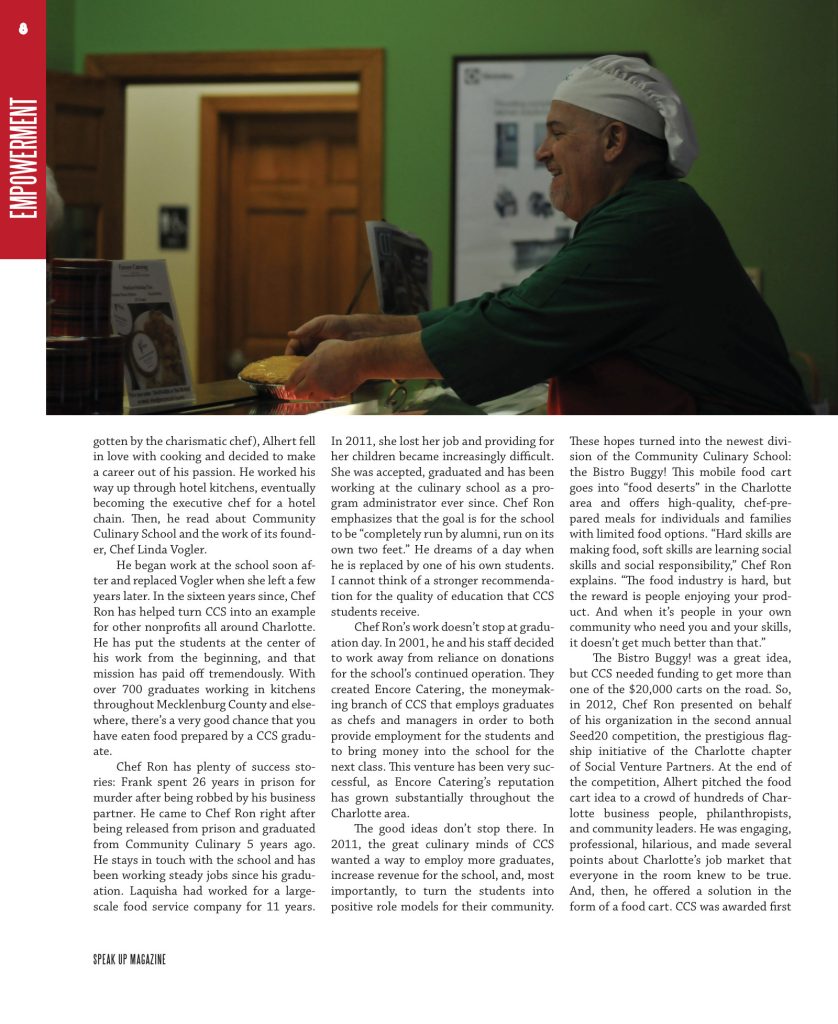
throughout Mecklenburg County and else- ing branch of CCS that employs graduates in 2012, Chef Ron presented on behalf
where, there’s a very good chance that you as chefs and managers in order to both of his organization in the second annual
have eaten food prepared by a CCS gradu- provide employment for the students and Seed20 competition, the prestigious flag-
ate. to bring money into the school for the ship initiative of the Charlotte chapter
Chef Ron has plenty of success sto- next class. This venture has been very suc- of Social Venture Partners. At the end of
ries: Frank spent 26 years in prison for cessful, as Encore Catering’s reputation the competition, Alhert pitched the food
murder after being robbed by his business has grown substantially throughout the cart idea to a crowd of hundreds of Char-
partner. He came to Chef Ron right after Charlotte area. lotte business people, philanthropists,
being released from prison and graduated The good ideas don’t stop there. In and community leaders. He was engaging,
from Community Culinary 5 years ago. 2011, the great culinary minds of CCS professional, hilarious, and made several
He stays in touch with the school and has wanted a way to employ more graduates, points about Charlotte’s job market that
been working steady jobs since his gradu- increase revenue for the school, and, most everyone in the room knew to be true.
ation. Laquisha had worked for a large- importantly, to turn the students into And, then, he offered a solution in the
scale food service company for 11 years. positive role models for their community. form of a food cart. CCS was awarded first
SPEAK UP MAGAZINE
Page 9
9
To volunteer for, donate to, or learn more about
the Community Culinary School of
Charlotte, visit
www.communityculinary.org EMPOWERMENT
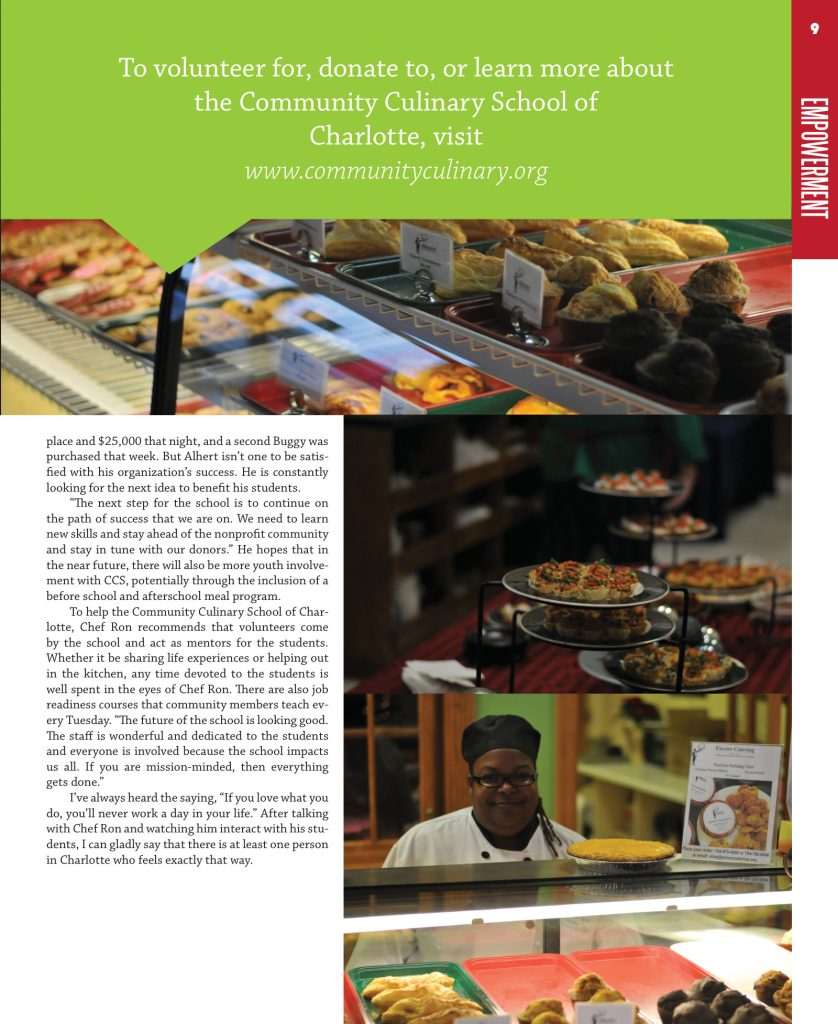
place and $25,000 that night, and a second Buggy was
purchased that week. But Alhert isn’t one to be satis-
fied with his organization’s success. He is constantly
looking for the next idea to benefit his students.
“The next step for the school is to continue on
the path of success that we are on. We need to learn
new skills and stay ahead of the nonprofit community
and stay in tune with our donors.” He hopes that in
the near future, there will also be more youth involve-
ment with CCS, potentially through the inclusion of a
before school and afterschool meal program.
To help the Community Culinary School of Char-
lotte, Chef Ron recommends that volunteers come
by the school and act as mentors for the students.
Whether it be sharing life experiences or helping out
in the kitchen, any time devoted to the students is
well spent in the eyes of Chef Ron. There are also job
readiness courses that community members teach ev-
ery Tuesday. “The future of the school is looking good.
The staff is wonderful and dedicated to the students
and everyone is involved because the school impacts
us all. If you are mission-minded, then everything
gets done.”
I’ve always heard the saying, “If you love what you
do, you’ll never work a day in your life.” After talking
with Chef Ron and watching him interact with his stu-
dents, I can gladly say that there is at least one person
in Charlotte who feels exactly that way.
SPEAK UP MAGAZINE
Page 10
10
Ruth’s vendor licenseGLIMPSE
Ruth keeps letters from her
adult daughter (who lives in
another state) so that she’s WHAT’S
never too far away
IN YOUR
BAG?
Not only does this little
bag have Ruth’s name
on it, but inside is a
foldable grocery bag!
SPEAK UP MAGAZINE
Page 11
11
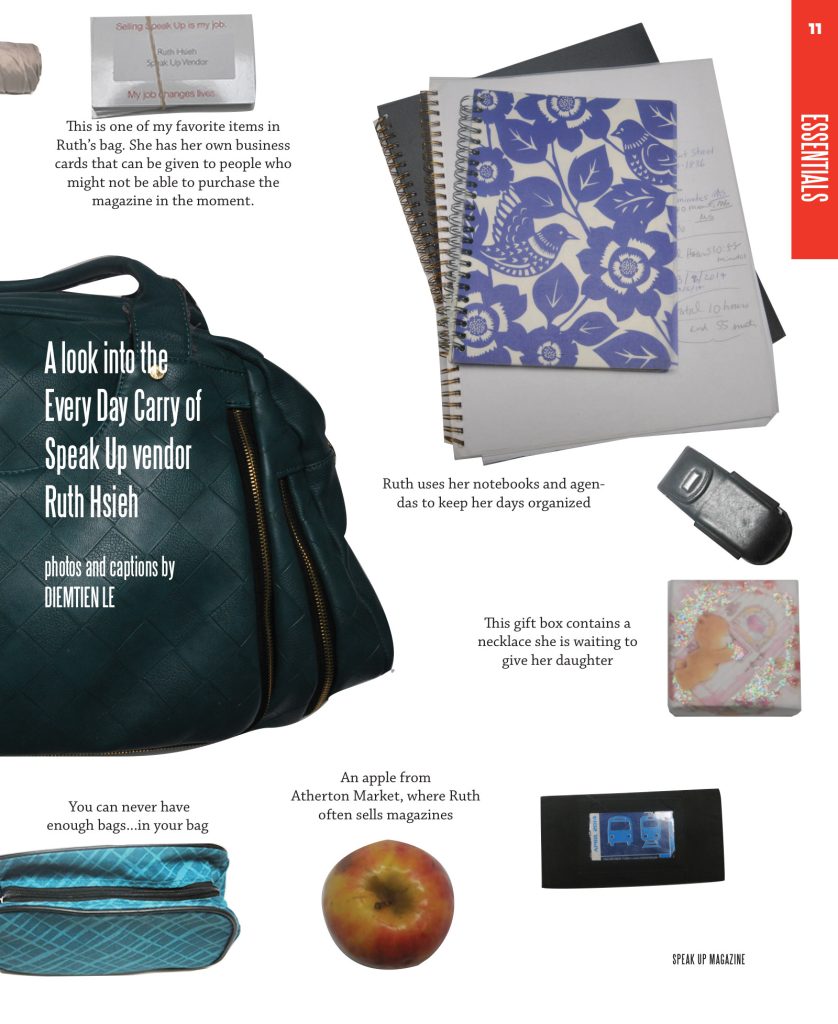
This is one of my favorite items in
Ruth’s bag. She has her own business
cards that can be given to people who
might not be able to purchase the ESSENTIALS magazine in the moment.
A look into the
Every Day Carry of
Speak Up vendor
Ruth uses her notebooks and agen-
das to keep her days organizedRuth Hsieh
photos and captions by
DIEMTIEN LE
This gift box contains a
necklace she is waiting to
give her daughter
An apple from
Atherton Market, where Ruth
You can never have often sells magazines
enough bags…in your bag
SPEAK UP MAGAZINE
Page 12
12
VOICES
STREET
STREET VOICES
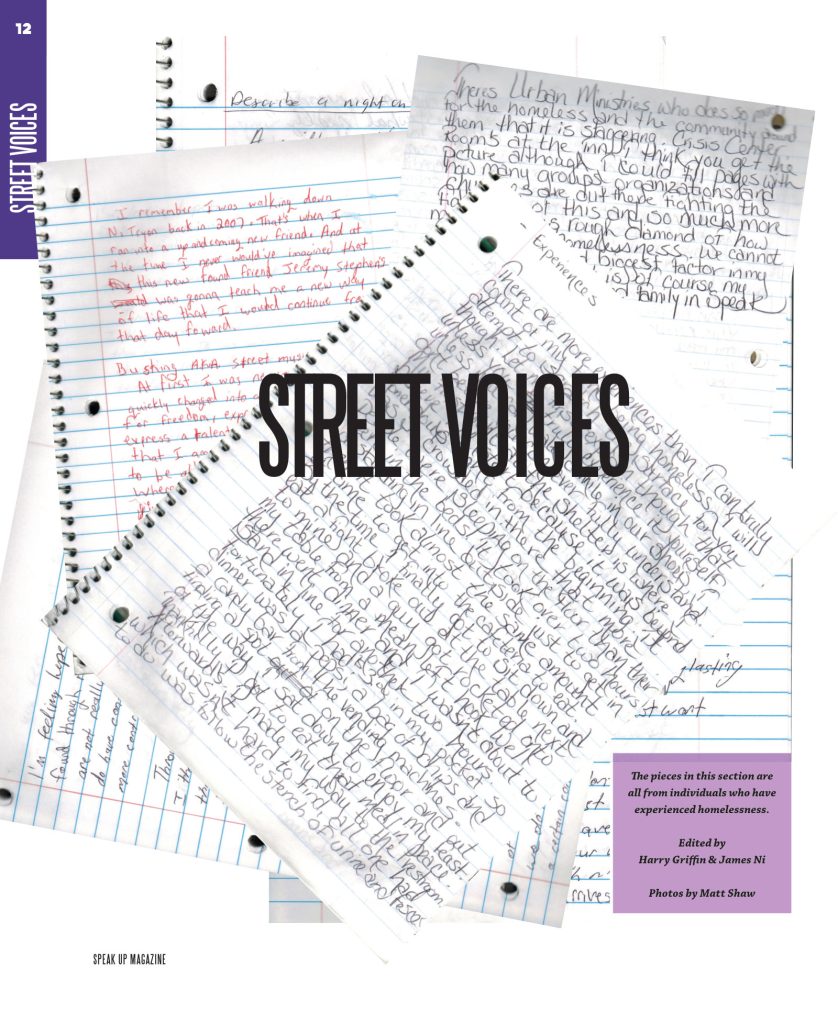
The pieces in this section are
all from individuals who have
experienced homelessness.
Edited by
Harry Griffin & James Ni
Photos by Matt Shaw
SPEAK UP MAGAZINE
Page 13
13
These Are The STREET
VOICESGood Days
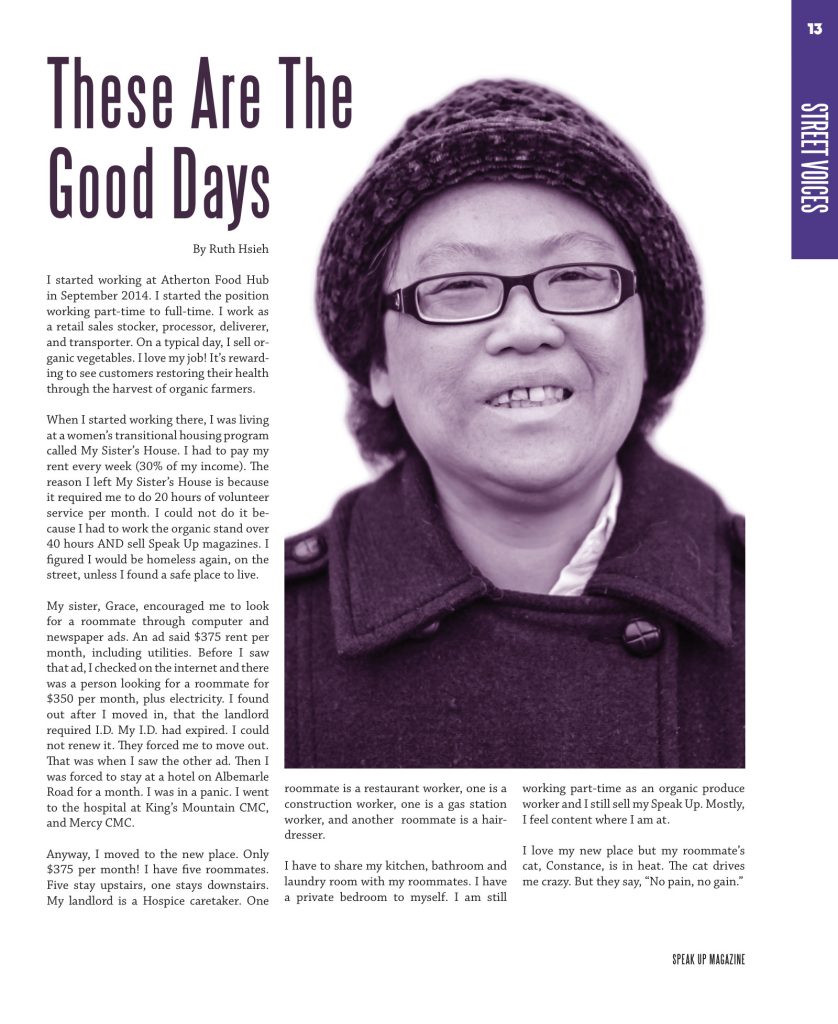
By Ruth Hsieh
I started working at Atherton Food Hub
in September 2014. I started the position
working part-time to full-time. I work as
a retail sales stocker, processor, deliverer,
and transporter. On a typical day, I sell or-
ganic vegetables. I love my job! It’s reward-
ing to see customers restoring their health
through the harvest of organic farmers.
When I started working there, I was living
at a women’s transitional housing program
called My Sister’s House. I had to pay my
rent every week (30% of my income). The
reason I left My Sister’s House is because
it required me to do 20 hours of volunteer
service per month. I could not do it be-
cause I had to work the organic stand over
40 hours AND sell Speak Up magazines. I
figured I would be homeless again, on the
street, unless I found a safe place to live.
My sister, Grace, encouraged me to look
for a roommate through computer and
newspaper ads. An ad said $375 rent per
month, including utilities. Before I saw
that ad, I checked on the internet and there
was a person looking for a roommate for
$350 per month, plus electricity. I found
out after I moved in, that the landlord
required I.D. My I.D. had expired. I could
not renew it. They forced me to move out.
That was when I saw the other ad. Then I
was forced to stay at a hotel on Albemarle
Road for a month. I was in a panic. I went roommate is a restaurant worker, one is a working part-time as an organic produce
to the hospital at King’s Mountain CMC, construction worker, one is a gas station worker and I still sell my Speak Up. Mostly,
and Mercy CMC. worker, and another roommate is a hair- I feel content where I am at.
dresser.
Anyway, I moved to the new place. Only I love my new place but my roommate’s
$375 per month! I have five roommates. I have to share my kitchen, bathroom and cat, Constance, is in heat. The cat drives
Five stay upstairs, one stays downstairs. laundry room with my roommates. I have me crazy. But they say, “No pain, no gain.”
My landlord is a Hospice caretaker. One a private bedroom to myself. I am still
SPEAK UP MAGAZINE
Page 14
14
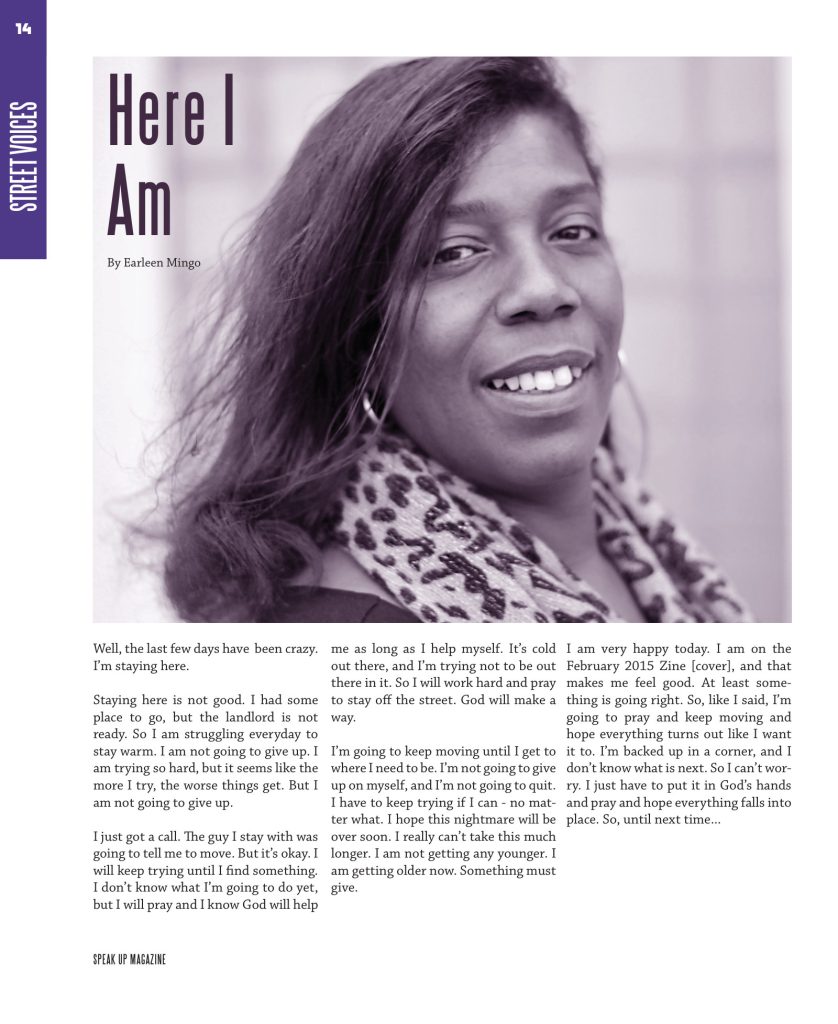
VOICES Here I
STREET Am
By Earleen Mingo
Well, the last few days have been crazy. me as long as I help myself. It’s cold I am very happy today. I am on the
I’m staying here. out there, and I’m trying not to be out February 2015 Zine [cover], and that
there in it. So I will work hard and pray makes me feel good. At least some-
Staying here is not good. I had some to stay off the street. God will make a thing is going right. So, like I said, I’m
place to go, but the landlord is not way. going to pray and keep moving and
ready. So I am struggling everyday to hope everything turns out like I want
stay warm. I am not going to give up. I I’m going to keep moving until I get to it to. I’m backed up in a corner, and I
am trying so hard, but it seems like the where I need to be. I’m not going to give don’t know what is next. So I can’t wor-
more I try, the worse things get. But I up on myself, and I’m not going to quit. ry. I just have to put it in God’s hands
am not going to give up. I have to keep trying if I can – no mat- and pray and hope everything falls into
ter what. I hope this nightmare will be place. So, until next time…
I just got a call. The guy I stay with was over soon. I really can’t take this much
going to tell me to move. But it’s okay. I longer. I am not getting any younger. I
will keep trying until I find something. am getting older now. Something must
I don’t know what I’m going to do yet, give.
but I will pray and I know God will help
SPEAK UP MAGAZINE
Page 15
15
I ponder the nature of the men and wom-
en who operate homeless shelters. I have
personally met quite a few in my tramp’s
journey. All of them seem to have an in-
tention of helping the downtrodden. Yet,
in short order, the overwhelming problem STREET consumes the best of intentions.
Somewhere between the mentally ill, drug
addicts, the thieves and liars, and the ba- sically lazy, they find themselves jaded to VOICES
the illusion of philanthropy.
Trapped in a world of the homeless and the
endless ocean of personal tragedy, each in-
dividual represents the quenched glimmer
of hope. It’s usually replaced with a hard-
ness which shelters their open hearts from
the reality of society.
Yet, I have met a precious few, the most
idealistic of us all, whose genuine love for
mankind cannot be turned by a sea of ad-
versity. Usually those who find themselves
in a shelter, who are there by sheer bad
luck, gravitate to these people. Unfortu- Shelter nately, I have found these individuals do
not have the power to alleviate the prob-
lems of the many into a solution for the
few.
Amidst the jaded, the precious, and the Living simply aghast, a homeless person is faced
with an almost insurmountable problem
By Mark Gansert of bootstrapping themselves to the main-
stream of society from a metal bunk bed
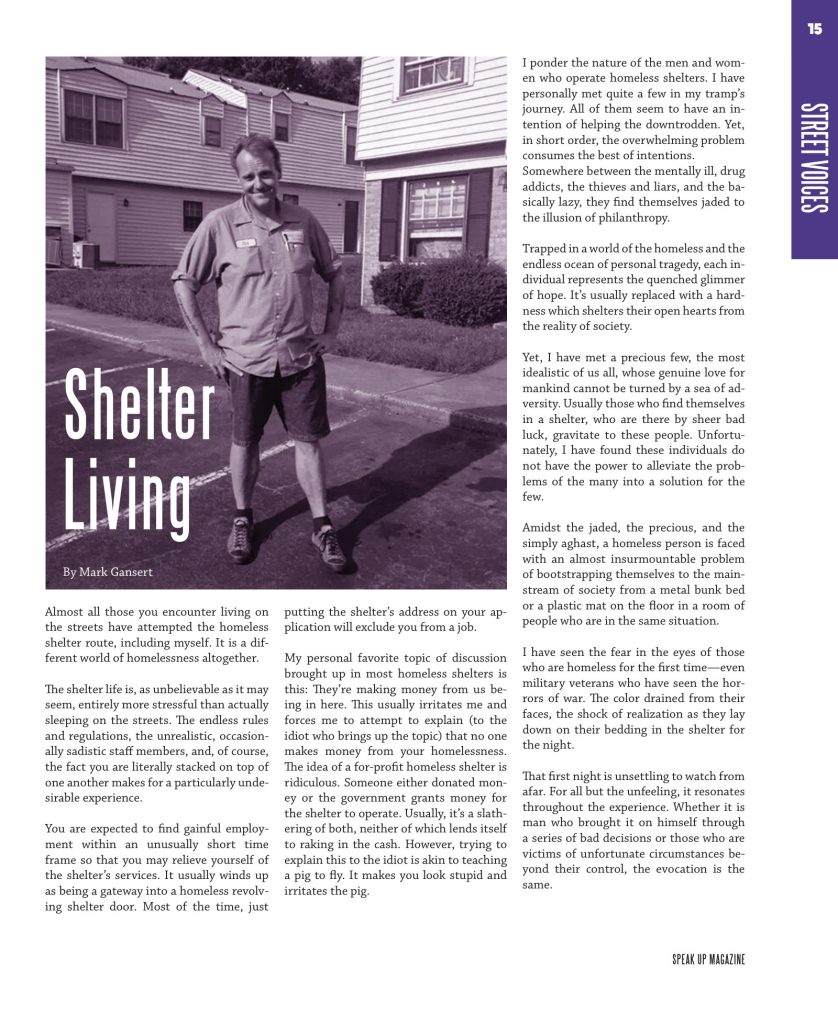
or a plastic mat on the floor in a room ofAlmost all those you encounter living on putting the shelter’s address on your ap-
people who are in the same situation.the streets have attempted the homeless plication will exclude you from a job.
shelter route, including myself. It is a dif-
I have seen the fear in the eyes of thoseferent world of homelessness altogether. My personal favorite topic of discussion
who are homeless for the first time—even brought up in most homeless shelters is
military veterans who have seen the hor-The shelter life is, as unbelievable as it may this: They’re making money from us be-
rors of war. The color drained from theirseem, entirely more stressful than actually ing in here. This usually irritates me and
faces, the shock of realization as they laysleeping on the streets. The endless rules forces me to attempt to explain (to the
down on their bedding in the shelter forand regulations, the unrealistic, occasion- idiot who brings up the topic) that no one
the night.ally sadistic staff members, and, of course, makes money from your homelessness.
the fact you are literally stacked on top of The idea of a for-profit homeless shelter is
That first night is unsettling to watch fromone another makes for a particularly unde- ridiculous. Someone either donated mon-
afar. For all but the unfeeling, it resonatessirable experience. ey or the government grants money for
throughout the experience. Whether it is the shelter to operate. Usually, it’s a slath-
man who brought it on himself throughYou are expected to find gainful employ- ering of both, neither of which lends itself
a series of bad decisions or those who arement within an unusually short time to raking in the cash. However, trying to
victims of unfortunate circumstances be-frame so that you may relieve yourself of explain this to the idiot is akin to teaching
yond their control, the evocation is thethe shelter’s services. It usually winds up a pig to fly. It makes you look stupid and
same.as being a gateway into a homeless revolv- irritates the pig.
ing shelter door. Most of the time, just
SPEAK UP MAGAZINE
Page 16
16
QUIZ] A B C [THE
QUIZ
ZINE
THE
ZINES? H I J K
YOUR speakupmag.org/zines KNOW at
YOU it Order DO
issue? WELL an
HOW Missed
1. WHO WRITES MOST OF THE ZINE ARTICLES? 3. MATCHING—WRITE THE CORRESPONDING LETTER TO
[a] Volunteers IDENTIFY THE VENDOR ON THE COVER:
[b] College students and interns
____ Renee ____ Ruth [c] Homeless and vulnerably-housed writers
[d] Amazon Mechanical Turk ____ Sidewalk ____ Franklin
____ Chuck ____ Laurie
2. WHO WROTE “UNMENTIONABLES”—ABOUT SEXUAL
____ Randy ____ Tawanna AGGRESSION TOWARD WOMEN ON THE STREETS?
[a] Mike Kendrick ____ Matt ____ Sheila
[b] Renee Rop ____ Big Issue Vendor 🙂 ____ Stephen
[c] Chuck Allen
[d] Sheila Apperson ____ Michal ____ Earleen
____ Franky
SPEAKSPEAK UPUP MAGAZINEMAGAZINE
Page 17
17
DecemberVolume20142 | Issue| Issue3 | $2.006 | $1.00 D E F G
WHAT
DO
YOU
KNOW?
CHARLOTTE’S
VOICE OF THE
HOMELESS
L M N O
4. WHO IS THE STREET EDITOR? 6. HOW HARD IS IT TO MAKE A DONATION TO KEEP
[a] Matt Shaw SPEAK UP STRONG AND EMPOWER PEOPLE WITH JOBS
[b] Ben Folds AND A VOICE?
[c] Harry Griffin [a] It’s Easy — visit speakupmag.org/donate
[d] Trick Question — there isn’t one!
7. WHERE IS ZINE WRITER MARK GANSERT LIVING?
5. HOW MANY PAGES ARE IN EACH ZINE [a] Charlotte
(INCLUDING THE COVER)? [b] Nashville
[a] 20 [c] Traverse City
[b] 16 [d] Miami
[c] 24
[d] 28 [d] 7. do! Please 6. [c] 5. [c] 4.
M N, B, L, D, F, I, O, A, G E, C, K, J, H, 3. [b] 2. [c] 1. ANSWERS:
SPEAK UP MAGAZINE
Page 18
18
COFFEE FOR A
CLIMB
THE CAUSE
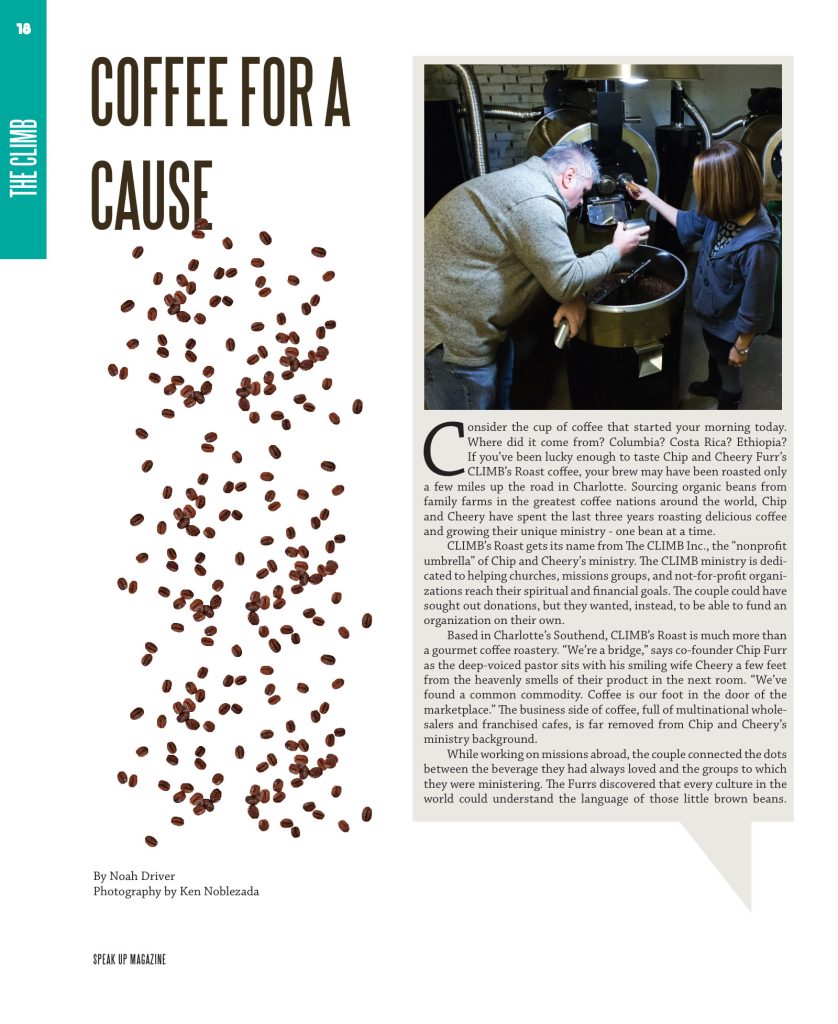
onsider the cup of coffee that started your morning today.
Where did it come from? Columbia? Costa Rica? Ethiopia?
If you’ve been lucky enough to taste Chip and Cheery Furr’s
CLIMB’s Roast coffee, your brew may have been roasted only
a few miles up the road in Charlotte. Sourcing organic beans from C
family farms in the greatest coffee nations around the world, Chip
and Cheery have spent the last three years roasting delicious coffee
and growing their unique ministry – one bean at a time.
CLIMB’s Roast gets its name from The CLIMB Inc., the “nonprofit
umbrella” of Chip and Cheery’s ministry. The CLIMB ministry is dedi-
cated to helping churches, missions groups, and not-for-profit organi-
zations reach their spiritual and financial goals. The couple could have
sought out donations, but they wanted, instead, to be able to fund an
organization on their own.
Based in Charlotte’s Southend, CLIMB’s Roast is much more than
a gourmet coffee roastery. “We’re a bridge,” says co-founder Chip Furr
as the deep-voiced pastor sits with his smiling wife Cheery a few feet
from the heavenly smells of their product in the next room. “We’ve
found a common commodity. Coffee is our foot in the door of the
marketplace.” The business side of coffee, full of multinational whole-
salers and franchised cafes, is far removed from Chip and Cheery’s
ministry background.
While working on missions abroad, the couple connected the dots
between the beverage they had always loved and the groups to which
they were ministering. The Furrs discovered that every culture in the
world could understand the language of those little brown beans.
NOAH DRIVER edited by ETHAN FAUST
By Noah Driver
Photography by Ken Noblezada
SPEAK UP MAGAZINE
Page 19
19
Coffee provided them with the ultimate
icebreaker for deeper, more meaningful
conversation. They brought this knowl-
edge home with them and even ventured
to San Francisco to become certified coffee
profilers. THE
In the four years since then, CLIMB’s
Roast has exploded in popularity and im-
pact. From local schools selling coffee bags CLIMBas a new fundraising platform to Charlotte
churches gifting packets of coffee to first-
time guests, CLIMB’s Roast is forming
bridges all over Charlotte. “Commodity
builds Community,” the pastor says, like
he is coining his favorite phrase for the
very first time.
Besides offering up their product
to other not-for-profit organizations,
CLIMB’s Roast stands on its own as a pow-
erful force in the world of local coffee pro-
duction. Now featured in forty-one Har-
ris Teeter locations and in several Rocky tied of its fragrant contents, the well-trav- In Biblical times, clothes made of
Mountain Coffee cafes, the business com- eled pouch is normally discarded en masse sackcloth were worn to show repentance
munity is taking notice. After a few sips and brought to a landfill. To avoid falling for wrongdoings from the past and to rep-
of a fresh brew, it is not difficult to under- into the same cycle of wastefulness, Chip resent a hopeful transformation toward a
stand why. and Cheery sought a “burlap rebirth” for new life. Chip sums up this Biblical foun-
The couple puts an incredible amount their neglected sacks. dation for S & A’s mission, saying “It’s
of effort into each small batch they pro- This was the beginning of Sackcloth about a second chance at something; it’s
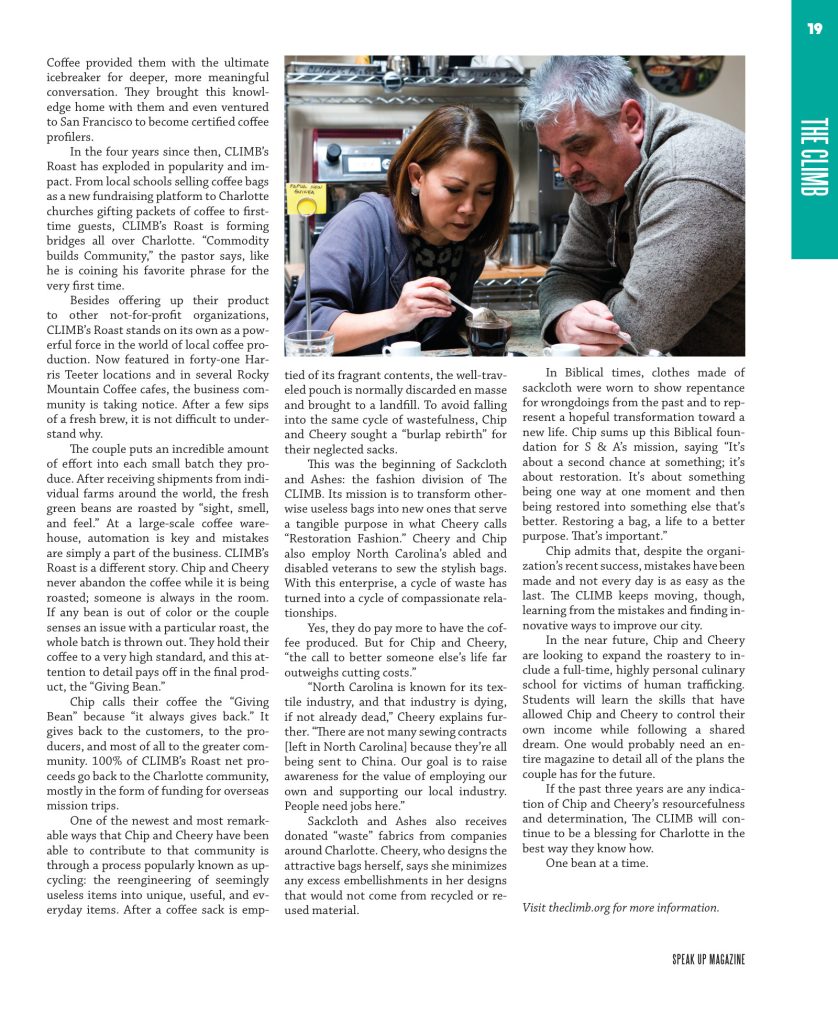
duce. After receiving shipments from indi- and Ashes: the fashion division of The about restoration. It’s about something
vidual farms around the world, the fresh CLIMB. Its mission is to transform other- being one way at one moment and then
green beans are roasted by “sight, smell, wise useless bags into new ones that serve being restored into something else that’s
and feel.” At a large-scale coffee ware- a tangible purpose in what Cheery calls better. Restoring a bag, a life to a better
house, automation is key and mistakes “Restoration Fashion.” Cheery and Chip purpose. That’s important.”
are simply a part of the business. CLIMB’s also employ North Carolina’s abled and Chip admits that, despite the organi-
Roast is a different story. Chip and Cheery disabled veterans to sew the stylish bags. zation’s recent success, mistakes have been
never abandon the coffee while it is being With this enterprise, a cycle of waste has made and not every day is as easy as the
roasted; someone is always in the room. turned into a cycle of compassionate rela- last. The CLIMB keeps moving, though,
If any bean is out of color or the couple tionships. learning from the mistakes and finding in-
senses an issue with a particular roast, the Yes, they do pay more to have the cof- novative ways to improve our city.
whole batch is thrown out. They hold their fee produced. But for Chip and Cheery, In the near future, Chip and Cheery
coffee to a very high standard, and this at- “the call to better someone else’s life far are looking to expand the roastery to in-
tention to detail pays off in the final prod- outweighs cutting costs.” clude a full-time, highly personal culinary
uct, the “Giving Bean.” “North Carolina is known for its tex- school for victims of human trafficking.
Chip calls their coffee the “Giving tile industry, and that industry is dying, Students will learn the skills that have
Bean” because “it always gives back.” It if not already dead,” Cheery explains fur- allowed Chip and Cheery to control their
gives back to the customers, to the pro- ther. “There are not many sewing contracts own income while following a shared
ducers, and most of all to the greater com- [left in North Carolina] because they’re all dream. One would probably need an en-
munity. 100% of CLIMB’s Roast net pro- being sent to China. Our goal is to raise tire magazine to detail all of the plans the
ceeds go back to the Charlotte community, awareness for the value of employing our couple has for the future.
mostly in the form of funding for overseas own and supporting our local industry. If the past three years are any indica-
mission trips. People need jobs here.” tion of Chip and Cheery’s resourcefulness
One of the newest and most remark- Sackcloth and Ashes also receives and determination, The CLIMB will con-
able ways that Chip and Cheery have been donated “waste” fabrics from companies tinue to be a blessing for Charlotte in the
able to contribute to that community is around Charlotte. Cheery, who designs the best way they know how.
through a process popularly known as up- attractive bags herself, says she minimizes One bean at a time.
cycling: the reengineering of seemingly any excess embellishments in her designs
useless items into unique, useful, and ev- that would not come from recycled or re-
eryday items. After a coffee sack is emp- used material. Visit theclimb.org for more information.
SPEAK UP MAGAZINE
Page 20
20
PROVIDING A GOOD NIGHT’S SLEEP
KIDS by NOAH DRIVER edited by ETHAN FAUST
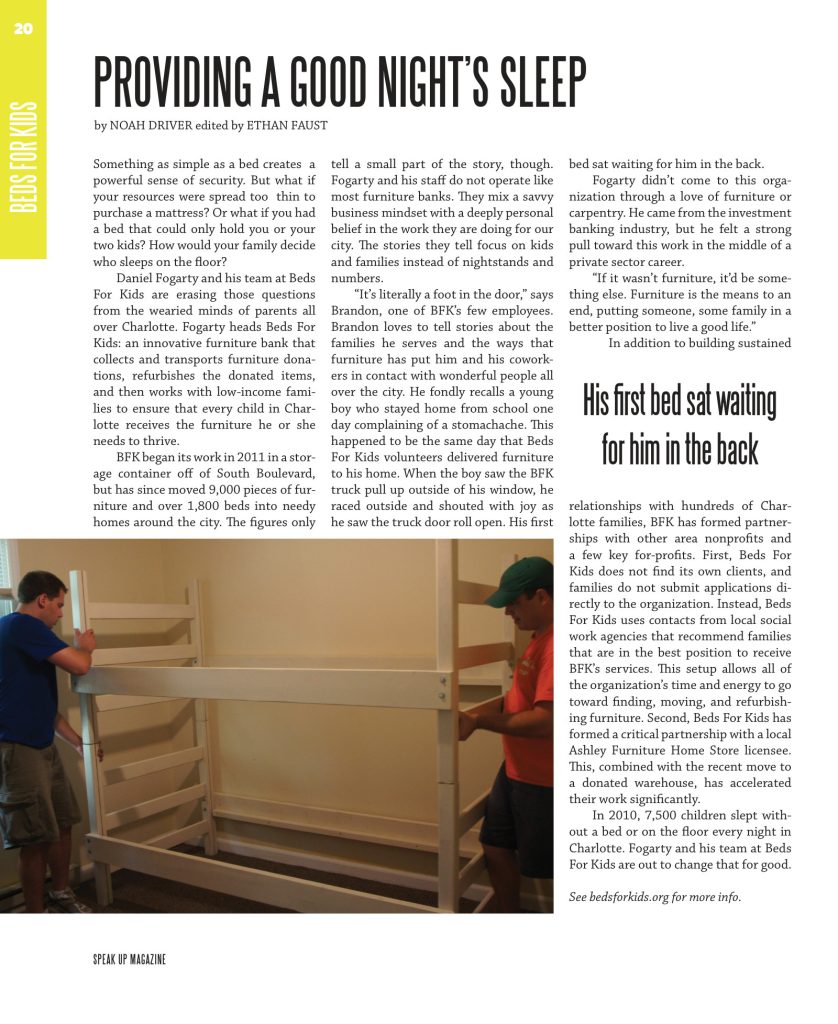
FOR Something as simple as a bed creates a tell a small part of the story, though. bed sat waiting for him in the back.
powerful sense of security. But what if Fogarty and his staff do not operate like Fogarty didn’t come to this orga-
your resources were spread too thin to most furniture banks. They mix a savvy nization through a love of furniture orBEDS
purchase a mattress? Or what if you had business mindset with a deeply personal carpentry. He came from the investment
a bed that could only hold you or your belief in the work they are doing for our banking industry, but he felt a strong
two kids? How would your family decide city. The stories they tell focus on kids pull toward this work in the middle of a
who sleeps on the floor? and families instead of nightstands and private sector career.
Daniel Fogarty and his team at Beds numbers. “If it wasn’t furniture, it’d be some-
For Kids are erasing those questions “It’s literally a foot in the door,” says thing else. Furniture is the means to an
from the wearied minds of parents all Brandon, one of BFK’s few employees. end, putting someone, some family in a
over Charlotte. Fogarty heads Beds For Brandon loves to tell stories about the better position to live a good life.”
Kids: an innovative furniture bank that families he serves and the ways that In addition to building sustained
collects and transports furniture dona- furniture has put him and his cowork-
tions, refurbishes the donated items, ers in contact with wonderful people all
and then works with low-income fami- over the city. He fondly recalls a young
lies to ensure that every child in Char- boy who stayed home from school one His first bed sat waiting
lotte receives the furniture he or she day complaining of a stomachache. This
needs to thrive. happened to be the same day that Beds
BFK began its work in 2011 in a stor- For Kids volunteers delivered furniture for him in the back
age container off of South Boulevard, to his home. When the boy saw the BFK
but has since moved 9,000 pieces of fur- truck pull up outside of his window, he
niture and over 1,800 beds into needy raced outside and shouted with joy as relationships with hundreds of Char-
homes around the city. The figures only he saw the truck door roll open. His first lotte families, BFK has formed partner-
ships with other area nonprofits and
a few key for-profits. First, Beds For
Kids does not find its own clients, and
families do not submit applications di-
rectly to the organization. Instead, Beds
For Kids uses contacts from local social
work agencies that recommend families
that are in the best position to receive
BFK’s services. This setup allows all of
the organization’s time and energy to go
toward finding, moving, and refurbish-
ing furniture. Second, Beds For Kids has
formed a critical partnership with a local
Ashley Furniture Home Store licensee.
This, combined with the recent move to
a donated warehouse, has accelerated
their work significantly.
In 2010, 7,500 children slept with-
out a bed or on the floor every night in
Charlotte. Fogarty and his team at Beds
For Kids are out to change that for good.
See bedsforkids.org for more info.
SPEAK UP MAGAZINE
Page 21
21
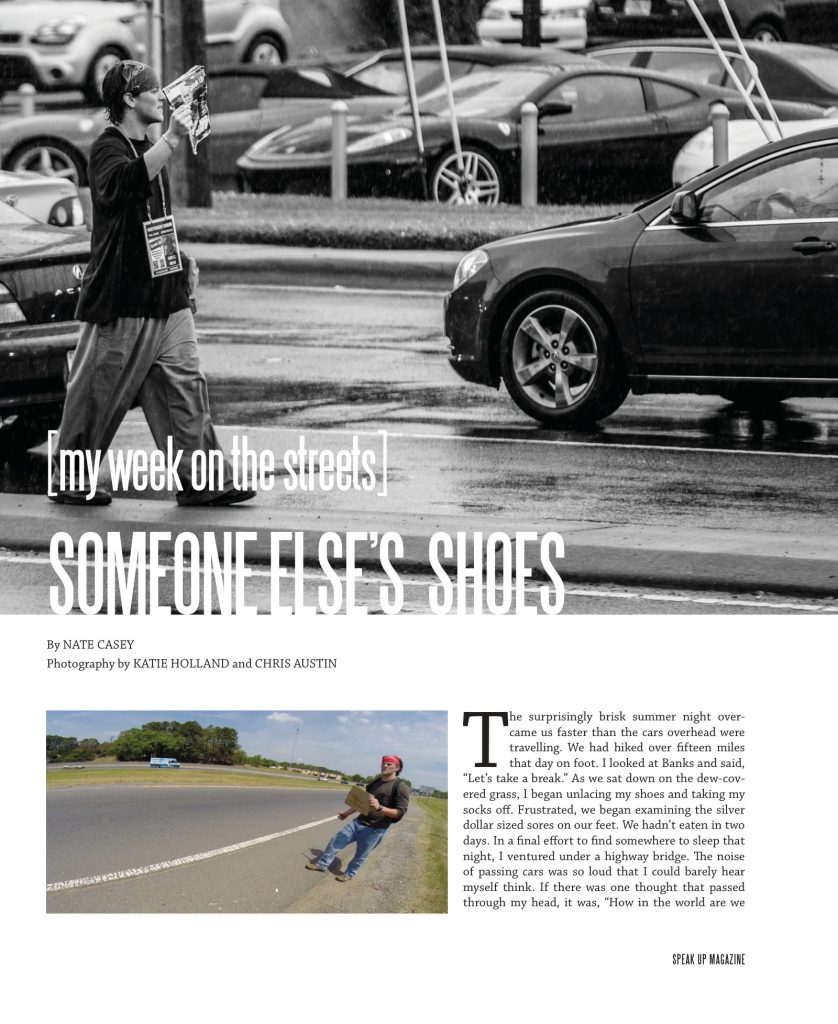
[my week on the streets]
SOMEONE ELSE’S SHOES
By NATE CASEY
Photography by KATIE HOLLAND and CHRIS AUSTIN
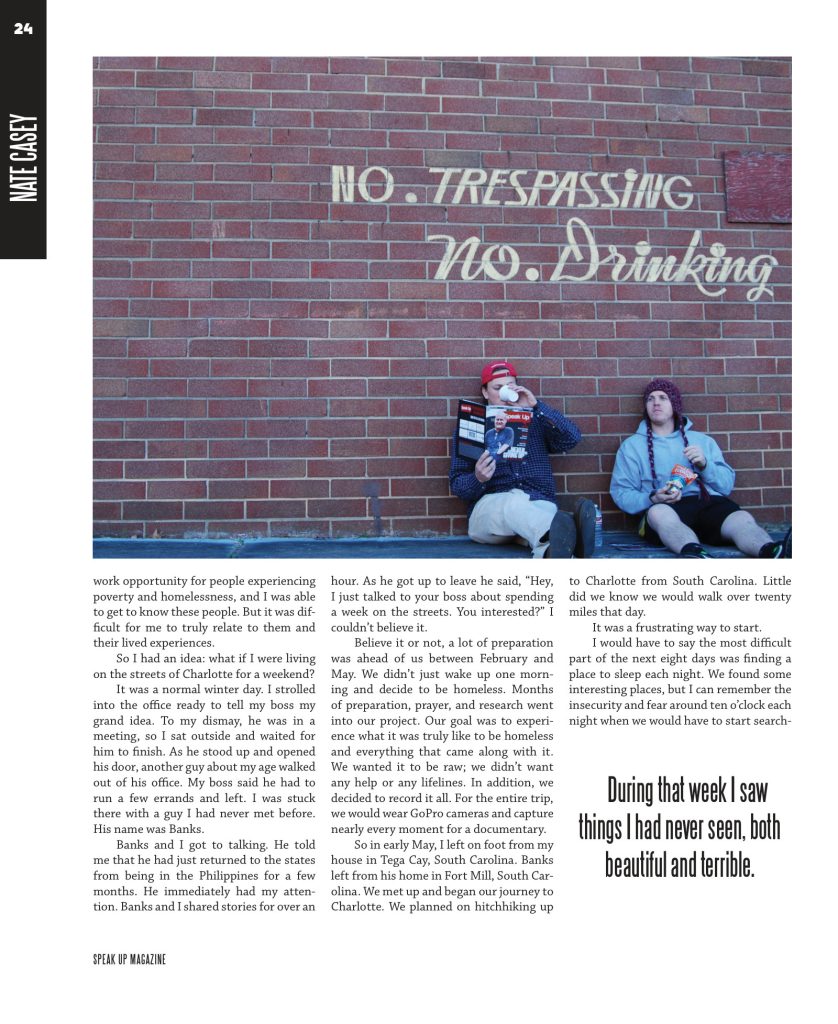
he surprisingly brisk summer night over-
came us faster than the cars overhead were
travelling. We had hiked over fifteen miles
that day on foot. I looked at Banks and said,
“Let’s take a break.” As we sat down on the dew-cov- T
ered grass, I began unlacing my shoes and taking my
socks off. Frustrated, we began examining the silver
dollar sized sores on our feet. We hadn’t eaten in two
days. In a final effort to find somewhere to sleep that
night, I ventured under a highway bridge. The noise
of passing cars was so loud that I could barely hear
myself think. If there was one thought that passed
through my head, it was, “How in the world are we
SPEAK UP MAGAZINE
Page 22
22
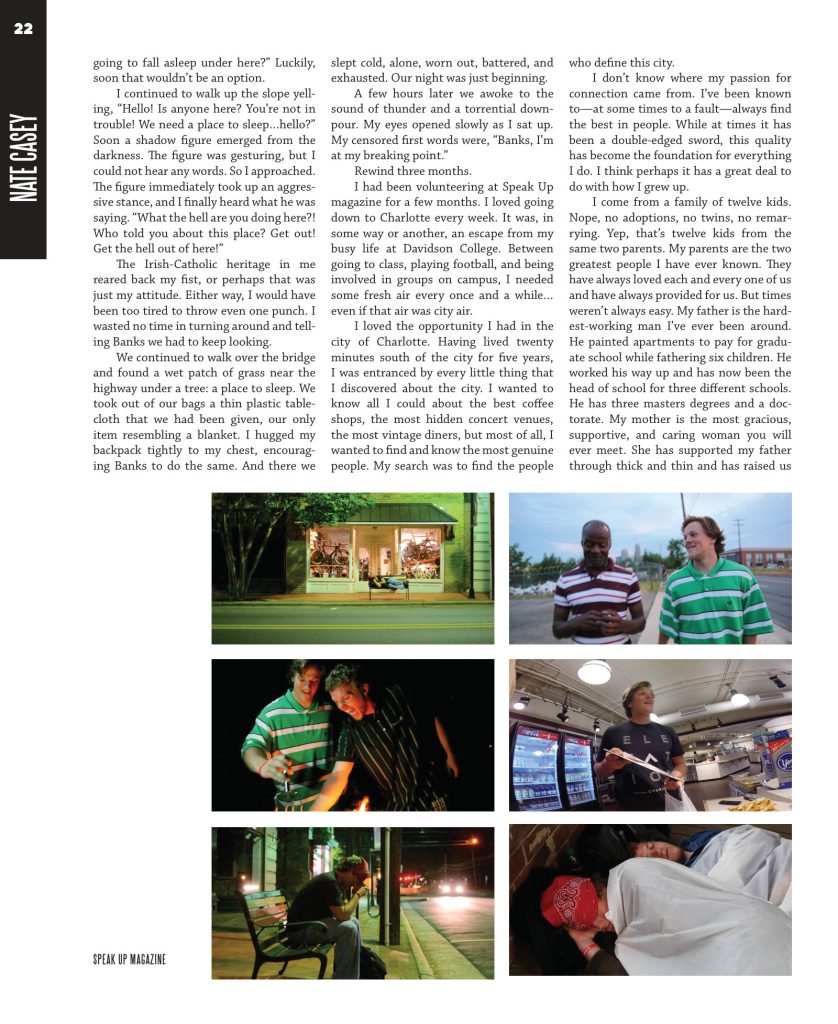
going to fall asleep under here?” Luckily, slept cold, alone, worn out, battered, and who define this city.
soon that wouldn’t be an option. exhausted. Our night was just beginning. I don’t know where my passion for
I continued to walk up the slope yell- A few hours later we awoke to the connection came from. I’ve been known
ing, “Hello! Is anyone here? You’re not in sound of thunder and a torrential down- to—at some times to a fault—always find
trouble! We need a place to sleep…hello?” pour. My eyes opened slowly as I sat up. the best in people. While at times it has
Soon a shadow figure emerged from the My censored first words were, “Banks, I’m been a double-edged sword, this qualityCASEY darkness. The figure was gesturing, but I at my breaking point.” has become the foundation for everything
could not hear any words. So I approached. Rewind three months. I do. I think perhaps it has a great deal to
The figure immediately took up an aggres- I had been volunteering at Speak Up do with how I grew up.NATE
sive stance, and I finally heard what he was magazine for a few months. I loved going I come from a family of twelve kids.
saying. “What the hell are you doing here?! down to Charlotte every week. It was, in Nope, no adoptions, no twins, no remar-
Who told you about this place? Get out! some way or another, an escape from my rying. Yep, that’s twelve kids from the
Get the hell out of here!” busy life at Davidson College. Between same two parents. My parents are the two
The Irish-Catholic heritage in me going to class, playing football, and being greatest people I have ever known. They
reared back my fist, or perhaps that was involved in groups on campus, I needed have always loved each and every one of us
just my attitude. Either way, I would have some fresh air every once and a while… and have always provided for us. But times
been too tired to throw even one punch. I even if that air was city air. weren’t always easy. My father is the hard-
wasted no time in turning around and tell- I loved the opportunity I had in the est-working man I’ve ever been around.
ing Banks we had to keep looking. city of Charlotte. Having lived twenty He painted apartments to pay for gradu-
We continued to walk over the bridge minutes south of the city for five years, ate school while fathering six children. He
and found a wet patch of grass near the I was entranced by every little thing that worked his way up and has now been the
highway under a tree: a place to sleep. We I discovered about the city. I wanted to head of school for three different schools.
took out of our bags a thin plastic table- know all I could about the best coffee He has three masters degrees and a doc-
cloth that we had been given, our only shops, the most hidden concert venues, torate. My mother is the most gracious,
item resembling a blanket. I hugged my the most vintage diners, but most of all, I supportive, and caring woman you will
backpack tightly to my chest, encourag- wanted to find and know the most genuine ever meet. She has supported my father
ing Banks to do the same. And there we people. My search was to find the people through thick and thin and has raised us
SPEAK UP MAGAZINE
Page 23
23
NATE
CASEY
weren’t for special housing in Denver, we and different types of people. I learned
I was too young to couldthoughthavewas,been“Dudehomeless.this is soAscool!a kid,I getall aI valuableto judge lessonsa man byat ahisyoungcharacterage, likeand hownot
room with all of my brothers!” I remem- the color of his skin or the thickness of his
ber my grandparents came out for Christ- wallet. Mark Twain writes in one of my understand all the intricacies mas and we made tanks out of cardboard favorite books Innocents Abroad/Rough-
boxes. I can recall getting a train whistle ing It, “Travel is fatal to prejudice, bigotry, of how difficult our financial for my birthday and sitting out on the and narrow-mindedness, and many of our
swing set overlooking the Rockies, waiting people need it sorely on these accounts.
for trains to pass by. We would save up all Broad, wholesome, charitable views of situation must have been
of our empty paper towel and toilet paper men and things cannot be acquired by veg-
all, and, at times, served as our teacher— rolls, only to cover them with clear plastic etating in one little corner of the earth all
with the love of a mother, of course. I brag wrap and rubber bands in order to make one’s lifetime.” My travels have been fatal
on them to shed light on how some things telescopes. We lived simply, and I loved it. to my own prejudices.
have changed since I was little, yet their I wouldn’t trade it for anything. While I enjoyed what I was doing
love and principles have stayed the same. We moved around a lot growing up. at Speak Up, I still didn’t feel as if I truly
My first memories come from run- I went to three different schools in three knew what the people I worked with were
ning barefoot in the streets of small cit- different states for elementary, middle, going through. Speak Up provides a unique
ies such as Rabinal, Guatemala and Belize and high school. It was difficult at times to
City. I can still picture my mom singing in up and leave from where I was. However,
the town, my brothers and I fighting ta- looking back on it, I wouldn’t change that I still didn’t feel as if I truly
rantulas and crossing over rivers on less either. I was constantly in a mode of meet-
than secure rope bridges. We were mis- ing new people and trying new things.sionaries, and I was too young to under- I’ve had the opportunity to travel knew what the people I worked
stand all the intricacies of how difficult quite a bit in my first twenty years. It has
our financial situation must have been. We become what I love to do. I’m intrigued with were going through”
were based out of Denver, Colorado. If it with different cultures, different religions,
SPEAK UP MAGAZINE
Page 24
24
CASEY
NATE
work opportunity for people experiencing hour. As he got up to leave he said, “Hey, to Charlotte from South Carolina. Little
poverty and homelessness, and I was able I just talked to your boss about spending did we know we would walk over twenty
to get to know these people. But it was dif- a week on the streets. You interested?” I miles that day.
ficult for me to truly relate to them and couldn’t believe it. It was a frustrating way to start.
their lived experiences. Believe it or not, a lot of preparation I would have to say the most difficult
So I had an idea: what if I were living was ahead of us between February and part of the next eight days was finding a
on the streets of Charlotte for a weekend? May. We didn’t just wake up one morn- place to sleep each night. We found some
It was a normal winter day. I strolled ing and decide to be homeless. Months interesting places, but I can remember the
into the office ready to tell my boss my of preparation, prayer, and research went insecurity and fear around ten o’clock each
grand idea. To my dismay, he was in a into our project. Our goal was to experi- night when we would have to start search-
meeting, so I sat outside and waited for ence what it was truly like to be homeless
him to finish. As he stood up and opened and everything that came along with it.
his door, another guy about my age walked We wanted it to be raw; we didn’t want
out of his office. My boss said he had to any help or any lifelines. In addition, we run a few errands and left. I was stuck decided to record it all. For the entire trip, During that week I saw
there with a guy I had never met before. we would wear GoPro cameras and capture
His name was Banks. nearly every moment for a documentary. things I had never seen, both
Banks and I got to talking. He told So in early May, I left on foot from my
me that he had just returned to the states house in Tega Cay, South Carolina. Banks from being in the Philippines for a few left from his home in Fort Mill, South Car- beautiful and terrible.
months. He immediately had my atten- olina. We met up and began our journey to
tion. Banks and I shared stories for over an Charlotte. We planned on hitchhiking up
SPEAK UP MAGAZINE
Page 25
25
ing for a place to sleep. We didn’t want to
break any laws, but we wanted to be safe.
We found refuge in Kent.
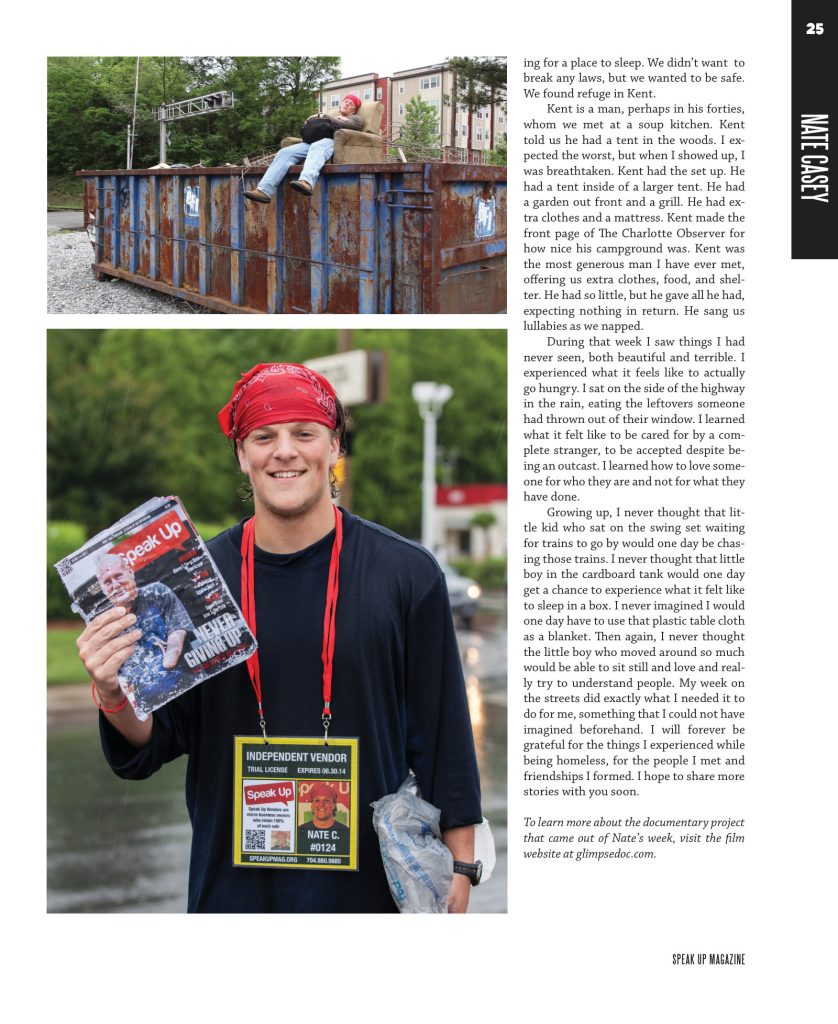
Kent is a man, perhaps in his forties,
whom we met at a soup kitchen. Kenttold us he had a tent in the woods. I ex- NATE
pected the worst, but when I showed up, I
was breathtaken. Kent had the set up. He
had a tent inside of a larger tent. He had CASEY
a garden out front and a grill. He had ex-
tra clothes and a mattress. Kent made the
front page of The Charlotte Observer for
how nice his campground was. Kent was
the most generous man I have ever met,
offering us extra clothes, food, and shel-
ter. He had so little, but he gave all he had,
expecting nothing in return. He sang us
lullabies as we napped.
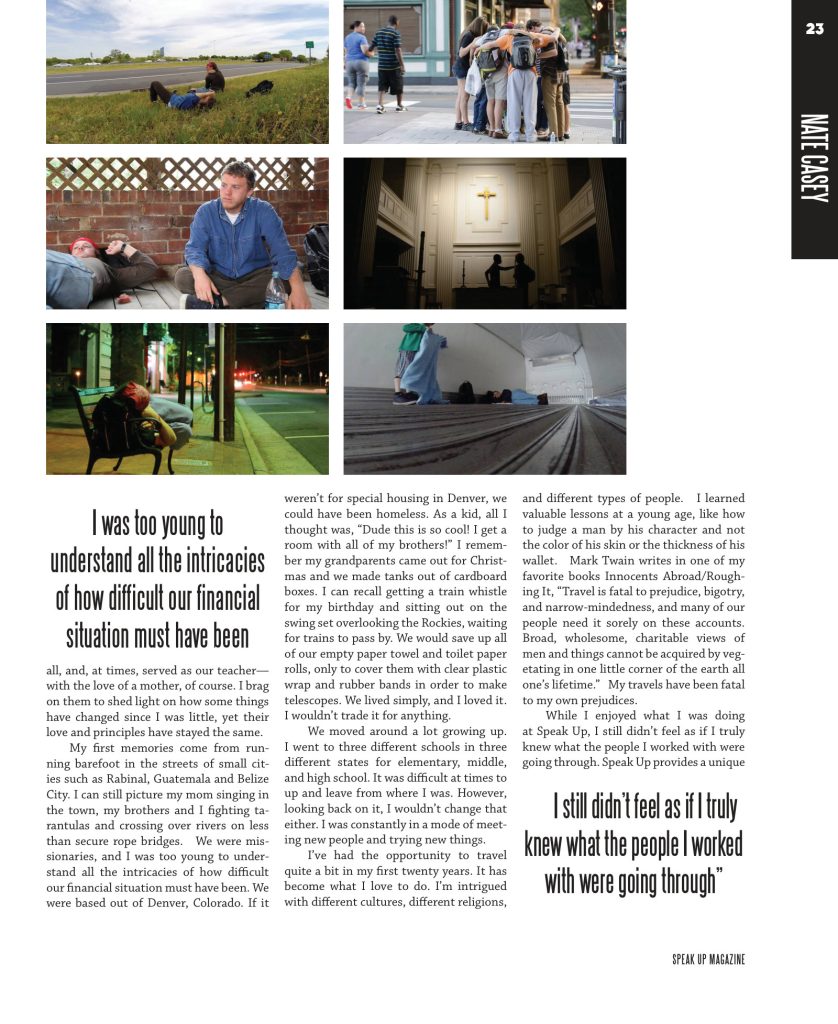
During that week I saw things I had
never seen, both beautiful and terrible. I
experienced what it feels like to actually
go hungry. I sat on the side of the highway
in the rain, eating the leftovers someone
had thrown out of their window. I learned
what it felt like to be cared for by a com-
plete stranger, to be accepted despite be-
ing an outcast. I learned how to love some-
one for who they are and not for what they
have done.
Growing up, I never thought that lit-
tle kid who sat on the swing set waiting
for trains to go by would one day be chas-
ing those trains. I never thought that little
boy in the cardboard tank would one day
get a chance to experience what it felt like
to sleep in a box. I never imagined I would
one day have to use that plastic table cloth
as a blanket. Then again, I never thought
the little boy who moved around so much
would be able to sit still and love and real-
ly try to understand people. My week on
the streets did exactly what I needed it to
do for me, something that I could not have
imagined beforehand. I will forever be
grateful for the things I experienced while
being homeless, for the people I met and
friendships I formed. I hope to share more
stories with you soon.
To learn more about the documentary project
that came out of Nate’s week, visit the film
website at glimpsedoc.com.
SPEAK UP MAGAZINE
Page 26
26 ADA JENKINS Serving the Community in Need
COMMUNITY
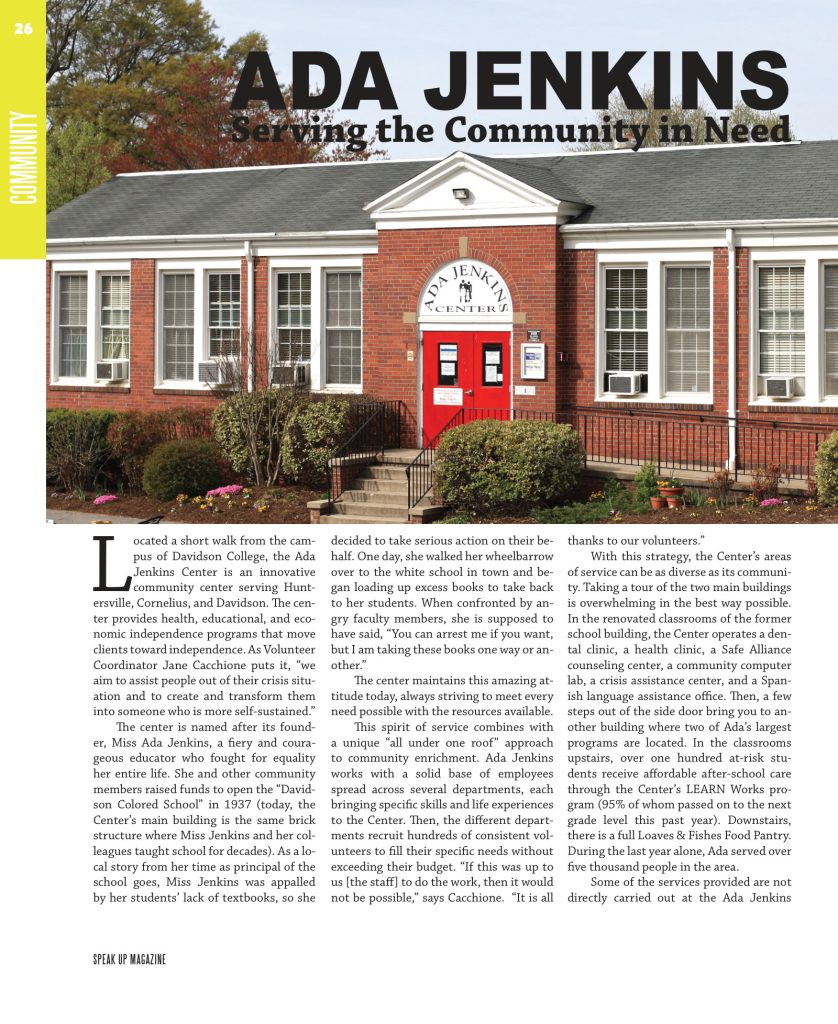
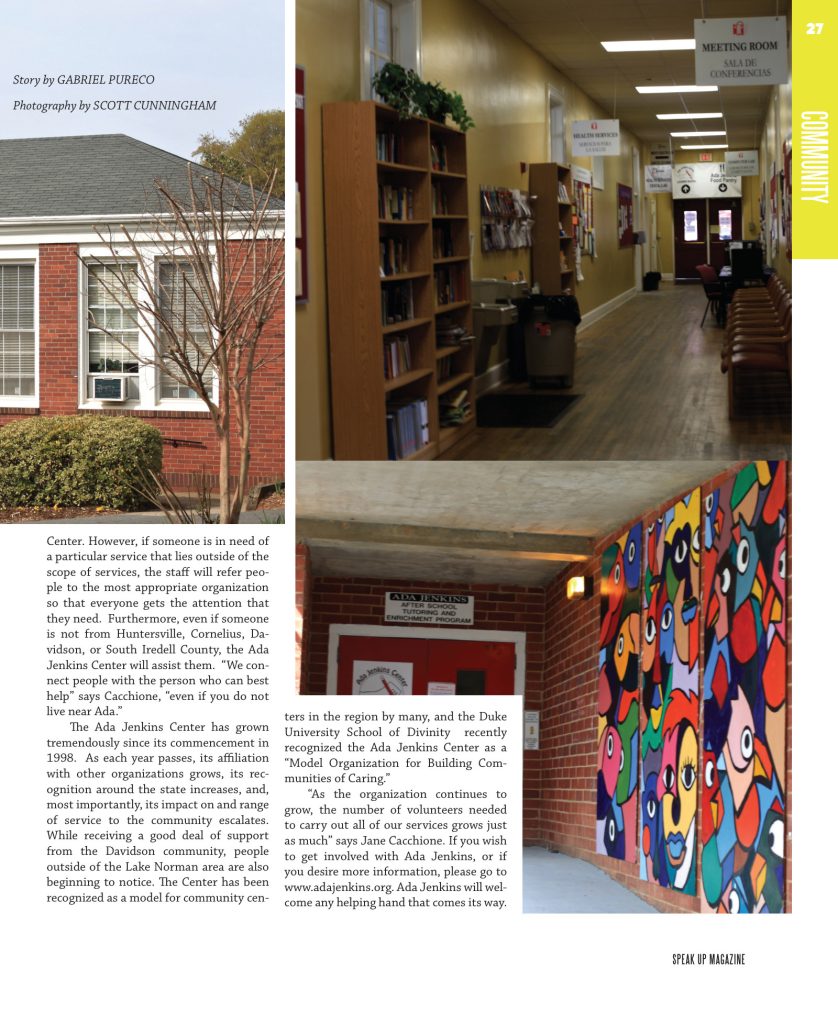
ocated a short walk from the cam- decided to take serious action on their be- thanks to our volunteers.”
pus of Davidson College, the Ada half. One day, she walked her wheelbarrow With this strategy, the Center’s areas
Jenkins Center is an innovative over to the white school in town and be- of service can be as diverse as its communi-
community center serving Hunt- gan loading up excess books to take back ty. Taking a tour of the two main buildings
ersville, Cornelius, and Davidson. The cen- to her students. When confronted by an- is overwhelming in the best way possible. L
ter provides health, educational, and eco- gry faculty members, she is supposed to In the renovated classrooms of the former
nomic independence programs that move have said, “You can arrest me if you want, school building, the Center operates a den-
clients toward independence. As Volunteer but I am taking these books one way or an- tal clinic, a health clinic, a Safe Alliance
Coordinator Jane Cacchione puts it, “we other.” counseling center, a community computer
aim to assist people out of their crisis situ- The center maintains this amazing at- lab, a crisis assistance center, and a Span-
ation and to create and transform them titude today, always striving to meet every ish language assistance office. Then, a few
into someone who is more self-sustained.” need possible with the resources available. steps out of the side door bring you to an-
The center is named after its found- This spirit of service combines with other building where two of Ada’s largest
er, Miss Ada Jenkins, a fiery and coura- a unique “all under one roof” approach programs are located. In the classrooms
geous educator who fought for equality to community enrichment. Ada Jenkins upstairs, over one hundred at-risk stu-
her entire life. She and other community works with a solid base of employees dents receive affordable after-school care
members raised funds to open the “David- spread across several departments, each through the Center’s LEARN Works pro-
son Colored School” in 1937 (today, the bringing specific skills and life experiences gram (95% of whom passed on to the next
Center’s main building is the same brick to the Center. Then, the different depart- grade level this past year). Downstairs,
structure where Miss Jenkins and her col- ments recruit hundreds of consistent vol- there is a full Loaves & Fishes Food Pantry.
leagues taught school for decades). As a lo- unteers to fill their specific needs without During the last year alone, Ada served over
cal story from her time as principal of the exceeding their budget. “If this was up to five thousand people in the area.
school goes, Miss Jenkins was appalled us [the staff] to do the work, then it would Some of the services provided are not
by her students’ lack of textbooks, so she not be possible,” says Cacchione. “It is all directly carried out at the Ada Jenkins
SPEAK UP MAGAZINE
Page 27
27
Story by GABRIEL PURECO
Photography by SCOTT CUNNINGHAM
COMMUNITY
Center. However, if someone is in need of
a particular service that lies outside of the
scope of services, the staff will refer peo-
ple to the most appropriate organization
so that everyone gets the attention that
they need. Furthermore, even if someone
is not from Huntersville, Cornelius, Da-
vidson, or South Iredell County, the Ada
Jenkins Center will assist them. “We con-
nect people with the person who can best
help” says Cacchione, “even if you do not
live near Ada.” ters in the region by many, and the Duke
The Ada Jenkins Center has grown University School of Divinity recently
tremendously since its commencement in recognized the Ada Jenkins Center as a
1998. As each year passes, its affiliation “Model Organization for Building Com-
with other organizations grows, its rec- munities of Caring.”
ognition around the state increases, and, “As the organization continues to
most importantly, its impact on and range grow, the number of volunteers needed
of service to the community escalates. to carry out all of our services grows just
While receiving a good deal of support as much” says Jane Cacchione. If you wish
from the Davidson community, people to get involved with Ada Jenkins, or if
outside of the Lake Norman area are also you desire more information, please go to
beginning to notice. The Center has been www.adajenkins.org. Ada Jenkins will wel-
recognized as a model for community cen- come any helping hand that comes its way.
SPEAK UP MAGAZINE
Page 28
28
PHOTOGRAPHY
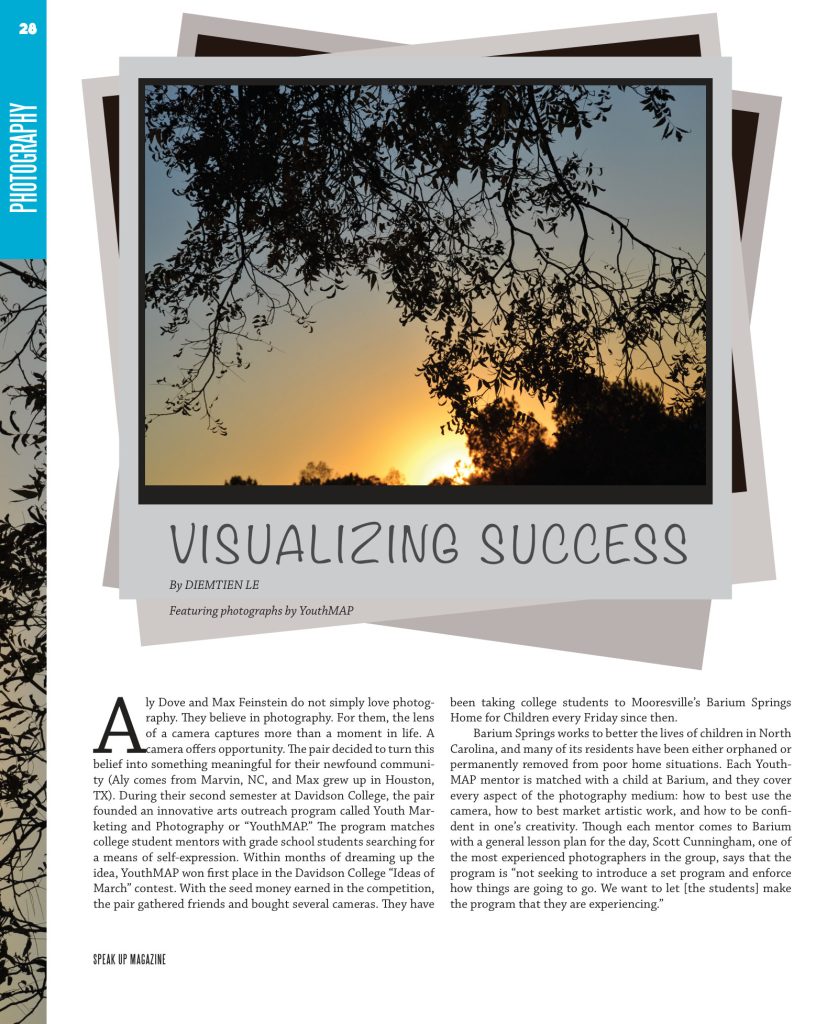
VISUALIZING SUCCESS
By DIEMTIEN LE
Featuring photographs by YouthMAP
ly Dove and Max Feinstein do not simply love photog- been taking college students to Mooresville’s Barium Springs
raphy. They believe in photography. For them, the lens Home for Children every Friday since then.
of a camera captures more than a moment in life. A Barium Springs works to better the lives of children in North
camera offers opportunity. The pair decided to turn this Carolina, and many of its residents have been either orphaned or
belief into something meaningful for their newfound communi- permanently removed from poor home situations. Each Youth- A
ty (Aly comes from Marvin, NC, and Max grew up in Houston, MAP mentor is matched with a child at Barium, and they cover
TX). During their second semester at Davidson College, the pair every aspect of the photography medium: how to best use the
founded an innovative arts outreach program called Youth Mar- camera, how to best market artistic work, and how to be confi-
keting and Photography or “YouthMAP.” The program matches dent in one’s creativity. Though each mentor comes to Barium
college student mentors with grade school students searching for with a general lesson plan for the day, Scott Cunningham, one of
a means of self-expression. Within months of dreaming up the the most experienced photographers in the group, says that the
idea, YouthMAP won first place in the Davidson College “Ideas of program is “not seeking to introduce a set program and enforce
March” contest. With the seed money earned in the competition, how things are going to go. We want to let [the students] make
the pair gathered friends and bought several cameras. They have the program that they are experiencing.”
SPEAK UP MAGAZINE
Page 29
29
YouthMAP takes a bottom-up ap- dent who genuinely cares about their suc-
proach to its instruction. They believe the cess. These moments outside of the fray
As of publication, YouthMAP has been awardedstudents are working their own way to- foster clarity and encourage creativity. As
another grant from Davidson’s “Ideas of March”ward articulating emotions and thoughts Max says, “We are committed to our par-
that other students and adults can under- ticipants.” competition. This money will be used to buy those
stand and relate to. After working with a The number of kids is growing, too. much-needed cameras.
mentor for three months, Davidson Col- The group recently created another Youth-
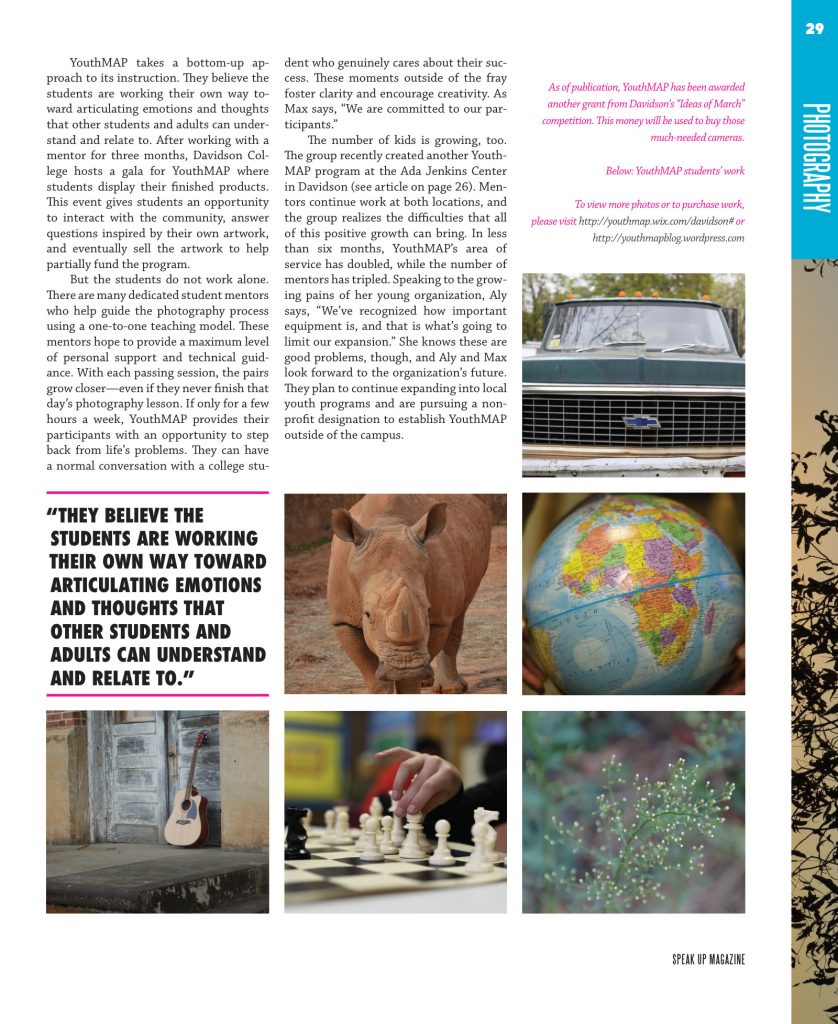
lege hosts a gala for YouthMAP where MAP program at the Ada Jenkins Center Below: YouthMAP students’ work
students display their finished products. in Davidson (see article on page 26). Men-This event gives students an opportunity tors continue work at both locations, and To view more photos or to purchase work, PHOTOGRAPHY
to interact with the community, answer the group realizes the difficulties that all please visit http://youthmap.wix.com/davidson# or
questions inspired by their own artwork, of this positive growth can bring. In less http://youthmapblog.wordpress.com
and eventually sell the artwork to help than six months, YouthMAP’s area of
partially fund the program. service has doubled, while the number of
But the students do not work alone. mentors has tripled. Speaking to the grow-
There are many dedicated student mentors ing pains of her young organization, Aly
who help guide the photography process says, “We’ve recognized how important
using a one-to-one teaching model. These equipment is, and that is what’s going to
mentors hope to provide a maximum level limit our expansion.” She knows these are
of personal support and technical guid- good problems, though, and Aly and Max
ance. With each passing session, the pairs look forward to the organization’s future.
grow closer—even if they never finish that They plan to continue expanding into local
day’s photography lesson. If only for a few youth programs and are pursuing a non-
hours a week, YouthMAP provides their profit designation to establish YouthMAP
participants with an opportunity to step outside of the campus.
back from life’s problems. They can have
a normal conversation with a college stu-
“THEY BELIEVE THE
STUDENTS ARE WORKING
THEIR OWN WAY TOWARD
ARTICULATING EMOTIONS
AND THOUGHTS THAT
OTHER STUDENTS AND
ADULTS CAN UNDERSTAND
AND RELATE TO.”
SPEAK UP MAGAZINE
Page 30
30
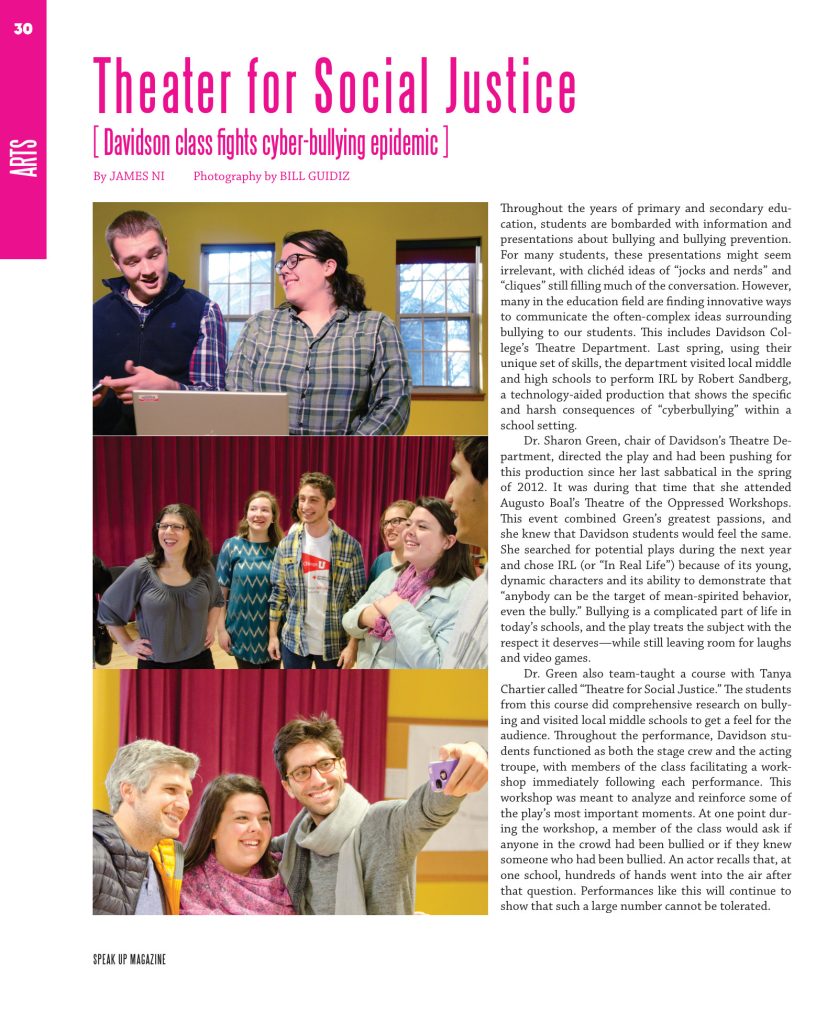
Theater for Social Justice
[ Davidson class fights cyber-bullying epidemic ]ARTS By JAMES NI Photography by BILL GUIDIZ
Throughout the years of primary and secondary edu-
cation, students are bombarded with information and
presentations about bullying and bullying prevention.
For many students, these presentations might seem
irrelevant, with clichéd ideas of “jocks and nerds” and
“cliques” still filling much of the conversation. However,
many in the education field are finding innovative ways
to communicate the often-complex ideas surrounding
bullying to our students. This includes Davidson Col-
lege’s Theatre Department. Last spring, using their
unique set of skills, the department visited local middle
and high schools to perform IRL by Robert Sandberg,
a technology-aided production that shows the specific
and harsh consequences of “cyberbullying” within a
school setting.
Dr. Sharon Green, chair of Davidson’s Theatre De-
partment, directed the play and had been pushing for
this production since her last sabbatical in the spring
of 2012. It was during that time that she attended
Augusto Boal’s Theatre of the Oppressed Workshops.
This event combined Green’s greatest passions, and
she knew that Davidson students would feel the same.
She searched for potential plays during the next year
and chose IRL (or “In Real Life”) because of its young,
dynamic characters and its ability to demonstrate that
“anybody can be the target of mean-spirited behavior,
even the bully.” Bullying is a complicated part of life in
today’s schools, and the play treats the subject with the
respect it deserves—while still leaving room for laughs
and video games.
Dr. Green also team-taught a course with Tanya
Chartier called “Theatre for Social Justice.” The students
from this course did comprehensive research on bully-
ing and visited local middle schools to get a feel for the
audience. Throughout the performance, Davidson stu-
dents functioned as both the stage crew and the acting
troupe, with members of the class facilitating a work-
shop immediately following each performance. This
workshop was meant to analyze and reinforce some of
the play’s most important moments. At one point dur-
ing the workshop, a member of the class would ask if
anyone in the crowd had been bullied or if they knew
someone who had been bullied. An actor recalls that, at
one school, hundreds of hands went into the air after
that question. Performances like this will continue to
show that such a large number cannot be tolerated.
SPEAK UP MAGAZINE
Page 31
“Speak Up for those who cannot speak for
themselves, for the rights of
all who are destitute.”
Proverbs 31:8
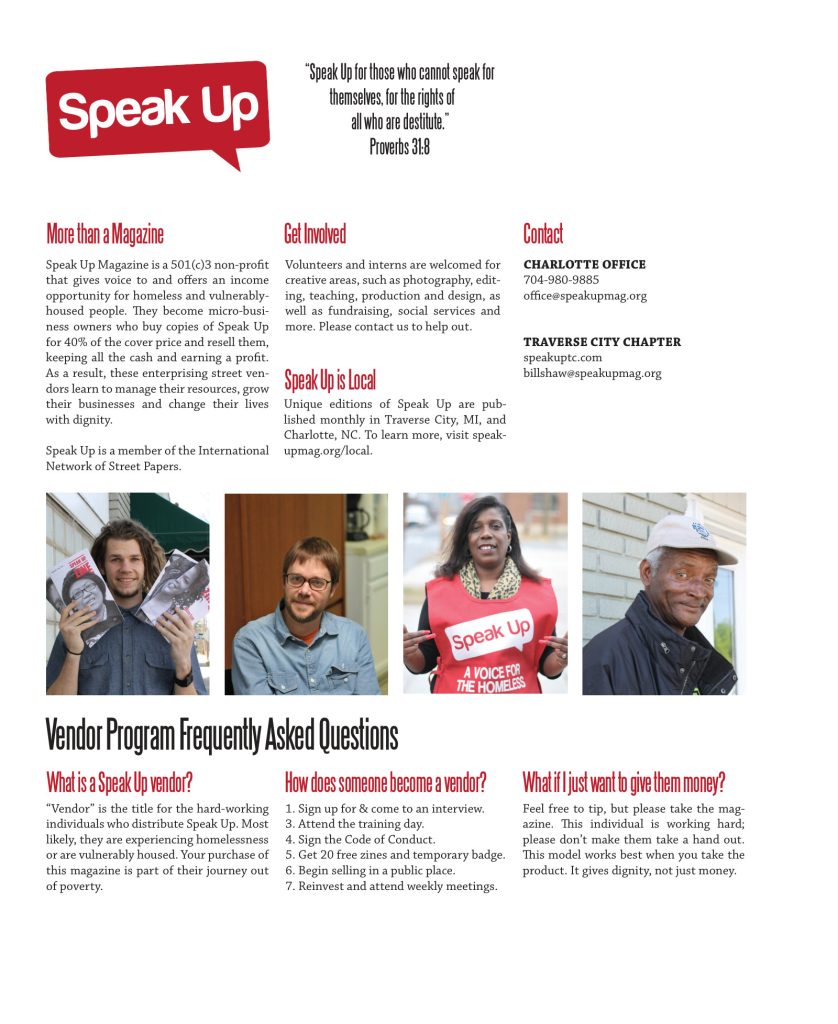
More than a Magazine Get Involved Contact
Speak Up Magazine is a 501(c)3 non-profit Volunteers and interns are welcomed for CHARLOTTE OFFICE
that gives voice to and offers an income creative areas, such as photography, edit- 704-980-9885
opportunity for homeless and vulnerably- ing, teaching, production and design, as office@speakupmag.org
housed people. They become micro-busi- well as fundraising, social services and
ness owners who buy copies of Speak Up more. Please contact us to help out.
for 40% of the cover price and resell them, TRAVERSE CITY CHAPTER
keeping all the cash and earning a profit. speakuptc.com
As a result, these enterprising street ven- Speak Up is Local billshaw@speakupmag.orgdors learn to manage their resources, grow
their businesses and change their lives Unique editions of Speak Up are pub-
with dignity. lished monthly in Traverse City, MI, and
Charlotte, NC. To learn more, visit speak-
Speak Up is a member of the International upmag.org/local.
Network of Street Papers.
Vendor Program Frequently Asked Questions
What is a Speak Up vendor? How does someone become a vendor? What if I just want to give them money?
“Vendor” is the title for the hard-working 1. Sign up for & come to an interview. Feel free to tip, but please take the mag-
individuals who distribute Speak Up. Most 3. Attend the training day. azine. This individual is working hard;
likely, they are experiencing homelessness 4. Sign the Code of Conduct. please don’t make them take a hand out.
or are vulnerably housed. Your purchase of 5. Get 20 free zines and temporary badge. This model works best when you take the
this magazine is part of their journey out 6. Begin selling in a public place. product. It gives dignity, not just money.
of poverty. 7. Reinvest and attend weekly meetings.
Infographic by: Eric Gorman
Page 32
Thank You to Our Sponsor,
the Bonner Community Fund
SPONSOR CHANGED LIVES AND PERCEPTIONS
speakupmag.org/sponsor