










1 / 24
Read as text
Page 1
VOL 2 | ISSUE 2 | $2.00 DONATION
TRAVERSE CITY’S VOICE
FOR THE HOMELESS
Page 2
“Speak Up for those
who cannot speak for
themselves, for the rights
of all who are destitute.”
Proverbs 31:8
More than a Magazine Get Involved
Speak Up Magazine is a 501(c)3 non-prof- Volunteers and interns are welcomed for
it that gives voice to and offers an in- creative areas, such as photography, ed-
come opportunity for homeless and vul- iting, teaching, production and design, as
nerably-housed people. They become well as fundraising, social services and
micro-business owners who buy copies of more. Please contact us to help out.
Speak Up for a low price and resell them,
keeping all the cash and earning a profit.
As a result, these enterprising street ven-
dors learn to manage their resources, grow Speak Up is Local
their businesses and change their lives with
dignity. Unique editions of Speak Up are pub-
lished monthly in Traverse City, MI, andSpeak Up is a member of the International
Charlotte, NC.Network of Street Papers, which connects
and supports over 100 such organizations To explore bringing Speak Up to your re-
worldwide. gion, visit speakupmag.org/local.
This Zine Team Contact
Editing & Writing Clinics Charlotte Office (NC)
Matt Shaw, Sabrina BP, Peggi Knowe, Matt (704) 980-9885
Shaw, Ben Shaw, Nate Casey, Robb Astor, speakupmag.org
office@speakupmag.orgLana Shaw, Harry Griffin, Melissa
1515 S Mint St,Sprenkle, Bill Shaw, Mary Pierce, Mickey Charlotte, NC 28203
Grooters, Deborah Shaw, Leah Burnett
Traverse City Chapter (MI)
Visuals speakuptc.com
Photos: Deb Shaw, Matt Shaw billshaw@speakupmag.org
Design: C.Bay Design
2
Page 3
VENDOR
PROGRAM
Frequently
Asked
Questions
What is a Speak Up vendor?
“Vendor” is the title for the hard-working individuals who distribute Speak Up. Most likely,
they are experiencing homelessness or are vulnerably housed. Your purchase of this maga-
zine is part of their journey out of poverty. You can learn more at speakupmag.org/vendors.
How does someone become a vendor?
1. Sign up for & come to an interview
3. Attend the training day
4. Sign the Code of Conduct
5. Get 20 free Zines and temporary badge
6. Reinvest and attend weekly meetings
Look for a valid Speak Up badge
What if I give money but don’t take the magazine?
Always take the magazine. This individual is working hard, please don’t make them take a
hand out. Feel free to tip, but always take the product. This gives dignity, not just money.
But I don’t have any cash!
A few smartphone-equipped vendors can accept a credit card payment. For now, the best
option is to plan ahead and bring cash.
How can I help?
Here’s one way: Be a friend to the person that sells the magazine. Sit down with them for
coffee, buy them lunch, get to know them. Keep it simple. Healthy and encouraging relation-
ships are crucial as people build new community and grow in opportunity and perspective.
3
Page 4
SPEAK UP VENDORS
BRING INSPIRATION ONE
MAGAZINE AT A TIME
Dear Friends,
There’s a good chance that you bought this You may have encountered Tom in Char-
magazine from a Speak Up vendor. The lotte, NC, during the eight months he sold
vendor who sold it to you is either home- Speak Up. Well loved by many, Tom would
less, vulnerably housed, or recently home- often say during his office visits, “I can’t talk
less. Right now, all across the world, street long. I’ve got customers waiting!” Then out
papers and magazines like Speak Up are he would run – literally run – up the sidewalk
celebrating these magazine-selling vendors. toward Uptown. He’s now happily living in
It’s a big community and a huge celebration: a veterans’ residency program in Asheville,
114 street papers in 35 different countries NC, that provides room, board and job train-
are read by six million readers like you. And ing. This is the result of Tom’s remarkable
each day, these papers are faithfully distrib- work ethic and persistent desire to better
uted and sold by 14,000 vendors across the himself.
globe. Perhaps you’ve purchased magazines from
Frank in Traverse City, MI. “I have 1,250 cus-Although there are thousands of vendors
tomers, for sure,” he said. Jubilant, outgoing,selling magazines right now, I believe that
and full of lyrical passion, Frank leveragesthe most significant figure is the smallest:
his artistry and physicality when selling mag-one. Street magazines impact individuals
azines. He hops, dances and calls out wittyand communities in groups of one. One
sayings and puns to passersby. “Excuse me,vendor, bravely stepping out to change his
sir, have you been Zine’d today?” he’ll ask,or her circumstances. One sale, the start of
holding up the latest copy of Speak Up Zine.a cycle of self-sufficiency. One magazine,
When the weather is good, Frank is out earlyinforming and deepening the public conver-
in the morning and works for many hours.sation about homelessness. One customer,
you, buying a magazine and giving back dig- Speak Up vendors, we are proud of you!
nity and opportunity. What you are choosing when you go out to
sell your magazines is the harder and moreWe are immensely proud of the men and
honorable way of personal responsibility andwomen who sell these magazines every respectable work. You are doing great. Youweek. Doing so is not easy. When individu- deserve our respect and honor. Keep look-als enter Speak Up’s vendor program, they ing up–the best is yet to come!are given a “seed” of 20 free magazines.
However, fewer than half of them will return Thank You,
to reinvest and buy more magazines. There
are no promises of quick, easy money; Matt Shaw
and being successful requires consistency Executive Director
and tenacity.
4
Page 5
Getting back on your feet is
not an easy thing, but it is not
impossible. Five years ago, I was
homeless and barely able to walk.
Sean, page 9
Homesteading 06
An Interview with Earleen Mingo 08
Attitude 09
Alzheimer’s Disease 10
A Week in Safe Harbor 11
Glen Eulogy 12
S.A.D. 14
Yesterday, Today & Tomorrow 15
Trials and Tribulations to Resilience 16
Finding Forgiveness on Death Row 17
East Jordan High School Sells Speak Up Zine 20
Love in a Pot 22
Sponsors 23
5
Page 6
[GLIMPSE]
HOMESTEADING
Interview by Bill Shaw in Traverse City, MI
So you want to protect your identity. had enough, this is what I like to do. I get
Do you have an alias we could use? away from it all, regroup, get my spiritu-
ality in order, and try it all again.Yep, Swamp Thing. My friends will know
who that is, and the rest will have no idea. I’ve been in a tent since last spring. I
used to live in a cabin I had built between
Cedar and Traverse City. I lived there five
Swamp Thing, did you years. It wasn’t my property though.
grow up in Traverse City?
Yep, born and raised here. I grew up on How has the wintryThree Mile across from the East Bay El- weather affected you?ementary School. I graduated from Tra-
verse City High School in 1976…should Bring it on. Bring it on. The colder the
have been ‘75. I have family here, two better. I have wrapped this place with five
daughters, one in Traverse and one in layers of 30# felt, or maybe it’s 60#, the
heaviest they make, and two layers of iceBuckley. They would like this place, es-
and water shield.pecially my grandchildren. I am waiting
to bring them out until I have it fixed up
a little more. What do you eat here?
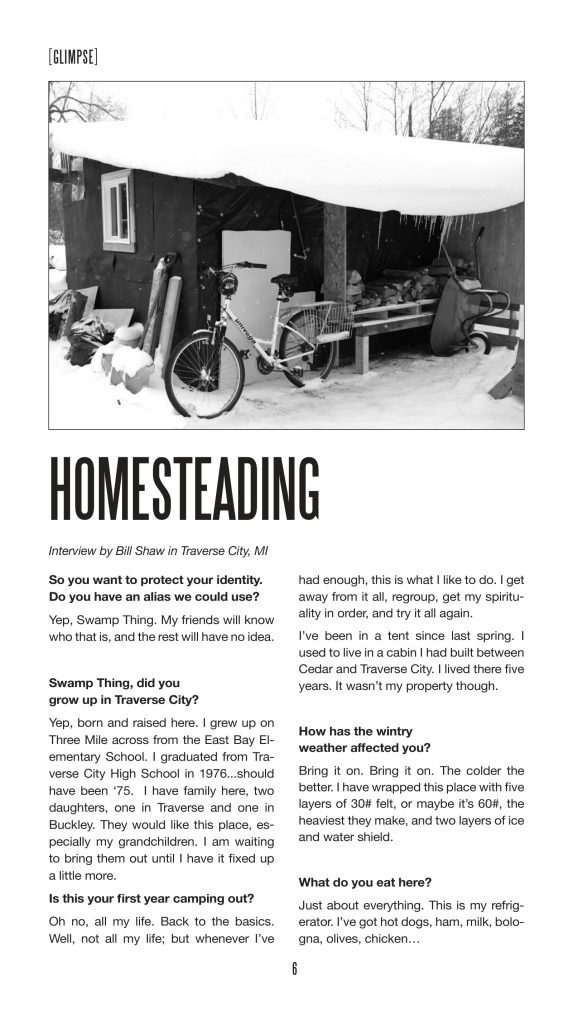
Is this your first year camping out? Just about everything. This is my refrig-
Oh no, all my life. Back to the basics. erator. I’ve got hot dogs, ham, milk, bolo-
Well, not all my life; but whenever I’ve gna, olives, chicken…
6
Page 7
Where do you shop? things. I have blood clots in my lungs.
What do they call that, pulmonary embo-Family Fare. Not Walmart, definitely not. It
is too big a place for me. lism? I shouldn’t smoke, but I’d probably
die if I quit.
So you’re building this
“squatter” home, and What do you need living here?
people know you are here.
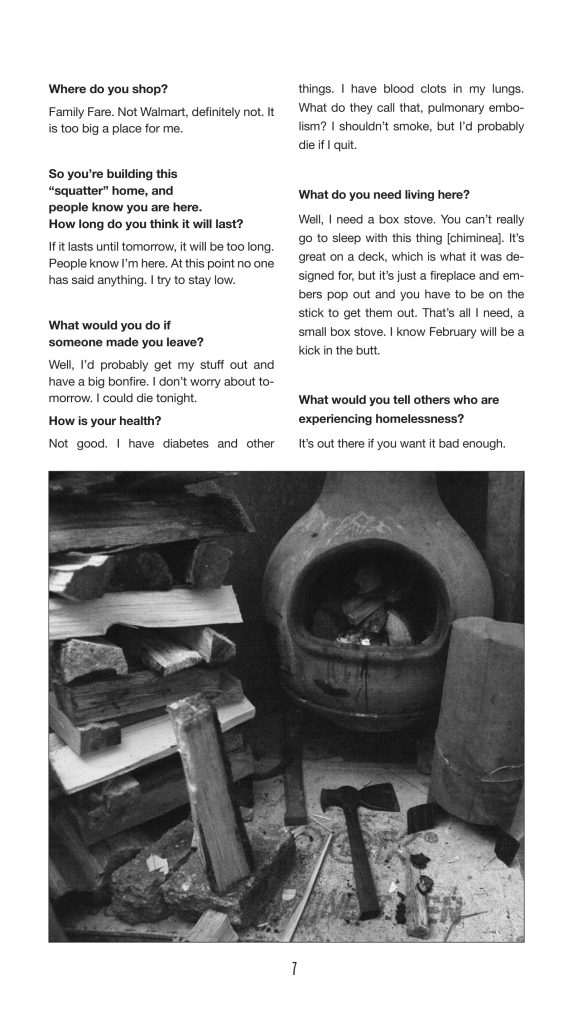
How long do you think it will last? Well, I need a box stove. You can’t really
go to sleep with this thing [chiminea]. It’sIf it lasts until tomorrow, it will be too long.
great on a deck, which is what it was de-People know I’m here. At this point no one
signed for, but it’s just a fireplace and em-has said anything. I try to stay low.
bers pop out and you have to be on the
stick to get them out. That’s all I need, a
What would you do if small box stove. I know February will be a
someone made you leave? kick in the butt.
Well, I’d probably get my stuff out and
have a big bonfire. I don’t worry about to-
morrow. I could die tonight. What would you tell others who are
How is your health? experiencing homelessness?
Not good. I have diabetes and other It’s out there if you want it bad enough.
7
Page 8
[COVER VENDOR INTERVIEW]
An Interview
with Earleen Mingo
Interviewed by Matt Shaw in Charlotte, NC
Where are you from originally?
I was born and raised in New York. We would
come down here [to Charlotte] when I was
about 13. I have been on and off, back and
forth, from New York all my life…that is my city.
Where are you living right now?
I’m living with a friend. I am trying to get out on
my own. Tired of staying with people.
What is the best memory you
have from growing up?
Playing Double-Dutch Jump Rope with I fill my bag up with sandwiches, gloves, andmy sister. We used to play it all the time in
whatever they might need.New York.
Have you been homeless?What person has meant the
most to you in your life? Yeah, but I always wind up keeping myself off
the streets. It isn’t easy, but I try to stay safe.I have always been close to my mother. I
I’m working toward getting my own homestayed with my mother all of my life. We were
right now.always close.
Tell me about your family.How did you learn about Speak Up?
My nieces and nephews are awesome. TheyOne day, I was downtown, really struggling
don’t even know that I am in this situation. I’mand trying to figure out what I was going to
trying to build myself up on my own withoutdo next. This lady asked me what was wrong.
their help. Whenever I get to that situationI said, “I don’t know what I am going to do.”
where I can’t do it on my own, I will ask themAnd she said, “Do you want a job?” She
for help. My family is nice, good, strong-mind-brought me to Speak Up.
ed, and all of them are church-going people.
Where do you sell your magazines?
What’s a recent accomplishment?
I sell my magazines just about everywhere,
My very good friend was in a tough situation,but I sell mainly downtown. I have a lot of cus-
and I had the resources to him help out. Nowtomers there. They really like me a lot.
he is with his family in Georgia.
What has been your most positive
During this time of transition,experience while selling Speak Up?
what gives you comfort?
Meeting a lot of nice people. I love meet-
Basically, getting up every day and going toing people, and they have given me a lot
sell my magazines. It keeps me motivated.of inspiration.
Where do you see yourself in five years?How do you like to give back to the
community and help out others in need? As the editor of Speak Up.
8
Page 9
[REMODELING]
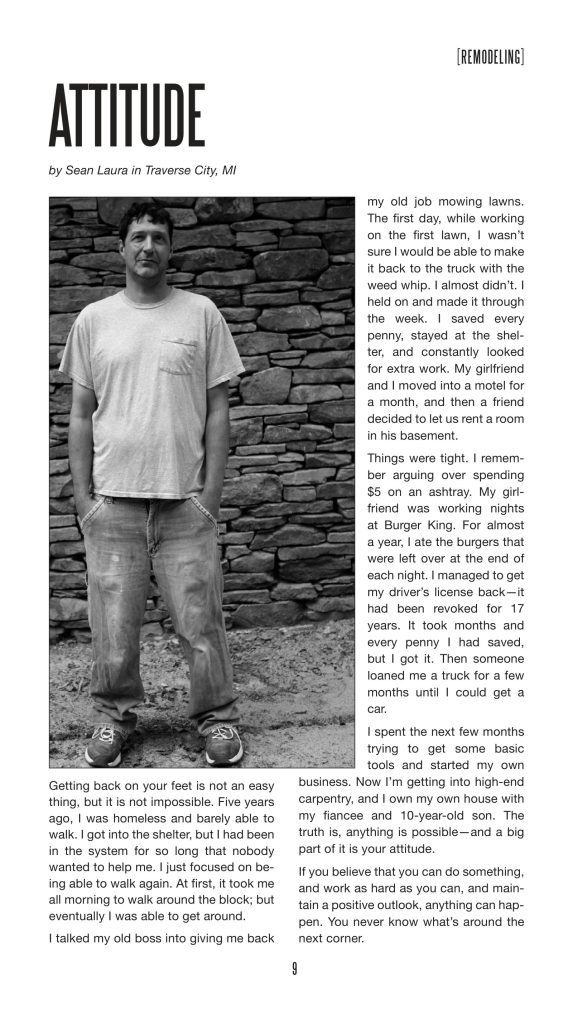
ATTITUDE
by Sean Laura in Traverse City, MI
my old job mowing lawns.
The first day, while working
on the first lawn, I wasn’t
sure I would be able to make
it back to the truck with the
weed whip. I almost didn’t. I
held on and made it through
the week. I saved every
penny, stayed at the shel-
ter, and constantly looked
for extra work. My girlfriend
and I moved into a motel for
a month, and then a friend
decided to let us rent a room
in his basement.
Things were tight. I remem-
ber arguing over spending
$5 on an ashtray. My girl-
friend was working nights
at Burger King. For almost
a year, I ate the burgers that
were left over at the end of
each night. I managed to get
my driver’s license back—it
had been revoked for 17
years. It took months and
every penny I had saved,
but I got it. Then someone
loaned me a truck for a few
months until I could get a
car.
I spent the next few months
trying to get some basic
tools and started my own
Getting back on your feet is not an easy business. Now I’m getting into high-end
thing, but it is not impossible. Five years carpentry, and I own my own house with
ago, I was homeless and barely able to my fiancee and 10-year-old son. The
walk. I got into the shelter, but I had been truth is, anything is possible—and a big
in the system for so long that nobody part of it is your attitude.
wanted to help me. I just focused on be- If you believe that you can do something,
ing able to walk again. At first, it took me and work as hard as you can, and main-
all morning to walk around the block; but tain a positive outlook, anything can hap-
eventually I was able to get around. pen. You never know what’s around the
I talked my old boss into giving me back next corner.
9
Page 10
[FAMILY]
ALZHEIMER’S DISEASE
by Earleen Mingo in Charlotte, NC
I could not get help from DSS for my to pack and put my stuff in a storage
mother. I remember sitting in the park- unit. After a few months, everything
ing lot, and I just cried. I couldn’t be- was gone.
lieve they would not help my mom. My
I cried, prayed, cried, and prayed.mom turned to me and said, “What is
Wherever I went, my mother went. So Iwrong, baby?” I shook my head and
did the best I could until I couldn’t do itsaid, “Nothing. It’s okay.” I went back
any more. I was all alone. No one wasto the apartment, and she told me, “I’m
there but God. I continued to care forgoing home.” I told her not to wander
out there or someone was going to my mother and lived with my cousin for
get her. She turned around and came a year. I then called my sister to come
back. I knew my mother was sick, so and take my mother. My sister moved
I took her to the doctor. They told me my mother to New York. After that, I
she was in the first stage of Alzhei- was all by myself with no place to turn.
mer’s Disease. I didn’t know what to do. I didn’t have
a place to stay. There was no one toMy job had been paying good mon- help me.ey—paying all my bills and I was liv-
ing very well. Then everything started One day, I was downtown and a lady
going downhill. I could not believe it asked me what was wrong. I told her.
was happening to me. I could not put She said, “Do you want a job?” I said,
my mother into a nursing home. I had “Yes.” She told me about Speak Up,
promised her that I would not put her and here I am.
in a home after she asked me not to This job at Speak Up helps me, and I
do that. don’t feel alone. I am living again. I’m
I had to quit my job, so I had a month trying to get back on my feet and get
to move out of my apartment. Then I my life in order. I hope that I will. So,
lost my apartment. I still remember the for everyone who is reading this, don’t
day that I moved out. I had beautiful give up. God is good all the time. Try
things like mink coats, oak tables, and to do the right thing, and God will do
over 100 pairs of shoes. I paid a guy the rest.
“I had beautiful things like mink
coats, oak tables, and over 100 pairs
of shoes . . . after a few months,
everything was gone.”
10
Page 11
[SHELTER]
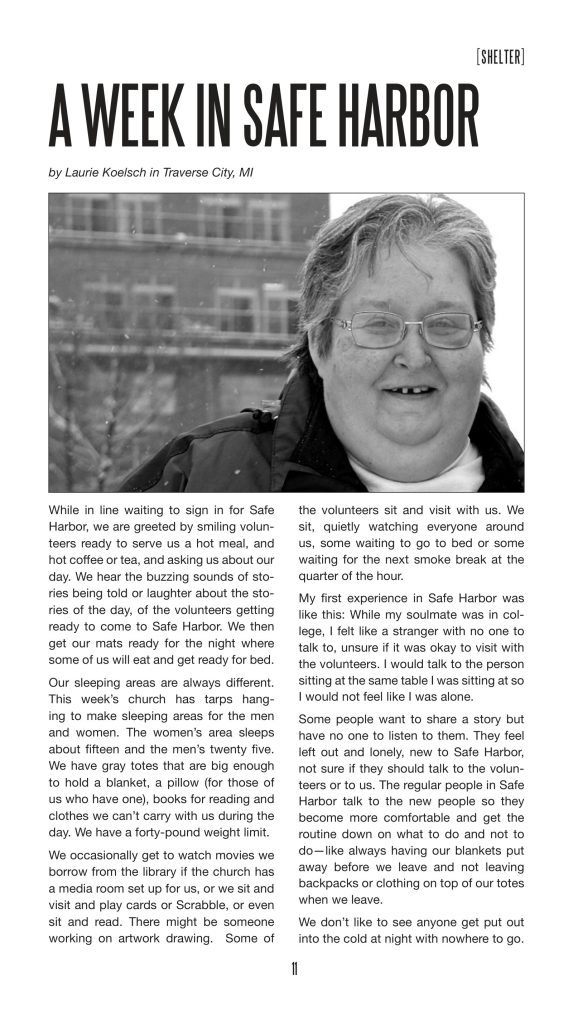
A WEEK IN SAFE HARBOR
by Laurie Koelsch in Traverse City, MI
While in line waiting to sign in for Safe the volunteers sit and visit with us. We
Harbor, we are greeted by smiling volun- sit, quietly watching everyone around
teers ready to serve us a hot meal, and us, some waiting to go to bed or some
hot coffee or tea, and asking us about our waiting for the next smoke break at the
day. We hear the buzzing sounds of sto- quarter of the hour.
ries being told or laughter about the sto- My first experience in Safe Harbor was
ries of the day, of the volunteers getting like this: While my soulmate was in col-
ready to come to Safe Harbor. We then lege, I felt like a stranger with no one to
get our mats ready for the night where talk to, unsure if it was okay to visit with
some of us will eat and get ready for bed. the volunteers. I would talk to the person
Our sleeping areas are always different. sitting at the same table I was sitting at so
This week’s church has tarps hang- I would not feel like I was alone.
ing to make sleeping areas for the men Some people want to share a story but
and women. The women’s area sleeps have no one to listen to them. They feel
about fifteen and the men’s twenty five. left out and lonely, new to Safe Harbor,
We have gray totes that are big enough not sure if they should talk to the volun-
to hold a blanket, a pillow (for those of teers or to us. The regular people in Safe
us who have one), books for reading and Harbor talk to the new people so they
clothes we can’t carry with us during the become more comfortable and get the
day. We have a forty-pound weight limit. routine down on what to do and not to
do—like always having our blankets putWe occasionally get to watch movies we
away before we leave and not leavingborrow from the library if the church has
backpacks or clothing on top of our totesa media room set up for us, or we sit and
when we leave.visit and play cards or Scrabble, or even
sit and read. There might be someone We don’t like to see anyone get put out
working on artwork drawing. Some of into the cold at night with nowhere to go.
11
Page 12
[LOSS]
GLEN EULOGY
by Jordan Ohagan in Traverse City, MI to mention local chill spots like gazebos and
docks. Our first encounter was at a local shel-
“Time is your most precious gift because you ter. I was new to town, new to a lot of things.
only have a set amount of it. You can make
more money, but you can’t make more time. Glen and I didn’t exactly hit it off, with me be-
When you give someone your time, you are ing a young Michigander buck and he being
giving them a portion of your life that you’ll a Southern-raised veteran. But even then, he
never get back.” – Rick Warren wanted to train me up, so to speak, because
This thought weighs upon me with the recent he liked to buck out the dings in people,
loss of Glen. I had the pleasure of sharing a polish them up, and set them back on their
sleeping space with him for about two and a feet. I’ve watched him do it, many times, and
half years, both in and out of Safe Harbor, not experienced it first hand. He liked to remind
“Time is your most precious gift because you only have a
set amount of it. You can make more money, but you can’t
make more time. When you give someone your time, you are
giving them a portion of your life that you’ll never get back.”
Rick Warren
12
Page 13
Rarely was it ever, “No. Sorry.” And if it was,
it was because he didn’t have it either. But it
always came around because he had done
it for us. And all he wanted in return was our
time. A few minutes or an hour to just “be.”
And that’s how he liked it. Not noisy or rowdy.
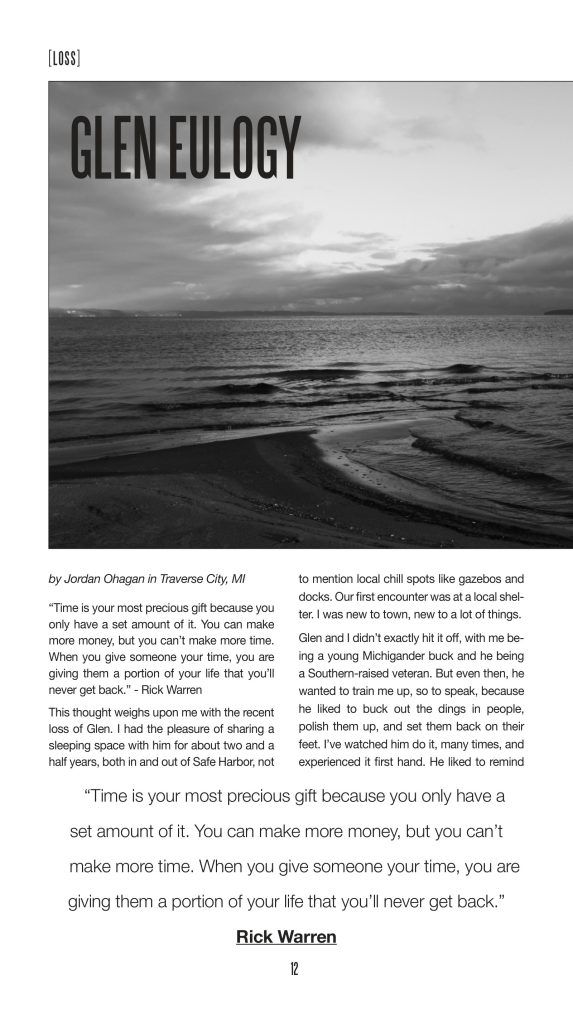
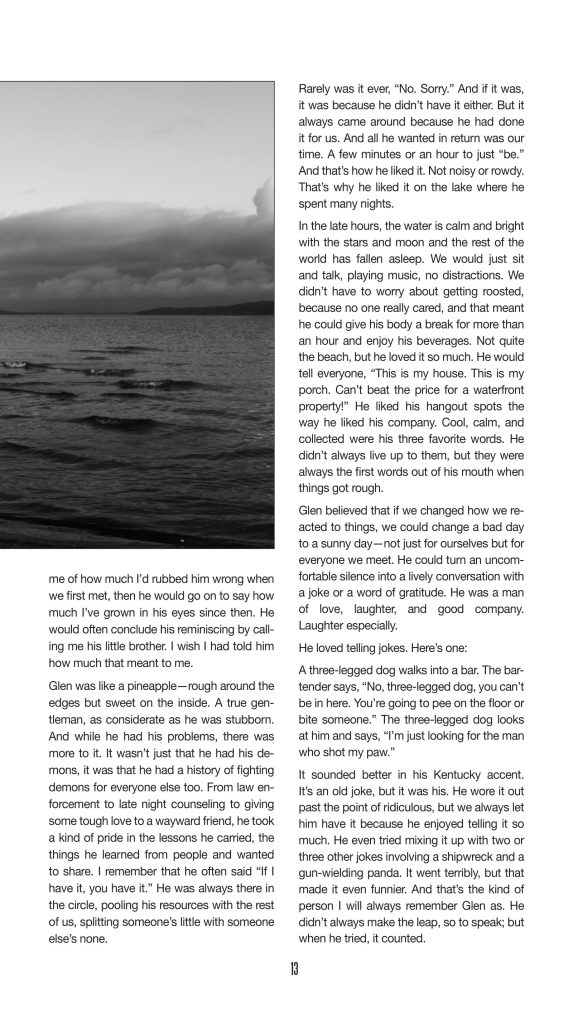
That’s why he liked it on the lake where he
spent many nights.
In the late hours, the water is calm and bright
with the stars and moon and the rest of the
world has fallen asleep. We would just sit
and talk, playing music, no distractions. We
didn’t have to worry about getting roosted,
because no one really cared, and that meant
he could give his body a break for more than
an hour and enjoy his beverages. Not quite
the beach, but he loved it so much. He would
tell everyone, “This is my house. This is my
porch. Can’t beat the price for a waterfront
property!” He liked his hangout spots the
way he liked his company. Cool, calm, and
collected were his three favorite words. He
didn’t always live up to them, but they were
always the first words out of his mouth when
things got rough.
Glen believed that if we changed how we re-
acted to things, we could change a bad day
to a sunny day—not just for ourselves but for
everyone we meet. He could turn an uncom-
me of how much I’d rubbed him wrong when fortable silence into a lively conversation with
we first met, then he would go on to say how a joke or a word of gratitude. He was a man
much I’ve grown in his eyes since then. He of love, laughter, and good company.
Laughter especially.would often conclude his reminiscing by call-
ing me his little brother. I wish I had told him He loved telling jokes. Here’s one:
how much that meant to me. A three-legged dog walks into a bar. The bar-
Glen was like a pineapple—rough around the tender says, “No, three-legged dog, you can’t
edges but sweet on the inside. A true gen- be in here. You’re going to pee on the floor or
tleman, as considerate as he was stubborn. bite someone.” The three-legged dog looks
And while he had his problems, there was at him and says, “I’m just looking for the man
more to it. It wasn’t just that he had his de- who shot my paw.”
mons, it was that he had a history of fighting It sounded better in his Kentucky accent.
demons for everyone else too. From law en- It’s an old joke, but it was his. He wore it out
forcement to late night counseling to giving past the point of ridiculous, but we always let
some tough love to a wayward friend, he took him have it because he enjoyed telling it so
a kind of pride in the lessons he carried, the much. He even tried mixing it up with two or
things he learned from people and wanted three other jokes involving a shipwreck and a
to share. I remember that he often said “If I gun-wielding panda. It went terribly, but that
have it, you have it.” He was always there in made it even funnier. And that’s the kind of
the circle, pooling his resources with the rest person I will always remember Glen as. He
of us, splitting someone’s little with someone didn’t always make the leap, so to speak; but
else’s none. when he tried, it counted.
13
Page 14
[DARK WINTER]
S.A.D.
by Renee Rop in Traverse City, MI
I am sad. I have been sad, on and off
again, for weeks now. Part of the reason
for this is PAWS: Post Acute Withdrawal
Syndrome. I have been sober (again) for
three months. Post-Acute Withdrawal
Syndrome is simply the experiencing of
some withdrawal symptoms (restless
sleep, sadness, irritability, cravings,
etc.) after the actual withdrawal is
completed. It’s the restless, irritable, and
discontented feeling often accompanied
in early recovery. But I also, like many
Michiganders, experience Seasonal
Affective Disorder (SAD), brought on by
the shorter, grayer days and the cold,
damp weather.
It doesn’t help that this winter is predicted
to be as bad as, if not worse than, last
winter. Last winter basically “sucked” for
most of us. The possible exceptions to
this being those who enjoy winter sports consider that there are between 40–100
(snowmobilers, skiers, snowboarders homeless people in need of showers and
and the like). Heating bills were high. laundry. It gets awfully crowded!
Shoveling snow was a daily task, often
It is cold outside!! Navigating sidewalksdone multiple times a day. Roads and
is dangerous and the roads are evensidewalks were treacherous.
more so. Trying to stay warm and dry is a
I am not looking forward to another challenge. Taking care of our feet is just as
harsh winter—especially in light of my challenging when you consider that most
homelessness. Safe Harbor is a Godsend of us walk everywhere. We are dressed in
to those of us experiencing homelessness. many layers, just to stay warm, but this
Many of us would die out on the streets too can impede travel.
were it not for those gracious and giving For myself, I hope to keep busy withrotating churches that temporarily house my volunteer work and try to findus from early November to mid-April from employment—which is additionally6 p.m. to around 7:45 a.m. challenging when you are homeless (this
Still, we are out “roaming” the streets for would constitute a whole other piece).
10 hours daily. Monday through Friday, Fortunately, I like to read, so this too
we can stop into Central United Methodist helps to pass the time. Being out on the
for hot coffee, a hot breakfast, and sign streets is no picnic. It is very different
up for a shower between 8:30 and 10:30 than going from the home, to the car, to
a.m. We can hang at Jubilee House on work, to the car, to the store, to the car,
Monday through Friday from 10 a.m. until to home. It is some heavy-duty outdoor
2 p.m. and try to sign up for a shower and time in the snow and ice and blasting
laundry. There’s a lot of competition if you wind. No wonder I’m suffering S.A.D.
14
Page 15
[FUTURE PRESENT]
YESTERDAY, TODAY
AND TOMORROW
by Randy Parcher in Traverse City, MI
Yesterday, I was your neighbor. Today I’m Tomorrow is a hope not yet born.
not seen. Tomorrow is a dream that slips Yesterday belongs to me—the one thing
away just a little more each day. no one can take from me. Today, I may let
Yesterday, I was a worker, homeowner, and you see a glimpse, but only a glimpse, of
part of the community. Today, I’m lonely in who I really am. Tomorrow—what drives
us forward? Is it the will to struggle on orcrowds, a ghost upon the street, or seen as
the dream that the future will be better thana monster to be chased out of town. Tomor-
yesterday and today?row will bring more pain and regret.
It is hard to think of tomorrow when one isYesterday, I felt good about both myself and
numb just trying to get through today, forhow I feel. Today, I’m sick more and more. tomorrow is far away and just a sweet dreadTomorrow—what will tomorrow bring? held upon the wings of angels. Tomorrow
Yesterday, I was safe. Today, I’m lost and makes all our yesterdays and todays worth
numb with nowhere to lay my head and cry. the struggles.
15
Page 16
[VIOLATED]
TRIALS & TRIBULATIONS
TO RESILIENCE
by Niko in Charlotte, NC
My name is Niko, and my story is a com- my mental medication, so I didn’t see
plicated one. I’m not here to write about them coming.
how I became homeless. That’s a story A group of men pinned me against the
for another sunrise. Instead, I want to wall and held a rag over my mouth to
write about the great, the bad, and the muffle my cries for help.
horrible—the shelter.
I was [raped and] kicked around like yes-
I went there after getting out of the hos- terday’s trash. I wanted to black out. I
pital for depression. I was left like an in- was feeling weak and woozy. It hurt to
fant on the floor having to learn to crawl breathe.
and then walk. It was new to me, yet
I couldn’t sleep, and I spiraled evenfamiliar, after living in a shelter most of
deeper into the shadowy damp pit. CJmy life in Brooklyn. I’ve heard the stories
knew something was up that morning. Iand seen the eclectic mix of characters.
had the bottle of pills and was mumblingBut I still wanted to avoid it all.
to myself.
My thought was to sleep the days away
He informed the shelter’s director of myin the shelter, and keep the people at
actions. I had to have a sit down with herbay. I slept more, ate less, and immersed
and my case manager.myself in my music and books.
They listened to what I had to say—I was alone—no family, no friends, just a
only half true because I was too scaredman plagued with this stigma of home-
and ashamed to let the whole truth belessness. I remained in a small cubicle
known. I told them I’d be okay.area with another man, CJ, who also laid
in bed. One day, I decided to say hello. I was now under the watch of CJ and JR.
One morning, JR dragged me out of bedIt was on that single hello that I started to
and made me get dressed.claw my way out of the murky abyss that
is depression. CJ and I then began to He took me to see a movie. It was a won-
chat with the man in the next cube whose derful time because he treated me like
name was JR. The first week I knew JR, a son and gave me words of wisdom
I didn’t realize that he was blind because like a father.
most days he walked without his cane. I learned about him and learned from
I related to both CJ and JR. They be- him. It felt so surreal to be out of that
came family to me in a matter of months. place and to get a sense of normalcy.
The depression and mental issues all I was recently released from the hospi-
seemed beatable now that I had these tal for the second time in the last year
great guys in my corner. Then that night after a mental breakdown. Thank you to
happened. CJ and JR for providing the laughs and
It was 2 a.m. in the shower room. I thought words of wisdom that have helped me
I was alone. I was fairly woozy from learn to crawl again.
16
Page 17
[FAMILY]
FINDING FORGIVENESS
ON DEATH ROW
by Amanda Haggard for the Contributor in Nashville, TN
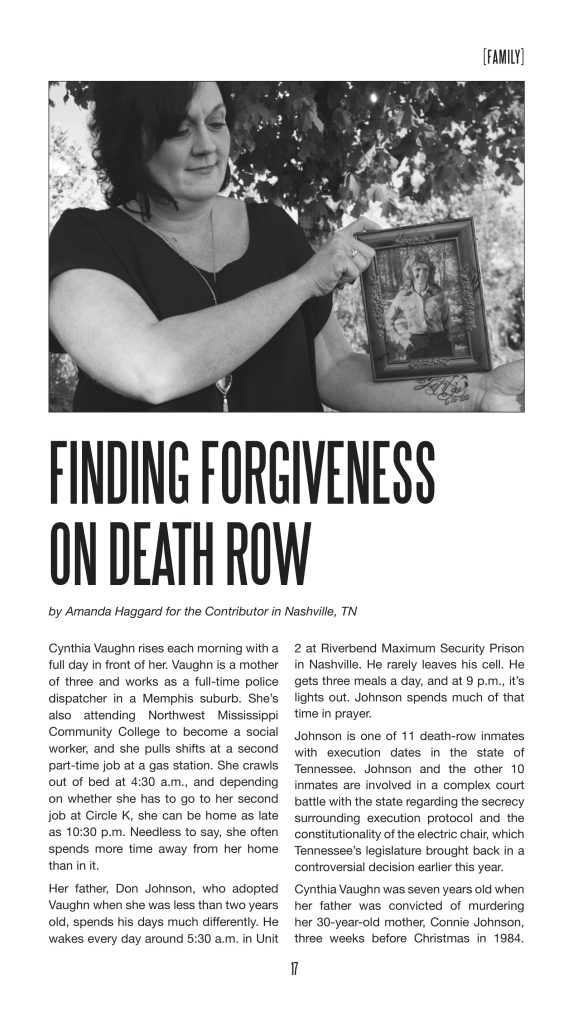
Cynthia Vaughn rises each morning with a 2 at Riverbend Maximum Security Prison
full day in front of her. Vaughn is a mother in Nashville. He rarely leaves his cell. He
of three and works as a full-time police gets three meals a day, and at 9 p.m., it’s
dispatcher in a Memphis suburb. She’s lights out. Johnson spends much of that
also attending Northwest Mississippi time in prayer.
Community College to become a social Johnson is one of 11 death-row inmates
worker, and she pulls shifts at a second with execution dates in the state of
part-time job at a gas station. She crawls Tennessee. Johnson and the other 10
out of bed at 4:30 a.m., and depending inmates are involved in a complex court
on whether she has to go to her second battle with the state regarding the secrecy
job at Circle K, she can be home as late surrounding execution protocol and the
as 10:30 p.m. Needless to say, she often constitutionality of the electric chair, which
spends more time away from her home Tennessee’s legislature brought back in a
than in it. controversial decision earlier this year.
Her father, Don Johnson, who adopted Cynthia Vaughn was seven years old when
Vaughn when she was less than two years her father was convicted of murdering
old, spends his days much differently. He her 30-year-old mother, Connie Johnson,
wakes every day around 5:30 a.m. in Unit three weeks before Christmas in 1984.
17
Page 18
“It just came over me mama was killed) didn’t have the best
childhood ever, and I wanted him to know
that I couldn’t keep hating about it,” Vaughn said. “I got denied by
the prison. They told me that since I was
him . . . And I realized that also the victim’s daughter that it created
conflict. I was crushed.”
my hatred wasn’t affecting In 2006, the state did not execute Johnson,
him. It didn’t, and wouldn’t who was in his mid-60s with graying hair and a slumping figure. Six years later, in
ever, change what 2012, Vaughn said she received a phone call “out of the blue.” Riverbend Prison
happened. I told him that wanted to let her in to see her father.
“I had a list of things I wanted to say,”
day I forgave him.” Vaughn said. “I accepted the invitation to
come, and I went up there with the mindset
of going off on him and letting him know Cynthia Vaughn
how he affected my life in all these terrible
Vaughn, now 37, remembers her mother ways…and I did that. I wanted him to know
dropping her off at the babysitter’s house what our childhood was like, what it’s like
on December 8. Vaughn recalls her father to be the daughter of a death-row inmate
coming that evening to tell her and her who killed his wife.” But when Vaughn got
brother that their mother had “gone to live there, she was surprised by a feeling that
with the angels” before he was arrested. came over her when she looked into her
father’s eyes as he listened to her explain“The next thing I remember is all of my her hatred and anger.aunts and grandmother talking in low
whispers,” Vaughn said. “They told me to “It just came over me that I couldn’t keep
leave the room when a television broadcast hating him,” Vaughn said. “And I realized
came on, but I still remember hearing that my hatred wasn’t affecting him. It
the people on the news and wondering, didn’t, and wouldn’t ever, change what
‘Why are they saying my daddy killed my happened. I told him that day I forgave
mama?’ Then I was sent to live with one of him. I said: ‘I can’t keep hating you. I
my mom’s sisters, and from then on out, it forgive you.’ He started crying.”
was very hard.” Johnson remembers that day, too. “My
In the aftermath of her father’s arrest and adopted daughter came in 2012 to tell
me off, but she ended up forgiving mesubsequent death-penalty conviction,
instead,” Johnson said. “She said sheVaughn found her childhood in Tunica,
didn’t come in here to forgive me.”Mississippi, very difficult. “This was
Tunica before the casinos,” she said. In correspondence with The Contributor,
“Nothing was private. Everyone knew my Johnson said his daughter told him she
story. This was the kind of town that if you had hated him her entire life.
checked the mail in your pajamas, your It stung. “But as she was in here talkingphone would ring as soon as you walked to me, she said she realized I wasn’t
in the house asking why you were outside making excuses [for how hard her life
in your nightgown.” was],” Johnson said. “And [she saw] that
Skip ahead to 2006. Vaughn heard on I looked her in the eye when she talked
television that Johnson had an execution to me. So something changed…and she
date. Two decades had passed since she realized she wanted to forgive me.”
last saw her father. She decided then and After deciding to forgive her father,
there to finally face him. Vaughn had questions. “I just basically
“My brother and I (he was four when my wanted to know the little things that kids
18
Page 19
MOVING BEYOND THE DEATH PENALTY
Vaughn said she thinks the state’s
focus should turn away from the death
penalty and executions to support for
the people that the crimes left behind.
She recounts the passing of her father’s
several execution dates—he’s had more
than three since 2012 alone.
“My problem with the death penalty is
that every so many years the inmate
gets an execution date and it throws
the families into a complete and total
whirlwind: It’s driving me crazy,” Vaughn
said. “And then they always get a stay
of execution and then it lasts another
seven years. And then by the time
I’m able to get back to normal life—I
mean, I’ll always be a victim’s familyknow already about their mama,” Vaughn membe—they’ll put another date on it,said. “What kind of perfume did she wear? and I become the death-row inmate’sWhat kind of car did she drive? What kind daughter again.”of movies did she like? What was her
favorite band? What were her hobbies? After 30 years of watching her father sit
What kind of mom was she? You find on death row, she has serious doubts
yourself questioning every little thing that the execution will ever actually
take place.when your mama was not around.”
“I really don’t know where I standSomething else surprised Vaughn when
morally and ethically when it comes toshe left the prison. She felt compelled
just straight-up death penalty,” Vaughnto turn to God for the first time in years.
said. “It’s not so black and white, cut“There’s that saying that people find
and dry to me.Jesus in a jail cell,” Vaughn said. “Well, I
did too…just not in the same way.” I do know that they can’t keep messing
with families this way. It seems likeVaughn started praying daily and attending
there’s always a focus on justice andchurch. “The murder consumed me at
execution and not on how to better ourmany points of my life,” Vaughn said. “It relationships and community.”was all I thought about every moment that
there was a free moment outside of work Vaughn still has a lot of questions about
and taking care of my kids and homework. her mother’s life and often thinks about
It was all about him and her and what how her life may have been completely
happened. But the way I handled my pain different if not for one tragic day in 1984.
changed dramatically after that visit with After their reconciliation, Don Johnson
my dad.” couldn’t give his daughter her mother
Johnson said people often “conjure up back nor the 30 years she spent
the image of Charles Manson” when wondering, but there was one thing he
they think of death-row inmates. “That’s could do for her:
not us,” he said. “There was a group of Connie wore Chanel No. 5. Her first
preachers who came in here who said car was a ‘73 Ford Torino.She enjoyed
they were apprehensive before coming romantic comedies. She loved the
in, but they said they saw the love of Rolling Stones. She reveled in country
God in our eyes. They said, ‘We didn’t cooking. “And he told me she was just
expect this.’” the best mom ever,” Vaughn said.
19
Page 20
[YOUTH INNOVATION]
EAST JORDAN HIGH SCHOOL
SELLS SPEAK UP ZINE
by Stephanie Buckholtz, a Senior, at EJHS in East Jordan, MI
20
Page 21
It is so empowering and valuable to know the first school to sell magazines in a
that anyone can make a difference. When community.
Corban and Matt Shaw, past graduates When the Shaws came to our school and
from East Jordan High School, spoke at our asked us to contribute to this program to
high school about Speak Up Zine, a street benefit the homeless and needy students in
magazine written by and benefiting home- our community, our eyes were opened to a
less people in northern Michigan, many growing problem in the East Jordan com-
of us were excited about contributing to munity. All of the NHS members wanted to
that effort. help in any way possible.
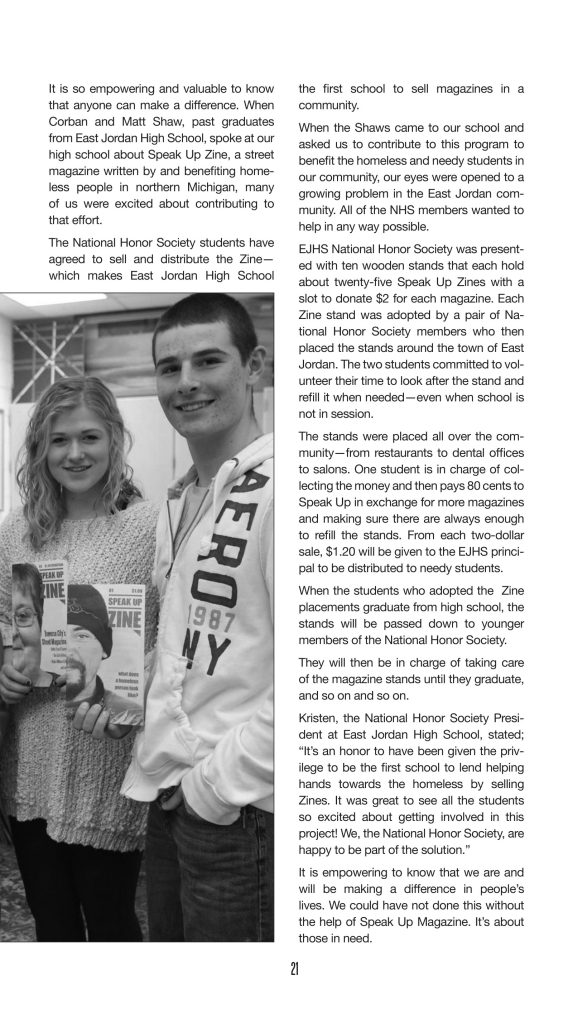
The National Honor Society students have EJHS National Honor Society was present-
agreed to sell and distribute the Zine— ed with ten wooden stands that each hold
which makes East Jordan High School about twenty-five Speak Up Zines with a
slot to donate $2 for each magazine. Each
Zine stand was adopted by a pair of Na-
tional Honor Society members who then
placed the stands around the town of East
Jordan. The two students committed to vol-
unteer their time to look after the stand and
refill it when needed—even when school is
not in session.
The stands were placed all over the com-
munity—from restaurants to dental offices
to salons. One student is in charge of col-
lecting the money and then pays 80 cents to
Speak Up in exchange for more magazines
and making sure there are always enough
to refill the stands. From each two-dollar
sale, $1.20 will be given to the EJHS princi-
pal to be distributed to needy students.
When the students who adopted the Zine
placements graduate from high school, the
stands will be passed down to younger
members of the National Honor Society.
They will then be in charge of taking care
of the magazine stands until they graduate,
and so on and so on.
Kristen, the National Honor Society Presi-
dent at East Jordan High School, stated;
“It’s an honor to have been given the priv-
ilege to be the first school to lend helping
hands towards the homeless by selling
Zines. It was great to see all the students
so excited about getting involved in this
project! We, the National Honor Society, are
happy to be part of the solution.”
It is empowering to know that we are and
will be making a difference in people’s
lives. We could have not done this without
the help of Speak Up Magazine. It’s about
those in need.
21
Page 22
[STUFF]
LOVE IN A POT
by Sheila Apperson in Charlotte, NC they were. She told them that it really
hurt because there is so much love in
There are so many memories of friends her pots.
and family in a pot. Everyone needs Later on, the woman returned to visita pot. each of her friends. When they were not
I knew this lady who had become looking, she took her pots back one at a
homeless and lost everything; however, time. One day, she called all three friends
she was determined to keep her pots. and invited them over for dinner. She had
She asked three different friends to keep a wonderful dinner prepared in all three
each of her three pots. As time went by, pots. As they sat at her table and noticed
the lady finally found a home. She went her pots, she could see how surprised
to each friend to retrieve her pots, and they looked. She looked at them and
each one said they did not know where said, “There is so much love in my pots.”
Love is in all the pots
In the world swirling
Whirling with love
Something good, something shared
Something thoughtfully prepared
Something hot hitting the spot
Love is always in a pot.
22
Page 23
[GIVING] [OPPORTUNITY]
Many thanks to Speak Up’s sponsors & donors.
TRANSFORMED THE COMMUNITY
CHANGED PERCEPTIONS
GAVE A VOICE
PROMOTED OPPORTUNITY
watershedtc.org
STARTED A CONVERSATION
Laura Weiss of Kapow Soap and KaChomp Dog Treats
FAITHFUL DONORS
Peggy Byland, Mike and Michelle Davis, Robert and Rita Jason, Mary Pierce,
Norman and Catherine Schmitt, Bill and Deborah Shaw
23
Page 24
Become a Sponsor
Please consider a sponsorship gift today to empower those in need and publicly show your
support for jobs and opportunity in the community. All gifts are tax-deductible.
TRANSFORM THE COMMUNITY / $2,500+
“Sponsored by [Your Name]” printed on the front cover
Full page “Featured Sponsor Q & A” published in next Zine
plus everything below
CHANGE PERCEPTIONS / $750 & Up
“Meet the Sponsor” blog post profiling
your organization plus everything below
GIVE A VOICE / $500 & Up
One line of contact info included with your logo in the Zine
Thanked in a video, shared on website and on social media
plus everything below
PROMOTE OPPORTUNITY / $250 & Up
Logo included on sponsor’s page in the Zine
Thanked on social media (4,500 fans)
plus everything below
STARTED A CONVERSATION / $100 & Up
Listed in next Zine on the sponsor’s page
Identified as a sponsor on Speak Up website
“Speak Up gave me a chance
to create my own future.”
—said by a once-homeless former magazine
vendor who now owns his own moving company