




1 / 24
Read as text
Page 1
January 2015 | Vol 2 / Issue 1 | $1.00
THE
INTERNATIONAL
ISSUE
Page 2
“Speak Up for those who cannot speak for
themselves, for the rights of all who are
destitute.”
—Proverbs 31:8
More than a Magazine Get Involved
Speak Up Magazine is a 501(c)3 non- Volunteers and interns are welcomed for
profit that gives voice to and offers an creative areas, such as photography, editing,
income opportunity for homeless and teaching, and production, design, as well as
vulnerably-housed people. They become fundraising, social services and more. Please
micro-business owners who buy copies contact us to help out.
of Speak Up for a low price and resell
them, keeping all the cash and earning a
profit. As a result, these enterprising street Speak Up is Local
vendors learn to manage their resources,
grow their businesses and change their Unique editions of Speak Up are
lives with dignity. published monthly in Traverse City, MI,
Speak Up is a member of the and Charlotte, NC.
International Network of Street Papers, To explore bringing Speak Up to your
which connects and supports over 100 region, visit speakupmag.org/local.
such organizations worldwide.
Zine Credits Contact
Tanks to the STREET NEWS SERVICE Charlotte Office (NC)
for the photography and articles for this (704) 980-9885
special edition. speakupmag.org
office@speakupmag.org
ALSO: 1515 S Mint St,
Peggi Knowe, editing Charlotte, NC 28203
Nate Casey, research
Matt Shaw, design & editing
Traverse City Chapter (MI)
speakuptc.com
billshaw@speakupmag.org
2
Page 3
VENDOR PROGRAM Frequently Asked Questions
What is a Speak Up vendor?
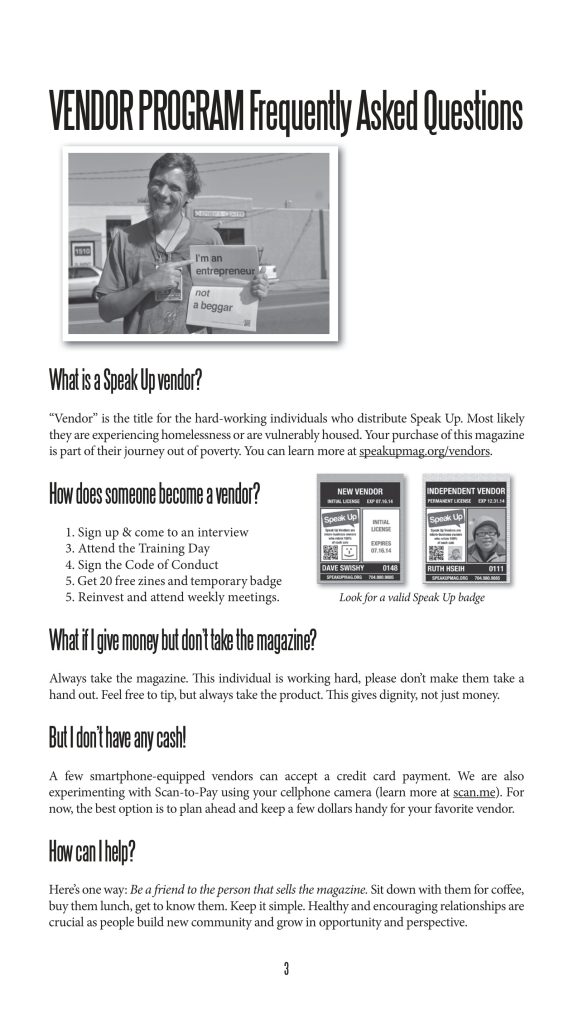
“Vendor” is the title for the hard-working individuals who distribute Speak Up. Most likely
they are experiencing homelessness or are vulnerably housed. Your purchase of this magazine
is part of their journey out of poverty. You can learn more at speakupmag.org/vendors.
How does someone become a vendor?
1. Sign up & come to an interview
3. Attend the Training Day
4. Sign the Code of Conduct
5. Get 20 free zines and temporary badge
5. Reinvest and attend weekly meetings. Look for a valid Speak Up badge
What if I give money but don’t take the magazine?
Always take the magazine. This individual is working hard, please don’t make them take a
hand out. Feel free to tip, but always take the product. This gives dignity, not just money.
But I don’t have any cash!
A few smartphone-equipped vendors can accept a credit card payment. We are also
experimenting with Scan-to-Pay using your cellphone camera (learn more at scan.me). For
now, the best option is to plan ahead and keep a few dollars handy for your favorite vendor.
How can I help?
Here’s one way: Be a friend to the person that sells the magazine. Sit down with them for coffee,
buy them lunch, get to know them. Keep it simple. Healthy and encouraging relationships are
crucial as people build new community and grow in opportunity and perspective.
3
Page 4
THE BIG SELL OFF
[February 2-8, 2015]
THE BIG SELL OFF is weeklong global fundraiser during which non-
homeless individuals become vendors for a few hours to raise funds
for their local street magazines. This fun event is a chance for you to
walk in the shoes of a magazine vendor, raise money for Speak Up and
support a community of inspiring micro-business people.
learn more & sign up:
SPEAKUPMAG.ORG/thebigselloff
4
Page 5
INTERNATIONAL ISSUE
This special edition of Speak Up Magazine features stories
and writings from street magazines and newspapers
around the world.
The World’s Most INSPIRING Workforce 06
Argentina 08
Ukraine 09
Australia 10
England 11
Austria 12
Germany 13
Switzerland 14
Seattle 16
Zambia 17
Russia 18
Canada 20
Japan 21
Nashville 22
Sponsors 23
5
Page 6
[INTERNATIONAL NETWORK OF STREET PAPERS]
MEET THE
WORLD’S MOST
INSPIRING
WORK FORCE
By Laura Smith for the INSP
in Glasgow, Scotland
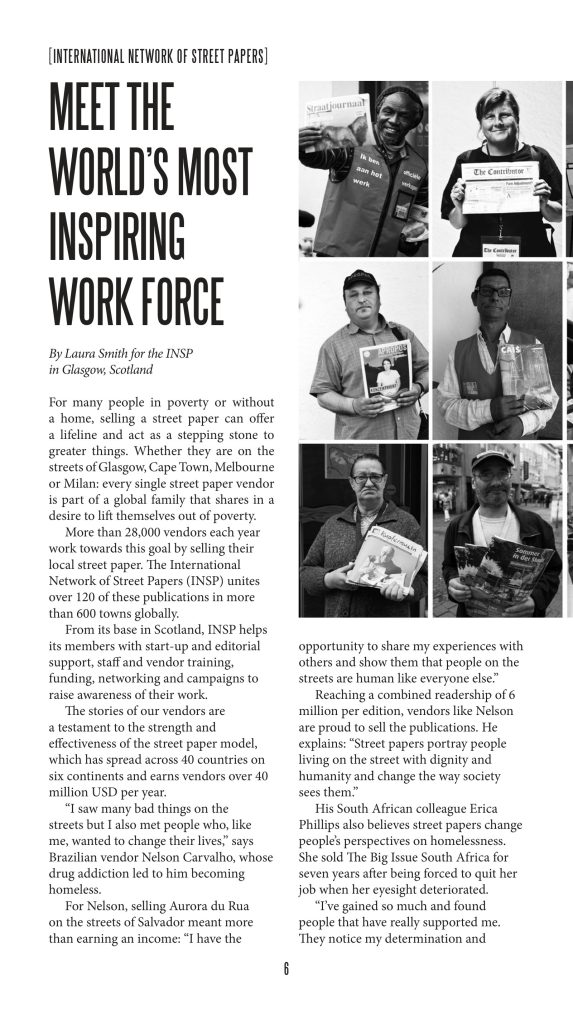
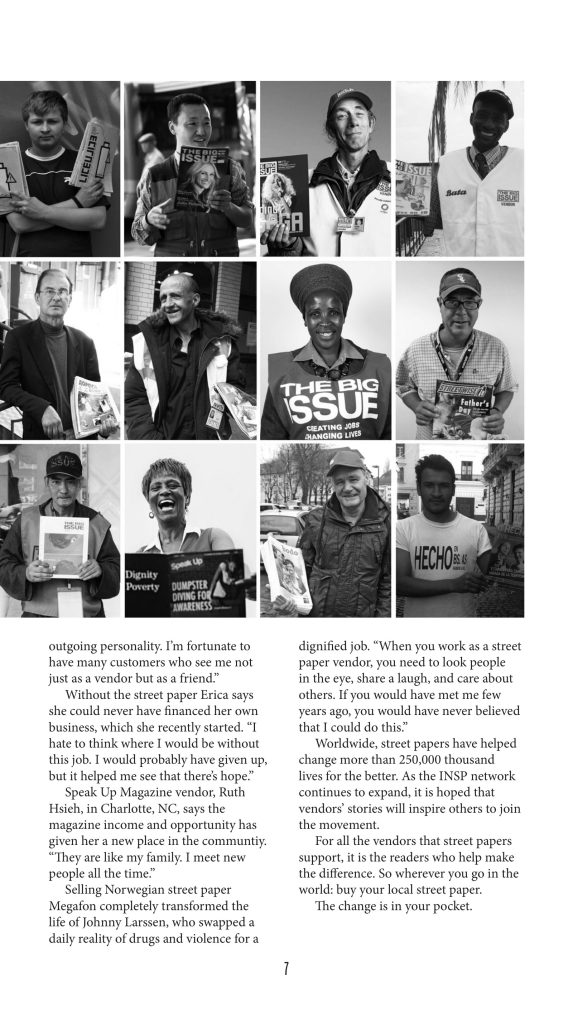
For many people in poverty or without
a home, selling a street paper can offer
a lifeline and act as a stepping stone to
greater things. Whether they are on the
streets of Glasgow, Cape Town, Melbourne
or Milan: every single street paper vendor
is part of a global family that shares in a
desire to lift themselves out of poverty.
More than 28,000 vendors each year
work towards this goal by selling their
local street paper. The International
Network of Street Papers (INSP) unites
over 120 of these publications in more
than 600 towns globally.
From its base in Scotland, INSP helps
its members with start-up and editorial opportunity to share my experiences with
support, staff and vendor training, others and show them that people on the
funding, networking and campaigns to streets are human like everyone else.”
raise awareness of their work. Reaching a combined readership of 6
The stories of our vendors are million per edition, vendors like Nelson
a testament to the strength and are proud to sell the publications. He
effectiveness of the street paper model, explains: “Street papers portray people
which has spread across 40 countries on living on the street with dignity and
six continents and earns vendors over 40 humanity and change the way society
million USD per year. sees them.”
“I saw many bad things on the His South African colleague Erica
streets but I also met people who, like Phillips also believes street papers change
me, wanted to change their lives,” says people’s perspectives on homelessness.
Brazilian vendor Nelson Carvalho, whose She sold The Big Issue South Africa for
drug addiction led to him becoming seven years after being forced to quit her
homeless. job when her eyesight deteriorated.
For Nelson, selling Aurora du Rua “I’ve gained so much and found
on the streets of Salvador meant more people that have really supported me.
than earning an income: “I have the They notice my determination and
6
Page 7
outgoing personality. I’m fortunate to dignified job. “When you work as a street
have many customers who see me not paper vendor, you need to look people
just as a vendor but as a friend.” in the eye, share a laugh, and care about
Without the street paper Erica says others. If you would have met me few
she could never have financed her own years ago, you would have never believed
business, which she recently started. “I that I could do this.”
hate to think where I would be without Worldwide, street papers have helped
this job. I would probably have given up, change more than 250,000 thousand
but it helped me see that there’s hope.” lives for the better. As the INSP network
Speak Up Magazine vendor, Ruth continues to expand, it is hoped that
Hsieh, in Charlotte, NC, says the vendors’ stories will inspire others to join
magazine income and opportunity has the movement.
given her a new place in the communtiy. For all the vendors that street papers
“They are like my family. I meet new support, it is the readers who help make
people all the time.” the difference. So wherever you go in the
Selling Norwegian street paper world: buy your local street paper.
Megafon completely transformed the The change is in your pocket.
life of Johnny Larssen, who swapped a
daily reality of drugs and violence for a
7
Page 8
[ARGENTINA]
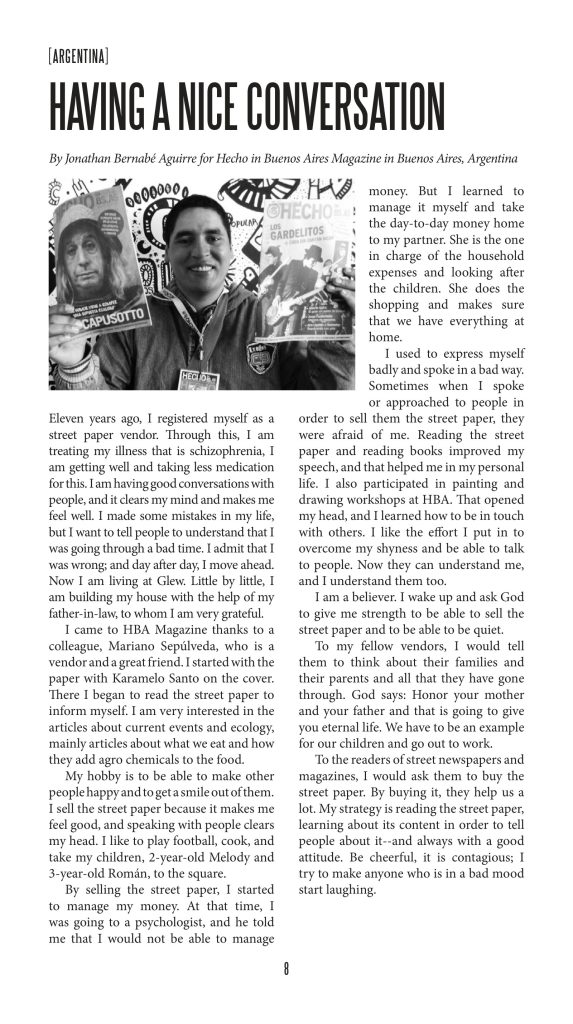
HAVING A NICE CONVERSATION
By Jonathan Bernabé Aguirre for Hecho in Buenos Aires Magazine in Buenos Aires, Argentina
money. But I learned to
manage it myself and take
the day-to-day money home
to my partner. She is the one
in charge of the household
expenses and looking after
the children. She does the
shopping and makes sure
that we have everything at
home.
I used to express myself
badly and spoke in a bad way.
Sometimes when I spoke
or approached to people in
Eleven years ago, I registered myself as a order to sell them the street paper, they
street paper vendor. Through this, I am were afraid of me. Reading the street
treating my illness that is schizophrenia, I paper and reading books improved my
am getting well and taking less medication speech, and that helped me in my personal
for this. I am having good conversations with life. I also participated in painting and
people, and it clears my mind and makes me drawing workshops at HBA. That opened
feel well. I made some mistakes in my life, my head, and I learned how to be in touch
but I want to tell people to understand that I with others. I like the effort I put in to
was going through a bad time. I admit that I overcome my shyness and be able to talk
was wrong; and day after day, I move ahead. to people. Now they can understand me,
Now I am living at Glew. Little by little, I and I understand them too.
am building my house with the help of my I am a believer. I wake up and ask God
father-in-law, to whom I am very grateful. to give me strength to be able to sell the
I came to HBA Magazine thanks to a street paper and to be able to be quiet.
colleague, Mariano Sepúlveda, who is a To my fellow vendors, I would tell
vendor and a great friend. I started with the them to think about their families and
paper with Karamelo Santo on the cover. their parents and all that they have gone
There I began to read the street paper to through. God says: Honor your mother
inform myself. I am very interested in the and your father and that is going to give
articles about current events and ecology, you eternal life. We have to be an example
mainly articles about what we eat and how for our children and go out to work.
they add agro chemicals to the food. To the readers of street newspapers and
My hobby is to be able to make other magazines, I would ask them to buy the
people happy and to get a smile out of them. street paper. By buying it, they help us a
I sell the street paper because it makes me lot. My strategy is reading the street paper,
feel good, and speaking with people clears learning about its content in order to tell
my head. I like to play football, cook, and people about it–and always with a good
take my children, 2-year-old Melody and attitude. Be cheerful, it is contagious; I
3-year-old Román, to the square. try to make anyone who is in a bad mood
By selling the street paper, I started start laughing.
to manage my money. At that time, I
was going to a psychologist, and he told
me that I would not be able to manage
8
Page 9
[UKRAINE]
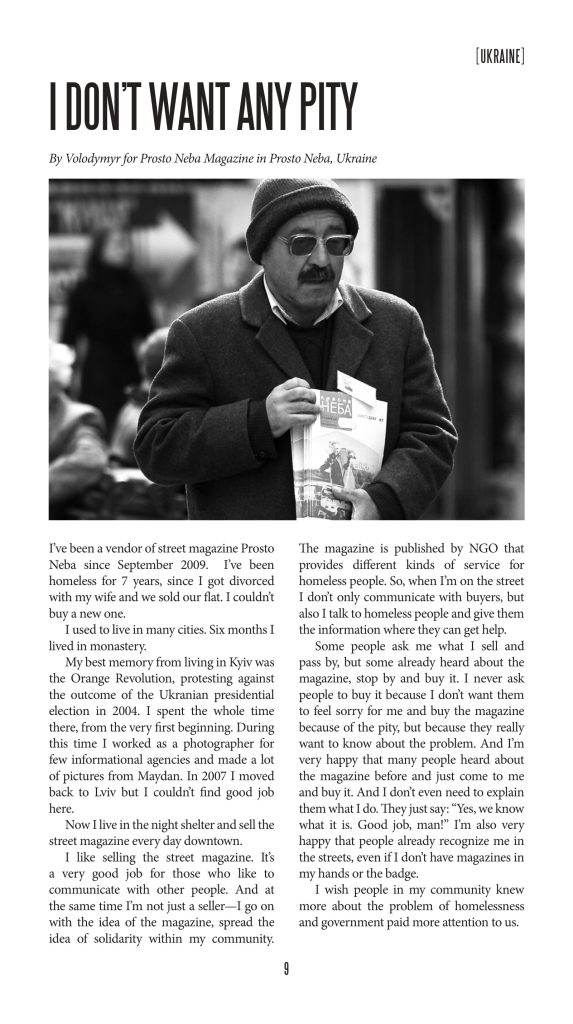
I DON’T WANT ANY PITY
By Volodymyr for Prosto Neba Magazine in Prosto Neba, Ukraine
I’ve been a vendor of street magazine Prosto The magazine is published by NGO that
Neba since September 2009. I’ve been provides different kinds of service for
homeless for 7 years, since I got divorced homeless people. So, when I’m on the street
with my wife and we sold our flat. I couldn’t I don’t only communicate with buyers, but
buy a new one. also I talk to homeless people and give them
I used to live in many cities. Six months I the information where they can get help.
lived in monastery. Some people ask me what I sell and
My best memory from living in Kyiv was pass by, but some already heard about the
the Orange Revolution, protesting against magazine, stop by and buy it. I never ask
the outcome of the Ukranian presidential people to buy it because I don’t want them
election in 2004. I spent the whole time to feel sorry for me and buy the magazine
there, from the very first beginning. During because of the pity, but because they really
this time I worked as a photographer for want to know about the problem. And I’m
few informational agencies and made a lot very happy that many people heard about
of pictures from Maydan. In 2007 I moved the magazine before and just come to me
back to Lviv but I couldn’t find good job and buy it. And I don’t even need to explain
here. them what I do. They just say: “Yes, we know
Now I live in the night shelter and sell the what it is. Good job, man!” I’m also very
street magazine every day downtown. happy that people already recognize me in
I like selling the street magazine. It’s the streets, even if I don’t have magazines in
a very good job for those who like to my hands or the badge.
communicate with other people. And at I wish people in my community knew
the same time I’m not just a seller—I go on more about the problem of homelessness
with the idea of the magazine, spread the and government paid more attention to us.
idea of solidarity within my community.
9
Page 10
[AUSTRALIA]
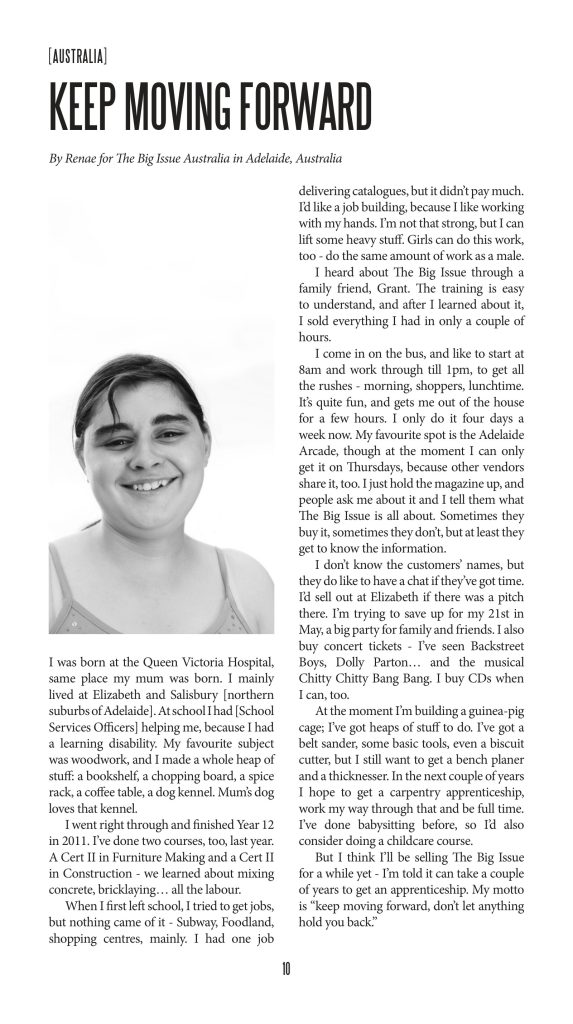
KEEP MOVING FORWARD
By Renae for The Big Issue Australia in Adelaide, Australia
delivering catalogues, but it didn’t pay much.
I’d like a job building, because I like working
with my hands. I’m not that strong, but I can
lift some heavy stuff. Girls can do this work,
too – do the same amount of work as a male.
I heard about The Big Issue through a
family friend, Grant. The training is easy
to understand, and after I learned about it,
I sold everything I had in only a couple of
hours.
I come in on the bus, and like to start at
8am and work through till 1pm, to get all
the rushes – morning, shoppers, lunchtime.
It’s quite fun, and gets me out of the house
for a few hours. I only do it four days a
week now. My favourite spot is the Adelaide
Arcade, though at the moment I can only
get it on Thursdays, because other vendors
share it, too. I just hold the magazine up, and
people ask me about it and I tell them what
The Big Issue is all about. Sometimes they
buy it, sometimes they don’t, but at least they
get to know the information.
I don’t know the customers’ names, but
they do like to have a chat if they’ve got time.
I’d sell out at Elizabeth if there was a pitch
there. I’m trying to save up for my 21st in
May, a big party for family and friends. I also
buy concert tickets – I’ve seen Backstreet
I was born at the Queen Victoria Hospital, Boys, Dolly Parton… and the musical
same place my mum was born. I mainly Chitty Chitty Bang Bang. I buy CDs when
lived at Elizabeth and Salisbury [northern I can, too.
suburbs of Adelaide]. At school I had [School At the moment I’m building a guinea-pig
Services Officers] helping me, because I had cage; I’ve got heaps of stuff to do. I’ve got a
a learning disability. My favourite subject belt sander, some basic tools, even a biscuit
was woodwork, and I made a whole heap of cutter, but I still want to get a bench planer
stuff: a bookshelf, a chopping board, a spice and a thicknesser. In the next couple of years
rack, a coffee table, a dog kennel. Mum’s dog I hope to get a carpentry apprenticeship,
loves that kennel. work my way through that and be full time.
I went right through and finished Year 12 I’ve done babysitting before, so I’d also
in 2011. I’ve done two courses, too, last year. consider doing a childcare course.
A Cert II in Furniture Making and a Cert II But I think I’ll be selling The Big Issue
in Construction – we learned about mixing for a while yet – I’m told it can take a couple
concrete, bricklaying… all the labour. of years to get an apprenticeship. My motto
When I first left school, I tried to get jobs, is “keep moving forward, don’t let anything
but nothing came of it – Subway, Foodland, hold you back.”
shopping centres, mainly. I had one job
10
Page 11
[ENGLAND]
A TERRIBLE LOSS
By Andrew Burns for The Big Issue in Oxford, England
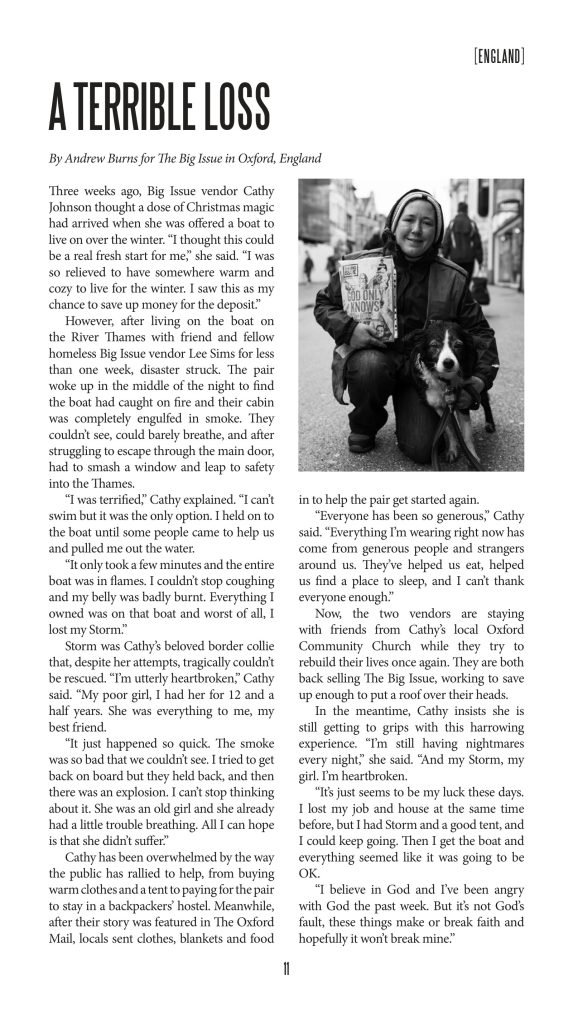
Three weeks ago, Big Issue vendor Cathy
Johnson thought a dose of Christmas magic
had arrived when she was offered a boat to
live on over the winter. “I thought this could
be a real fresh start for me,” she said. “I was
so relieved to have somewhere warm and
cozy to live for the winter. I saw this as my
chance to save up money for the deposit.”
However, after living on the boat on
the River Thames with friend and fellow
homeless Big Issue vendor Lee Sims for less
than one week, disaster struck. The pair
woke up in the middle of the night to find
the boat had caught on fire and their cabin
was completely engulfed in smoke. They
couldn’t see, could barely breathe, and after
struggling to escape through the main door,
had to smash a window and leap to safety
into the Thames.
“I was terrified,” Cathy explained. “I can’t in to help the pair get started again.
swim but it was the only option. I held on to “Everyone has been so generous,” Cathy
the boat until some people came to help us said. “Everything I’m wearing right now has
and pulled me out the water. come from generous people and strangers
“It only took a few minutes and the entire around us. They’ve helped us eat, helped
boat was in flames. I couldn’t stop coughing us find a place to sleep, and I can’t thank
and my belly was badly burnt. Everything I everyone enough.”
owned was on that boat and worst of all, I Now, the two vendors are staying
lost my Storm.” with friends from Cathy’s local Oxford
Storm was Cathy’s beloved border collie Community Church while they try to
that, despite her attempts, tragically couldn’t rebuild their lives once again. They are both
be rescued. “I’m utterly heartbroken,” Cathy back selling The Big Issue, working to save
said. “My poor girl, I had her for 12 and a up enough to put a roof over their heads.
half years. She was everything to me, my In the meantime, Cathy insists she is
best friend. still getting to grips with this harrowing
“It just happened so quick. The smoke experience. “I’m still having nightmares
was so bad that we couldn’t see. I tried to get every night,” she said. “And my Storm, my
back on board but they held back, and then girl. I’m heartbroken.
there was an explosion. I can’t stop thinking “It’s just seems to be my luck these days.
about it. She was an old girl and she already I lost my job and house at the same time
had a little trouble breathing. All I can hope before, but I had Storm and a good tent, and
is that she didn’t suffer.” I could keep going. Then I get the boat and
Cathy has been overwhelmed by the way everything seemed like it was going to be
the public has rallied to help, from buying OK.
warm clothes and a tent to paying for the pair “I believe in God and I’ve been angry
to stay in a backpackers’ hostel. Meanwhile, with God the past week. But it’s not God’s
after their story was featured in The Oxford fault, these things make or break faith and
Mail, locals sent clothes, blankets and food hopefully it won’t break mine.”
11
Page 12
[AUSTRIA]
IT ALL GOT BETTER AND BETTER
By Bertl Weißengruber for Kupfermuckn in Linz, Austria
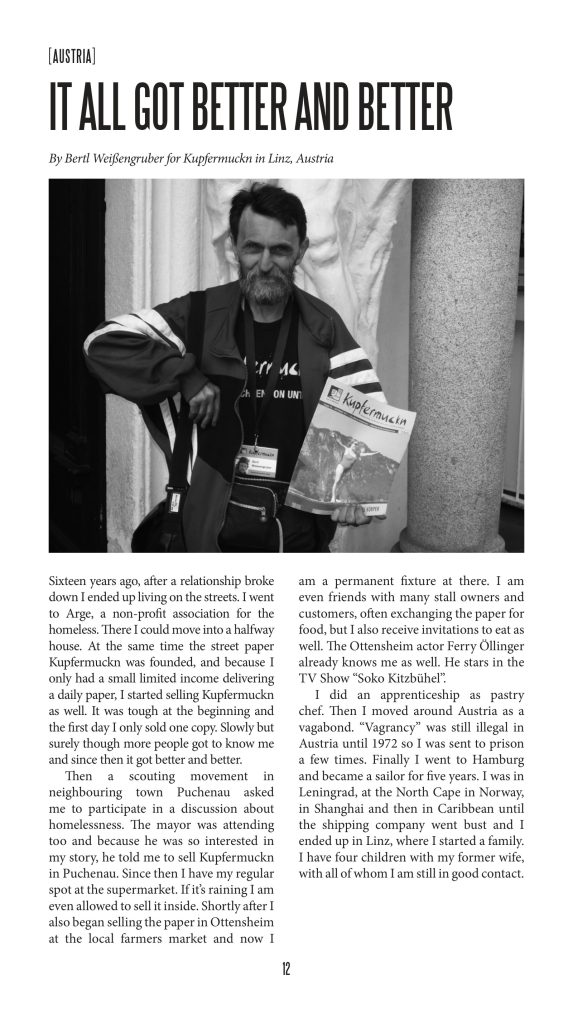
Sixteen years ago, after a relationship broke am a permanent fixture at there. I am
down I ended up living on the streets. I went even friends with many stall owners and
to Arge, a non-profit association for the customers, often exchanging the paper for
homeless. There I could move into a halfway food, but I also receive invitations to eat as
house. At the same time the street paper well. The Ottensheim actor Ferry Öllinger
Kupfermuckn was founded, and because I already knows me as well. He stars in the
only had a small limited income delivering TV Show “Soko Kitzbühel”.
a daily paper, I started selling Kupfermuckn I did an apprenticeship as pastry
as well. It was tough at the beginning and chef. Then I moved around Austria as a
the first day I only sold one copy. Slowly but vagabond. “Vagrancy” was still illegal in
surely though more people got to know me Austria until 1972 so I was sent to prison
and since then it got better and better. a few times. Finally I went to Hamburg
Then a scouting movement in and became a sailor for five years. I was in
neighbouring town Puchenau asked Leningrad, at the North Cape in Norway,
me to participate in a discussion about in Shanghai and then in Caribbean until
homelessness. The mayor was attending the shipping company went bust and I
too and because he was so interested in ended up in Linz, where I started a family.
my story, he told me to sell Kupfermuckn I have four children with my former wife,
in Puchenau. Since then I have my regular with all of whom I am still in good contact.
spot at the supermarket. If it’s raining I am
even allowed to sell it inside. Shortly after I
also began selling the paper in Ottensheim
at the local farmers market and now I
12
Page 13
[GERMANY]
THE PAST CAN’T BE CHANGED
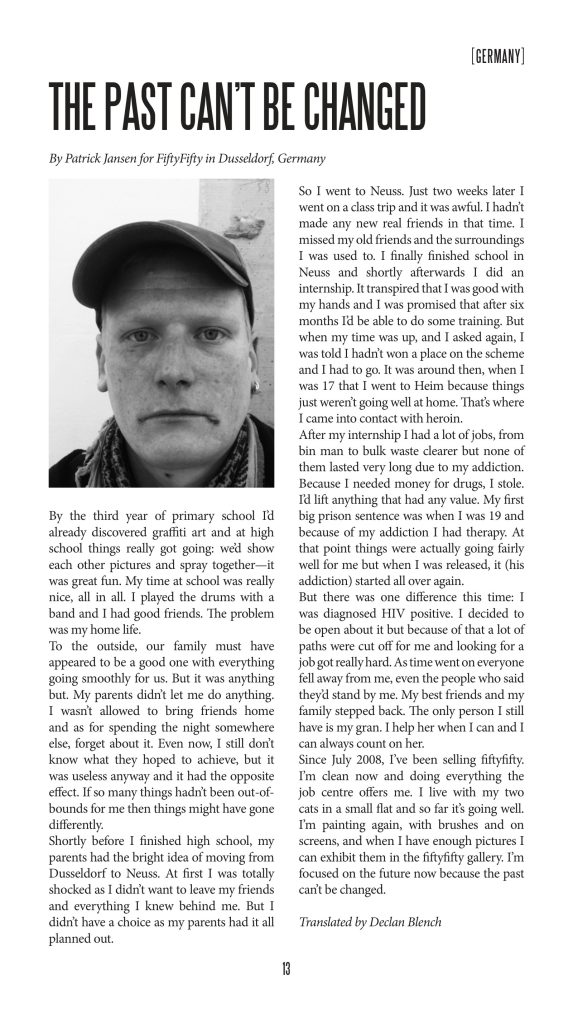
By Patrick Jansen for FiftyFifty in Dusseldorf, Germany
So I went to Neuss. Just two weeks later I
went on a class trip and it was awful. I hadn’t
made any new real friends in that time. I
missed my old friends and the surroundings
I was used to. I finally finished school in
Neuss and shortly afterwards I did an
internship. It transpired that I was good with
my hands and I was promised that after six
months I’d be able to do some training. But
when my time was up, and I asked again, I
was told I hadn’t won a place on the scheme
and I had to go. It was around then, when I
was 17 that I went to Heim because things
just weren’t going well at home. That’s where
I came into contact with heroin.
After my internship I had a lot of jobs, from
bin man to bulk waste clearer but none of
them lasted very long due to my addiction.
Because I needed money for drugs, I stole.
I’d lift anything that had any value. My first
By the third year of primary school I’d big prison sentence was when I was 19 and
already discovered graffiti art and at high because of my addiction I had therapy. At
school things really got going: we’d show that point things were actually going fairly
each other pictures and spray together—it well for me but when I was released, it (his
was great fun. My time at school was really addiction) started all over again.
nice, all in all. I played the drums with a But there was one difference this time: I
band and I had good friends. The problem was diagnosed HIV positive. I decided to
was my home life. be open about it but because of that a lot of
To the outside, our family must have paths were cut off for me and looking for a
appeared to be a good one with everything job got really hard. As time went on everyone
going smoothly for us. But it was anything fell away from me, even the people who said
but. My parents didn’t let me do anything. they’d stand by me. My best friends and my
I wasn’t allowed to bring friends home family stepped back. The only person I still
and as for spending the night somewhere have is my gran. I help her when I can and I
else, forget about it. Even now, I still don’t can always count on her.
know what they hoped to achieve, but it Since July 2008, I’ve been selling fiftyfifty.
was useless anyway and it had the opposite I’m clean now and doing everything the
effect. If so many things hadn’t been out-of- job centre offers me. I live with my two
bounds for me then things might have gone cats in a small flat and so far it’s going well.
differently. I’m painting again, with brushes and on
Shortly before I finished high school, my screens, and when I have enough pictures I
parents had the bright idea of moving from can exhibit them in the fiftyfifty gallery. I’m
Dusseldorf to Neuss. At first I was totally focused on the future now because the past
shocked as I didn’t want to leave my friends can’t be changed.
and everything I knew behind me. But I
didn’t have a choice as my parents had it all Translated by Declan Blench
planned out.
13
Page 14
[SWITZERLAND]
I SING IN A STREET MAGAZINE CHOIR
By Nadine Gartmann for Surprise in Basel, Switzerland
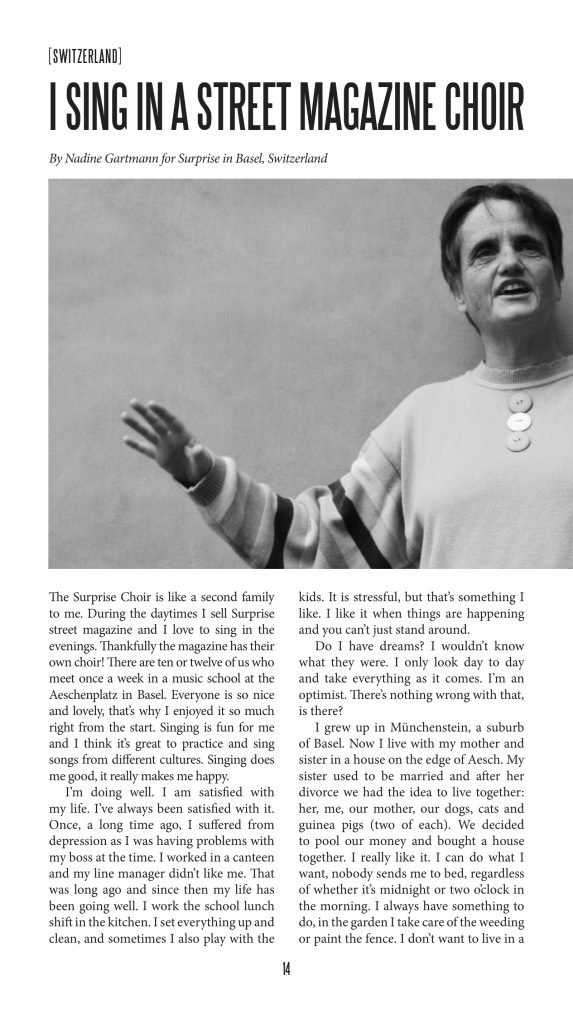
The Surprise Choir is like a second family kids. It is stressful, but that’s something I
to me. During the daytimes I sell Surprise like. I like it when things are happening
street magazine and I love to sing in the and you can’t just stand around.
evenings. Thankfully the magazine has their Do I have dreams? I wouldn’t know
own choir! There are ten or twelve of us who what they were. I only look day to day
meet once a week in a music school at the and take everything as it comes. I’m an
Aeschenplatz in Basel. Everyone is so nice optimist. There’s nothing wrong with that,
and lovely, that’s why I enjoyed it so much is there?
right from the start. Singing is fun for me I grew up in Münchenstein, a suburb
and I think it’s great to practice and sing of Basel. Now I live with my mother and
songs from different cultures. Singing does sister in a house on the edge of Aesch. My
me good, it really makes me happy. sister used to be married and after her
I’m doing well. I am satisfied with divorce we had the idea to live together:
my life. I’ve always been satisfied with it. her, me, our mother, our dogs, cats and
Once, a long time ago, I suffered from guinea pigs (two of each). We decided
depression as I was having problems with to pool our money and bought a house
my boss at the time. I worked in a canteen together. I really like it. I can do what I
and my line manager didn’t like me. That want, nobody sends me to bed, regardless
was long ago and since then my life has of whether it’s midnight or two o’clock in
been going well. I work the school lunch the morning. I always have something to
shift in the kitchen. I set everything up and do, in the garden I take care of the weeding
clean, and sometimes I also play with the or paint the fence. I don’t want to live in a
14
Page 15
block of flats, and I certainly don’t want to bag and laid her before a black cat before
live alone. I don’t really know how long throwing her in the back of it. I found that
my current situation will last, whether so brutal. He then took her with him, but
my sister emigrates one day, or should she is still in my heart.
anything happen to my mother as she is I enjoy travelling. It’s not as easy for me
already quite old. But I don’t worry about to travel these days because of the dogs.
it, we will see what happens. It’s difficult for me to leave them at home.
I have always liked animals and small My mother is not the youngest anymore
children. When I was younger I wanted to and the dogs are very lively. I want to
have children, now I’m 52 and it’s really visit Greece again to stay with Doris, our
ok not to have any. I have always earned a best friend, who also sings in the Surprise
bit of money looking after other people’s Choir. Maybe we’ll go there next spring.
children. I was always happy to have time With the car, my sister drives. Then
to myself in the evenings. Animals are the dogs can come too. Last time it was
uncomplicated, I love them all, except, of wonderful. We bathed in the sea, watched
course, snakes. From when we were very films and read a lot. People often passed
small we always had animals around us. by for a visit and once we spent the night
Before the holidays we had to get our dog under the stars.
Sinti put to sleep. She was doing really And that’s my life. Quite good, don’t
badly, she could hardly breathe. I held her you think?
in my arms until she was asleep. When she
was dead, the vet put her in a black plastic Translated by Amy Fox
15
Page 16
[SEATTLE]
I’M A VERY REAL PERSON
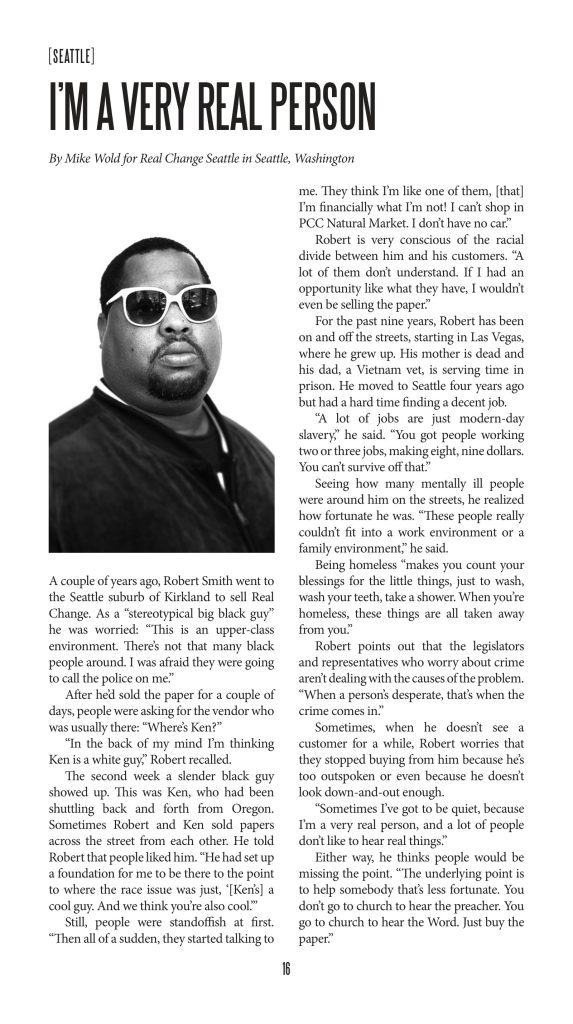
By Mike Wold for Real Change Seattle in Seattle, Washington
me. They think I’m like one of them, [that]
I’m financially what I’m not! I can’t shop in
PCC Natural Market. I don’t have no car.”
Robert is very conscious of the racial
divide between him and his customers. “A
lot of them don’t understand. If I had an
opportunity like what they have, I wouldn’t
even be selling the paper.”
For the past nine years, Robert has been
on and off the streets, starting in Las Vegas,
where he grew up. His mother is dead and
his dad, a Vietnam vet, is serving time in
prison. He moved to Seattle four years ago
but had a hard time finding a decent job.
“A lot of jobs are just modern-day
slavery,” he said. “You got people working
two or three jobs, making eight, nine dollars.
You can’t survive off that.”
Seeing how many mentally ill people
were around him on the streets, he realized
how fortunate he was. “These people really
couldn’t fit into a work environment or a
family environment,” he said.
Being homeless “makes you count your
A couple of years ago, Robert Smith went to blessings for the little things, just to wash,
the Seattle suburb of Kirkland to sell Real wash your teeth, take a shower. When you’re
Change. As a “stereotypical big black guy” homeless, these things are all taken away
he was worried: “This is an upper-class from you.”
environment. There’s not that many black Robert points out that the legislators
people around. I was afraid they were going and representatives who worry about crime
to call the police on me.” aren’t dealing with the causes of the problem.
After he’d sold the paper for a couple of “When a person’s desperate, that’s when the
days, people were asking for the vendor who crime comes in.”
was usually there: “Where’s Ken?” Sometimes, when he doesn’t see a
“In the back of my mind I’m thinking customer for a while, Robert worries that
Ken is a white guy,” Robert recalled. they stopped buying from him because he’s
The second week a slender black guy too outspoken or even because he doesn’t
showed up. This was Ken, who had been look down-and-out enough.
shuttling back and forth from Oregon. “Sometimes I’ve got to be quiet, because
Sometimes Robert and Ken sold papers I’m a very real person, and a lot of people
across the street from each other. He told don’t like to hear real things.”
Robert that people liked him. “He had set up Either way, he thinks people would be
a foundation for me to be there to the point missing the point. “The underlying point is
to where the race issue was just, ‘[Ken’s] a to help somebody that’s less fortunate. You
cool guy. And we think you’re also cool.’” don’t go to church to hear the preacher. You
Still, people were standoffish at first. go to church to hear the Word. Just buy the
“Then all of a sudden, they started talking to paper.”
16
Page 17
[ZAMBIA]
IT WAS NOT MY CHOICE
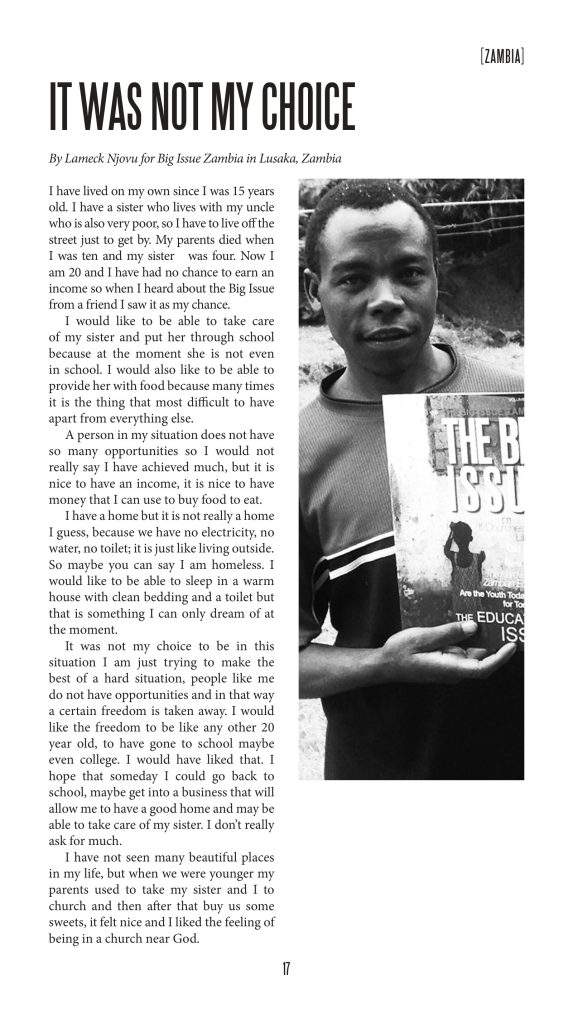
By Lameck Njovu for Big Issue Zambia in Lusaka, Zambia
I have lived on my own since I was 15 years
old. I have a sister who lives with my uncle
who is also very poor, so I have to live off the
street just to get by. My parents died when
I was ten and my sister was four. Now I
am 20 and I have had no chance to earn an
income so when I heard about the Big Issue
from a friend I saw it as my chance.
I would like to be able to take care
of my sister and put her through school
because at the moment she is not even
in school. I would also like to be able to
provide her with food because many times
it is the thing that most difficult to have
apart from everything else.
A person in my situation does not have
so many opportunities so I would not
really say I have achieved much, but it is
nice to have an income, it is nice to have
money that I can use to buy food to eat.
I have a home but it is not really a home
I guess, because we have no electricity, no
water, no toilet; it is just like living outside.
So maybe you can say I am homeless. I
would like to be able to sleep in a warm
house with clean bedding and a toilet but
that is something I can only dream of at
the moment.
It was not my choice to be in this
situation I am just trying to make the
best of a hard situation, people like me
do not have opportunities and in that way
a certain freedom is taken away. I would
like the freedom to be like any other 20
year old, to have gone to school maybe
even college. I would have liked that. I
hope that someday I could go back to
school, maybe get into a business that will
allow me to have a good home and may be
able to take care of my sister. I don’t really
ask for much.
I have not seen many beautiful places
in my life, but when we were younger my
parents used to take my sister and I to
church and then after that buy us some
sweets, it felt nice and I liked the feeling of
being in a church near God.
17
Page 18
[RUSSIA]
FOLLOWING A VENDOR FOR THE DAY
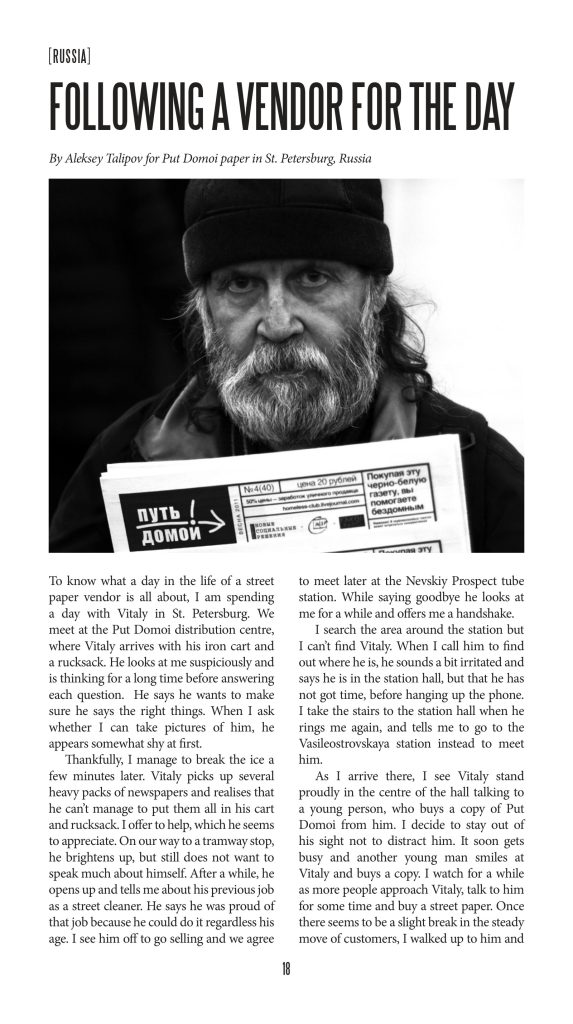
By Aleksey Talipov for Put Domoi paper in St. Petersburg, Russia
To know what a day in the life of a street to meet later at the Nevskiy Prospect tube
paper vendor is all about, I am spending station. While saying goodbye he looks at
a day with Vitaly in St. Petersburg. We me for a while and offers me a handshake.
meet at the Put Domoi distribution centre, I search the area around the station but
where Vitaly arrives with his iron cart and I can’t find Vitaly. When I call him to find
a rucksack. He looks at me suspiciously and out where he is, he sounds a bit irritated and
is thinking for a long time before answering says he is in the station hall, but that he has
each question. He says he wants to make not got time, before hanging up the phone.
sure he says the right things. When I ask I take the stairs to the station hall when he
whether I can take pictures of him, he rings me again, and tells me to go to the
appears somewhat shy at first. Vasileostrovskaya station instead to meet
Thankfully, I manage to break the ice a him.
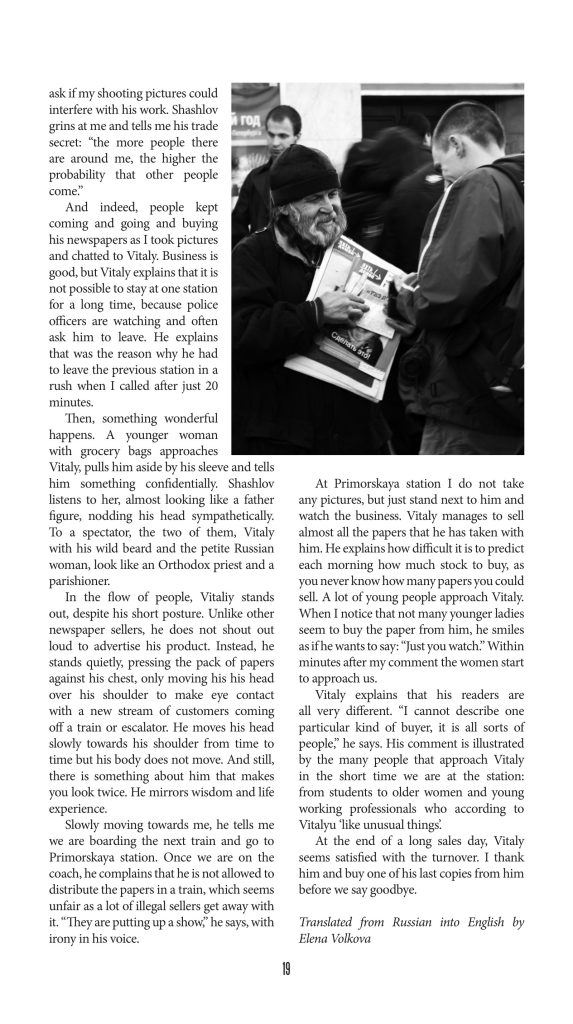
few minutes later. Vitaly picks up several As I arrive there, I see Vitaly stand
heavy packs of newspapers and realises that proudly in the centre of the hall talking to
he can’t manage to put them all in his cart a young person, who buys a copy of Put
and rucksack. I offer to help, which he seems Domoi from him. I decide to stay out of
to appreciate. On our way to a tramway stop, his sight not to distract him. It soon gets
he brightens up, but still does not want to busy and another young man smiles at
speak much about himself. After a while, he Vitaly and buys a copy. I watch for a while
opens up and tells me about his previous job as more people approach Vitaly, talk to him
as a street cleaner. He says he was proud of for some time and buy a street paper. Once
that job because he could do it regardless his there seems to be a slight break in the steady
age. I see him off to go selling and we agree move of customers, I walked up to him and
18
Page 19
ask if my shooting pictures could
interfere with his work. Shashlov
grins at me and tells me his trade
secret: “the more people there
are around me, the higher the
probability that other people
come.”
And indeed, people kept
coming and going and buying
his newspapers as I took pictures
and chatted to Vitaly. Business is
good, but Vitaly explains that it is
not possible to stay at one station
for a long time, because police
officers are watching and often
ask him to leave. He explains
that was the reason why he had
to leave the previous station in a
rush when I called after just 20
minutes.
Then, something wonderful
happens. A younger woman
with grocery bags approaches
Vitaly, pulls him aside by his sleeve and tells
him something confidentially. Shashlov At Primorskaya station I do not take
listens to her, almost looking like a father any pictures, but just stand next to him and
figure, nodding his head sympathetically. watch the business. Vitaly manages to sell
To a spectator, the two of them, Vitaly almost all the papers that he has taken with
with his wild beard and the petite Russian him. He explains how difficult it is to predict
woman, look like an Orthodox priest and a each morning how much stock to buy, as
parishioner. you never know how many papers you could
In the flow of people, Vitaliy stands sell. A lot of young people approach Vitaly.
out, despite his short posture. Unlike other When I notice that not many younger ladies
newspaper sellers, he does not shout out seem to buy the paper from him, he smiles
loud to advertise his product. Instead, he as if he wants to say: “Just you watch.” Within
stands quietly, pressing the pack of papers minutes after my comment the women start
against his chest, only moving his his head to approach us.
over his shoulder to make eye contact Vitaly explains that his readers are
with a new stream of customers coming all very different. “I cannot describe one
off a train or escalator. He moves his head particular kind of buyer, it is all sorts of
slowly towards his shoulder from time to people,” he says. His comment is illustrated
time but his body does not move. And still, by the many people that approach Vitaly
there is something about him that makes in the short time we are at the station:
you look twice. He mirrors wisdom and life from students to older women and young
experience. working professionals who according to
Slowly moving towards me, he tells me Vitalyu ‘like unusual things’.
we are boarding the next train and go to At the end of a long sales day, Vitaly
Primorskaya station. Once we are on the seems satisfied with the turnover. I thank
coach, he complains that he is not allowed to him and buy one of his last copies from him
distribute the papers in a train, which seems before we say goodbye.
unfair as a lot of illegal sellers get away with
it. “They are putting up a show,” he says, with Translated from Russian into English by
irony in his voice. Elena Volkova
19
Page 20
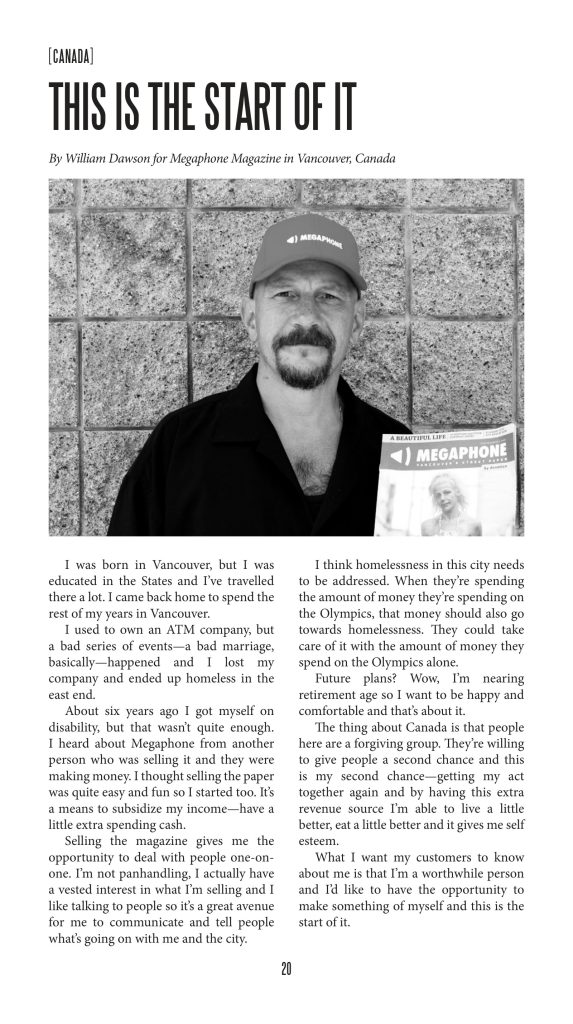
[CANADA]
THIS IS THE START OF IT
By William Dawson for Megaphone Magazine in Vancouver, Canada
I was born in Vancouver, but I was I think homelessness in this city needs
educated in the States and I’ve travelled to be addressed. When they’re spending
there a lot. I came back home to spend the the amount of money they’re spending on
rest of my years in Vancouver. the Olympics, that money should also go
I used to own an ATM company, but towards homelessness. They could take
a bad series of events—a bad marriage, care of it with the amount of money they
basically—happened and I lost my spend on the Olympics alone.
company and ended up homeless in the Future plans? Wow, I’m nearing
east end. retirement age so I want to be happy and
About six years ago I got myself on comfortable and that’s about it.
disability, but that wasn’t quite enough. The thing about Canada is that people
I heard about Megaphone from another here are a forgiving group. They’re willing
person who was selling it and they were to give people a second chance and this
making money. I thought selling the paper is my second chance—getting my act
was quite easy and fun so I started too. It’s together again and by having this extra
a means to subsidize my income—have a revenue source I’m able to live a little
little extra spending cash. better, eat a little better and it gives me self
Selling the magazine gives me the esteem.
opportunity to deal with people one-on- What I want my customers to know
one. I’m not panhandling, I actually have about me is that I’m a worthwhile person
a vested interest in what I’m selling and I and I’d like to have the opportunity to
like talking to people so it’s a great avenue make something of myself and this is the
for me to communicate and tell people start of it.
what’s going on with me and the city.
20
Page 21
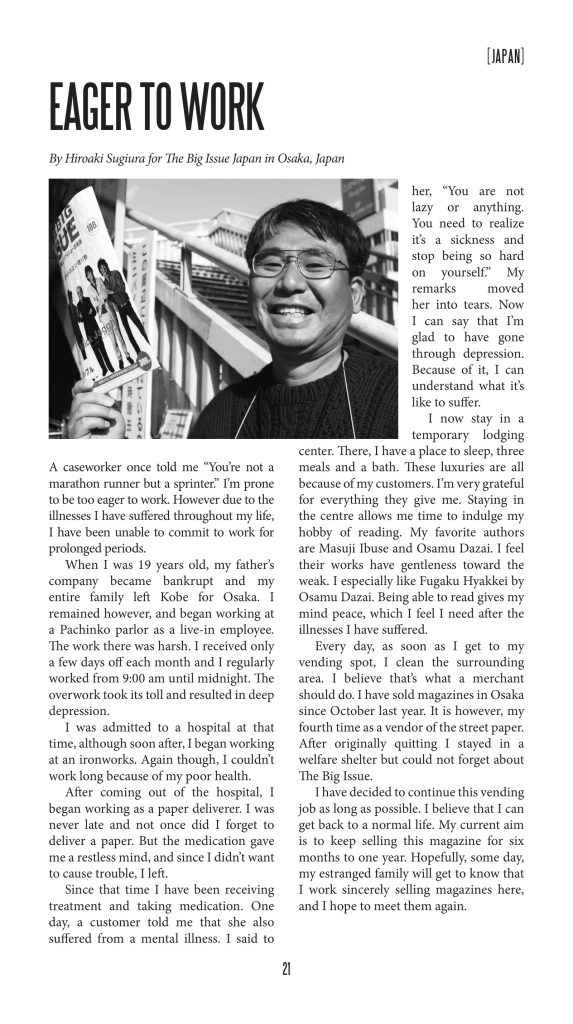
[JAPAN]
EAGER TO WORK
By Hiroaki Sugiura for The Big Issue Japan in Osaka, Japan
her, “You are not
lazy or anything.
You need to realize
it’s a sickness and
stop being so hard
on yourself.” My
remarks moved
her into tears. Now
I can say that I’m
glad to have gone
through depression.
Because of it, I can
understand what it’s
like to suffer.
I now stay in a
temporary lodging
center. There, I have a place to sleep, three
A caseworker once told me “You’re not a meals and a bath. These luxuries are all
marathon runner but a sprinter.” I’m prone because of my customers. I’m very grateful
to be too eager to work. However due to the for everything they give me. Staying in
illnesses I have suffered throughout my life, the centre allows me time to indulge my
I have been unable to commit to work for hobby of reading. My favorite authors
prolonged periods. are Masuji Ibuse and Osamu Dazai. I feel
When I was 19 years old, my father’s their works have gentleness toward the
company became bankrupt and my weak. I especially like Fugaku Hyakkei by
entire family left Kobe for Osaka. I Osamu Dazai. Being able to read gives my
remained however, and began working at mind peace, which I feel I need after the
a Pachinko parlor as a live-in employee. illnesses I have suffered.
The work there was harsh. I received only Every day, as soon as I get to my
a few days off each month and I regularly vending spot, I clean the surrounding
worked from 9:00 am until midnight. The area. I believe that’s what a merchant
overwork took its toll and resulted in deep should do. I have sold magazines in Osaka
depression. since October last year. It is however, my
I was admitted to a hospital at that fourth time as a vendor of the street paper.
time, although soon after, I began working After originally quitting I stayed in a
at an ironworks. Again though, I couldn’t welfare shelter but could not forget about
work long because of my poor health. The Big Issue.
After coming out of the hospital, I I have decided to continue this vending
began working as a paper deliverer. I was job as long as possible. I believe that I can
never late and not once did I forget to get back to a normal life. My current aim
deliver a paper. But the medication gave is to keep selling this magazine for six
me a restless mind, and since I didn’t want months to one year. Hopefully, some day,
to cause trouble, I left. my estranged family will get to know that
Since that time I have been receiving I work sincerely selling magazines here,
treatment and taking medication. One and I hope to meet them again.
day, a customer told me that she also
suffered from a mental illness. I said to
21
Page 22
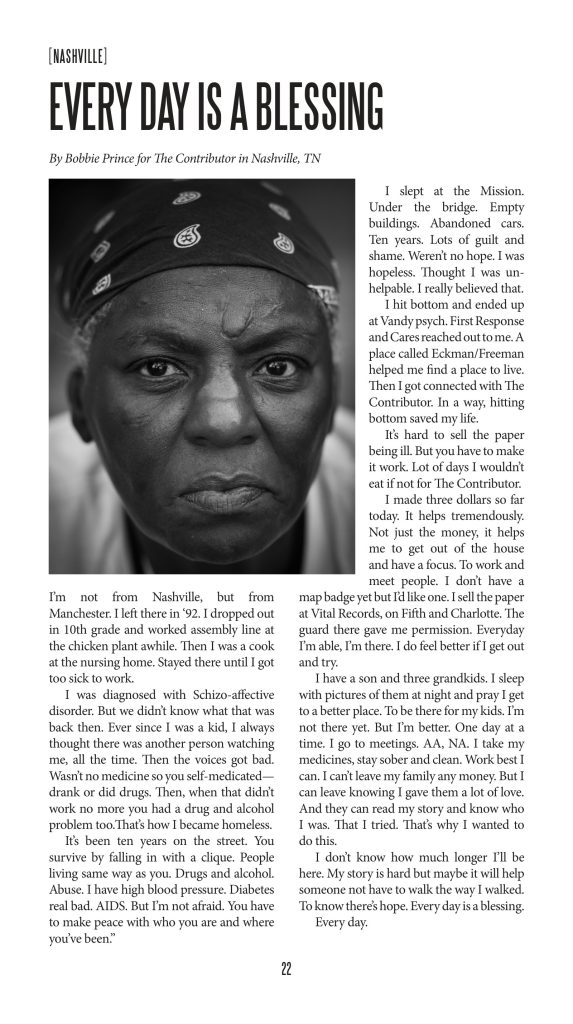
[NASHVILLE]
EVERY DAY IS A BLESSING
By Bobbie Prince for The Contributor in Nashville, TN
I slept at the Mission.
Under the bridge. Empty
buildings. Abandoned cars.
Ten years. Lots of guilt and
shame. Weren’t no hope. I was
hopeless. Thought I was un-
helpable. I really believed that.
I hit bottom and ended up
at Vandy psych. First Response
and Cares reached out to me. A
place called Eckman/Freeman
helped me find a place to live.
Then I got connected with The
Contributor. In a way, hitting
bottom saved my life.
It’s hard to sell the paper
being ill. But you have to make
it work. Lot of days I wouldn’t
eat if not for The Contributor.
I made three dollars so far
today. It helps tremendously.
Not just the money, it helps
me to get out of the house
and have a focus. To work and
meet people. I don’t have a
I’m not from Nashville, but from map badge yet but I’d like one. I sell the paper
Manchester. I left there in ‘92. I dropped out at Vital Records, on Fifth and Charlotte. The
in 10th grade and worked assembly line at guard there gave me permission. Everyday
the chicken plant awhile. Then I was a cook I’m able, I’m there. I do feel better if I get out
at the nursing home. Stayed there until I got and try.
too sick to work. I have a son and three grandkids. I sleep
I was diagnosed with Schizo-affective with pictures of them at night and pray I get
disorder. But we didn’t know what that was to a better place. To be there for my kids. I’m
back then. Ever since I was a kid, I always not there yet. But I’m better. One day at a
thought there was another person watching time. I go to meetings. AA, NA. I take my
me, all the time. Then the voices got bad. medicines, stay sober and clean. Work best I
Wasn’t no medicine so you self-medicated— can. I can’t leave my family any money. But I
drank or did drugs. Then, when that didn’t can leave knowing I gave them a lot of love.
work no more you had a drug and alcohol And they can read my story and know who
problem too.That’s how I became homeless. I was. That I tried. That’s why I wanted to
It’s been ten years on the street. You do this.
survive by falling in with a clique. People I don’t know how much longer I’ll be
living same way as you. Drugs and alcohol. here. My story is hard but maybe it will help
Abuse. I have high blood pressure. Diabetes someone not have to walk the way I walked.
real bad. AIDS. But I’m not afraid. You have To know there’s hope. Every day is a blessing.
to make peace with who you are and where Every day.
you’ve been.”
22
Page 23
[GIVING] [OPPORTUNITY]
Many thanks to Speak Up’s sponsors & donors.
TRANSFORMED THE COMMUNITY
CHANGED PERCEPTIONS
GAVE A VOICE
www.iciprocess.com
PROMOTED OPPORTUNITY
watershedtc.org bponline.org mullenpublications.com
lakeshorecf.com clgonline.org
STARTED A CONVERSATION
BRITTON
BANNERS
23
Page 24
Become a Sponsor
Please consider a sponsorship gift today to empower those in need and publicly show your
support for jobs and opportunity in the community. All gifts are tax-deductible.
TRANSFORM THE COMMUNITY / $2,500+
“Sponsored by [Your Name]” printed on the front cover
Full page “Featured Sponsor Q & A” published in next zine
plus everything below
CHANGE PERCEPTIONS / $750 & Up
“Meet the Sponsor” blog post profi ling your organization
plus everything below
GIVE A VOICE / $500 & Up
One line of contact info included with your logo in the zine
Thanked in a video, shared on website and on social media
plus everything below
PROMOTE OPPORTUNITY / $250 & Up
Logo included on sponsor’s page in the zine
Thanked on social media (4,500 fans)
plus everything below
START A CONVERSATION / $100 & Up
Listed in next zine on the sponsor’s page
Identified as a sponsor on Speak Up website
“Speak Up gave me a chance to
create my own future.”
—said by a once-homeless former magazine vendor
who now owns his own moving company